ABOUT THIS BLOG

Showing posts with label United Arab Emirates. Show all posts

14 October 2018

Al Ain, United Arab Emirates 2018


This post is pure fantasy. Because I missed my only chance to get to Al Ain, "garden city of the Emirates." Let's say, it's what I would have done, had I gone.

[We spent ten days sailing and touring in the hottest weather I've ever experienced, unseasonal even for the Middle East. The itinerary was made for me — new places like Khasab (Oman), Doha (Qatar), and Abu Dhabi (U.A.E.) ... more on some of those places elsewhere. But our final port, Abu Dhabi, promised an excursion to Al Ain and for whatever reason, it's been high on my bucket list. However, passengers were dropping out of shore excursions, unable to cope with the heat; only five minutes in the sun, between leaving the coach and entering the site to visit, melted us into dripping sweat and numbing of the brain. Stay out too long and we would literally begin to cook. More evidence of climate change. Finally I too admitted defeat; having the added sensory burden of fibromyalgia was too much of a health risk.]


My fantasy trip, perhaps, but based on collected facts. Abu Dhabi is one of the seven United Arab Emirates (U.A.E.) and its territory includes extensive land regions east and south of the city. Al Ain is situated about two hours inland from the city, verging on the fabled Empty Quarter desert (Rub Al Khali) ... a desert of epic journeys in the 1940s by British adventurer Wilfrid Thesiger. An exhibit of his photographs and other mementos is in the museum of Al Jahili, said to be the welcome sight of civilization he spotted after completing a crossing from the south.[1] Al Jahili Fort is now restored to its unique 1891 origins. There I would be, scanning from its circular heights for signs of a camel train.

Al Jahili Fort

Wilfrid Thesiger


I can scarcely imagine what Thesiger endured after leaving Salalah in the south. His Arabian Sands is regarded as a classic of travel literature, describing the lives of Bedu tribes, "probably the finest book ever written about Arabia and a tribute to a world now lost forever."[2] I.e., a world before oil was discovered. My own taste of the Empty Quarter was five years ago before scrambling around the debatable "lost city of Ubar," in Thesiger's time a site still buried and unknown. It is beside Shisur, a village familiar to Thesiger. Certainly the Bedouin are more accommodating now than some of the explorer's encounters with suspicion or hostility.


A 1948 Thesiger photo of  Qasr Al Muwaiji
The rugged Al Hajar mountains are on Al Ain's eastern flank; landmark Jebel Hafeet mountain overlooks the city for excellent views, highest peak in the Emirate.


Al Ain itself is a UNESCO World Heritage Site as one of the oldest continual habitations on earth. Centred on and blessed with a large, flourishing palm oasis hence its appellation as "garden city" it recently grew from a village to tourist proportions. "This date palm oasis has been recognised by the United Nation’s Food and Agriculture Organisation (FAO) for its importance as a repository of genetic resources, biodiversity and cultural heritage."[3] Strolling shady pathways in the oasis you can explore groves of tropical fruit trees and inspect working parts of the original irrigation system constructed 3,000 years ago.


Oasis

Dates
Besides Al Jahili, a number of forts that once protected plantations in the oasis have been re-purposed. Of heritage and cultural interest are Al Ain National Museum with sections on archaeology and traditional Bedouin crafts; the Palace Museum was once the home of the UAE founder Sheik Zayed bin Sultan al Nahyam, renovated in traditional design to exhibit the ruler's lifestyle and diplomatic relations. Qasr Al Muwaiji is the birthplace of the current Sheikh Khalifa of Abu Dhabi Emirate, displaying lush gardens and material related to the ruling family. And more ... Al Qattara Fort houses a gallery and centre for all manner of arts. Oh yes, I would be lingering over the jewellery exhibits, the colourful pottery, historical garments, the ancient artifacts. A handicrafts market takes place on seasonal weekends, including tastes of local food.

Al Ain Palace Museum
And then! The renowned camel market of Al Ain, apparently one of the few remaining livestock markets in the Emirates. Here the beasts are traded for breeding, racing, meat, or milk. I might lose myself freely wandering among the dusty pens, admiring and taking photographs (only with permission). Camels are and always will be an essential part of the heritage and fabric of the Bedouin, whether nomads or urban dwellers. Of course racing has become a national pastime with all the entailed competition and prize money.


Al Ain has other tourist attractions of modern variety not to be mentioned in the same breath. Great changes have come to the U.A.E. in the last fifty years, but Al Ain is determined to maintain an old and proud culture. So let's keep my fantasy trip far from the Emirates' glitzy shopping malls and outré architecture.


Sources:
[1] https://www.timeoutabudhabi.com/art/features/74944-in-the-footsteps-of-wilfred-thesiger
[2] Michael Asher, 27 August 2003, "Sir Wilfred Thesiger (obituary)," The Guardian.
[3] https://visitabudhabi.ae/en/explore/regions/al.ain.aspx
Also, "Al Ain," Yalla, the tourist guide for Abu Dhabi, Edition 2, 2018.

© 2018 Brenda Dougall Merriman

04 November 2015

Dubai, United Arab Emirates 2013, 2014

Approaching Dubai from the Persian Gulf; the mist often precludes a good, distant look at the skyline.
A couple of brief visits to this preeminent Arab city covered a few major attractions, but the lasting impression is of NEWness. Twenty-first century new. Like many cities in the Gulf area, Dubai sprang to life suddenly, it seems, with the advent of oil riches. Its "modern" history dates back only about sixty years.

CNN
I don't care for the skyline architecture, what I see as mainly a competition for outlandish design and dubious taste, but of course other progressive cities do the same (Shanghai comes to mind).
There's little in the way of history among the prevalent business power and super-consumerism. The town existed previously as a fishing village, gradually becoming a central trading point for the Gulf region. Dubai "heritage and diving villages" show something of its pearling history and craftsmen at work - oddly not featured on most tourism websites. Outside the city's flourishing progress and standard of life, the arid desert does not change.

  
The souks are not the mediaeval warrens of ages-old Middle East cities elsewhere. Here, all is fresh and sumptuous, like the gold souk.

Mind you, camels are evident in one form or another (breeding and racing are big business). Runaway camels are known to disrupt highway traffic but all I encountered were these sculptures at a roundabout. Alas, a tour of the racetrack or a farm was not on our schedule.

A visit to the beautiful Jumeirah Mosque was a tranquil moment in a busy city.


Two things stood out for me. I loved the museum, especially the life-size tableaux of Bedouin life. It sits within the city's oldest building, the (1790s) al-Fahidi fort. A small museum by any standards, it carefully showcases some archaeological finds and cultural arts.  


Where are the women, eh? ;-)

My Number Two highlight was something I felt I should do rather than something appealing or interesting. Even with a pathetic, whimpering fear of heights, I went up the tallest building in the world. Burj el-Khalifa. It's barely visible in the first skyline pictured above. It was the tallest in the world then; maybe an ambitious architect somewhere has surpassed it already. My tactic was to latch onto a friend as sturdy as a Brinks truck who wouldn't notice if I stumbled dizzily into him or who would surely break my fall should I pitch a faint.
Into the here and now:
Our guide is a communications failure. She does not have the voice projection for the job and we find ourselves in puzzled clusters after the bus unloads us. Where we are, we don't know. What we know for sure is: we have tickets for 11:30 to ride to the top of the famous building. Are we here? Or is this a temporary stop? Are we at the aquarium, is that something she mentioned? After being hustled along the sidewalk and up numerous escalators we enter a large building. Then discover that thanks to dear guide's misinformation, several people must race back to locate the bus and their backpacks because this is indeed our destination. She taps her watch pointedly; we are in danger of delaying the schedule.

It dawns on me about this time that we are in the famed Dubai Mall. The entrance to the Burj tower is here, deep within its glitzy bowels. Hello, we are passing an aquarium. A couple of gigantic viewing windows. Otherwise of course the mall is enormous with all the ridiculous high-end shops that could be Bloor Street in Toronto. The schedule allows for a bit of shopping so we dive into a souvenir shop, just the thing for gifts.

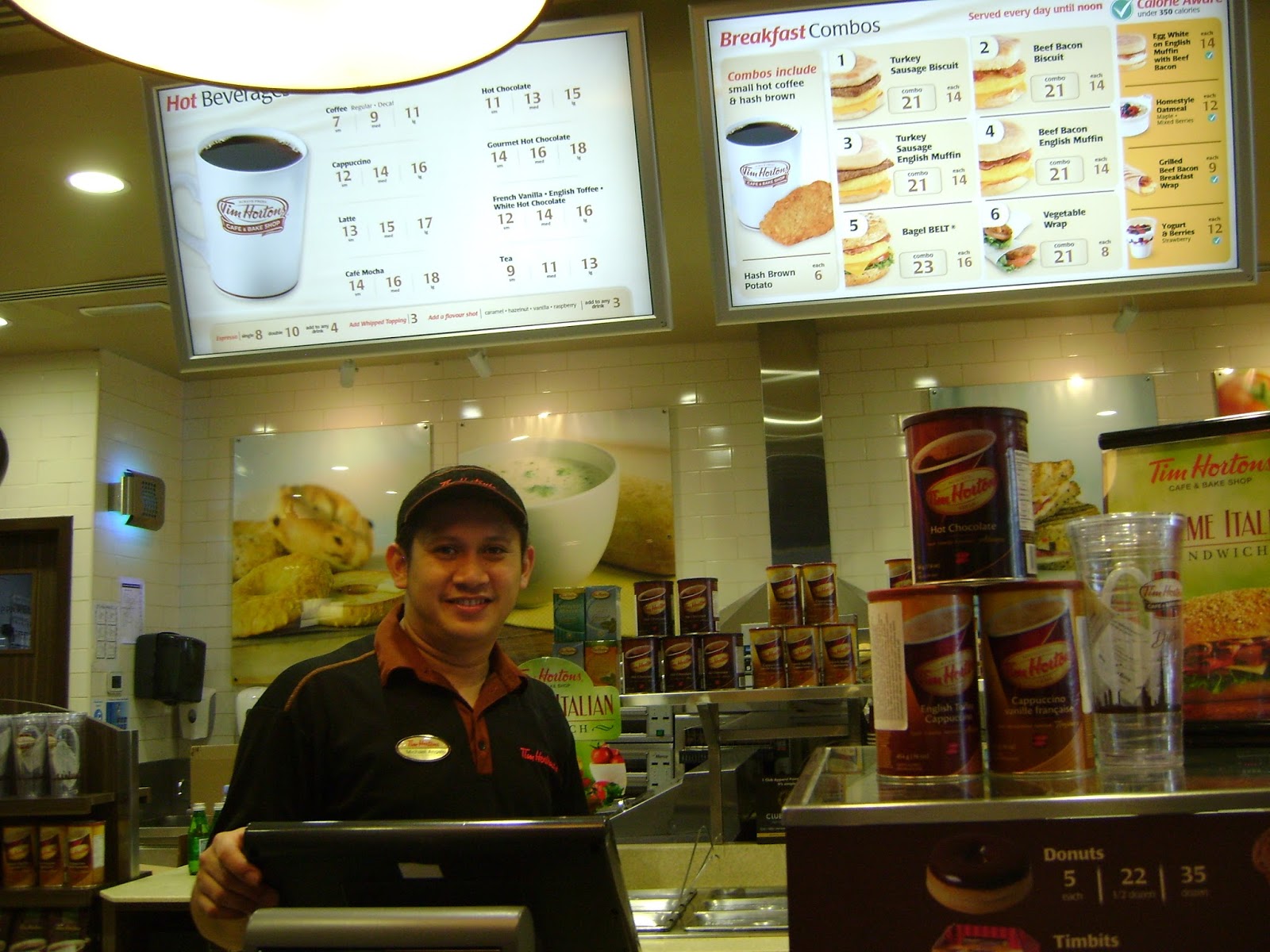
Then I spy a Tim Horton's and explain its significance to my fellow travellers, all of whom are Brit and rolling their eyes.
 
Our 11:30 timing comes. Just whisk us up and down and get it over with, I think. The strict procedure involves lining up for a security check, word filtering back that no lighters are allowed. Lighters like the ones several of us just purchased as souvenirs. More confusion, holding up the line. Our dithering guide collects the lighters for safekeeping, then returns them because she remembers she is going up in the elevator with us. Thank goodness a sensible person learns a bag can be stowed at the security point to pick up later. This lineup and fuss occupy almost an hour of painfully slow inching toward the security people. Like airport scans but no hint of body searches.

Once approved to enter, are the elevators just around the corner? No. The same long line is in front of us, shuffling through endless corridors. At least they show scenes and videos of how the edifice was constructed. Somewhere way ahead, the elevators are taking small groups at a time, people relieved to be finally moving. Am not letting myself get separated from Brinks truck.
Move we did. Up 189 floors! In contrast to snail's progress on the ground, we shoot to the top in sixty seconds, so the flashing digital readout tells us. Popping ears. Stepping out, clutching my companion's shirt, when I have the nerve to look up, it's not scary after all. We are on a wide enclosed platform and thankfully not a glass floor! Photo opps galore, although it seems like taking pictures from an airplane window, not quite real. Then we have to line up in a slow march again to descend. The entire process for a sixty-second ascent was almost two hours.

Oh, wait. A third thing! 
The best thing about the Dubai Mall is the outdoor dancing Fountain (yes, capital F). We have a brief taste, catching the end of the first show. Classical and world music accompanied by the incredible water performance. Very very pleasing. Even in the blistering heat. In the evening dusk with added lights and colour projectors, it would be thrilling.
The beam of light shining upward from the fountain can be seen from over 20 miles away, and will be visible from space making it the brightest spot in the Middle East, and quite possibly in the entire world. [1]

                    ~ Dubai does not do anything on a small scale ~

And this. A trash can for recycling. Because I like it.


POSTSCRIPT: I note a recent climate change report warning that this region, already in one of the planet's most extreme heat zones, could become uninhabitable for humans in less than ninety years at the rate we are going now.[2] Ironic: the air conditioning that provides relief is powered by fossil fuels, source of Gulf riches, and the burning of those (not inexhaustible) fuels contributes mightily to global carbon emissions. With all the riches and technology at its disposal, will the U.A.E. apply itself soon to that problem?

1] "The Dubai Fountain," The Dubai Mall (http://www.thedubaimall.com/en/Entertain/TheDubaiFountain.aspx).
[2] "Space + Science," CNN (http://edition.cnn.com/2015/10/27/world/persian-gulf-heat-climate-change/index.html?eref=edition).

© 2015 Brenda Dougall Merriman