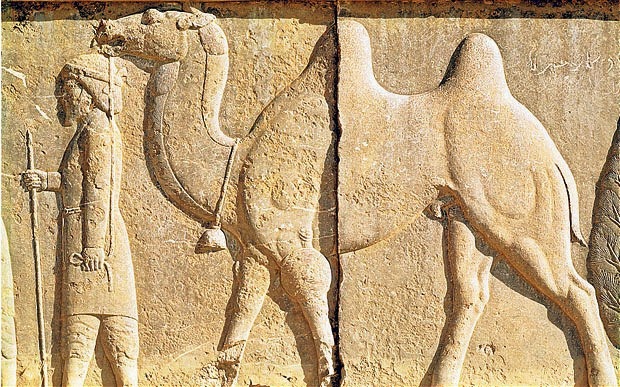
Wow,
who knew? Least of all, me. Lillooet, British Columbia, has a
structure called Bridge of the 23 Camels! Too good to ignore;
must be a story here (thank you, Google alert.)

Lillooet,
once known as Cayoosh Flat, is on the Fraser River in the interior of
the province. Its location where several streams join the Fraser is
an ancient native site with still a large St'at'imc (aka Lillooet)
First Nations population. Most Canadians with an inkling of history
would associate Lillooet with the late 1850s and 1860s gold rush.
From Lillooet's main street the Cariboo Trail began, leading north to
even more gold fields.
When
I was a child, Lillooet to me meant
only one
thing: "Ma"
Murray (1888–1982).
Anyone associated with the
news industry
in this country, as my
family was, had heard of
her. She ran the Bridge
River –
Lillooet News for
years, famous for her cantankerous editorials and salty expressions.
Her masthead said:
“Printed in the Sagebrush Country of the Lillooet every Thursday, God willing. Guaranteed a chuckle every week and a belly laugh once a month or your money back. Circulation 1556 and every bloody one paid for.” Her editorials consistently signed off with, "And that's fer damshur!"

A
genuine character, Ma
Murray seemed to
represent our very own wild west.
Many articles have been written about her, also books by Stan
Sauerwein and Georgina Keddell.
As
suspected, the name of the bridge honours the imported bactrian
camels of 1862 to act as pack animals on the Cariboo trail because of
their great strength. They acted all right, or rather reacted. The
rocky mountain land did not agree with their feet; they spooked
horses, especially the numerous stagecoaches; they were unhappy,
nervous, and belligerent with people in general. Most were finally
abandoned in the wild by their owners. The last known surviving
camel, named Lady, died on a BC farm in 1896. Alas, photography was
still in its infancy in that period; this iconic photo which is
duplicated on so many sites is said to be of Lady:

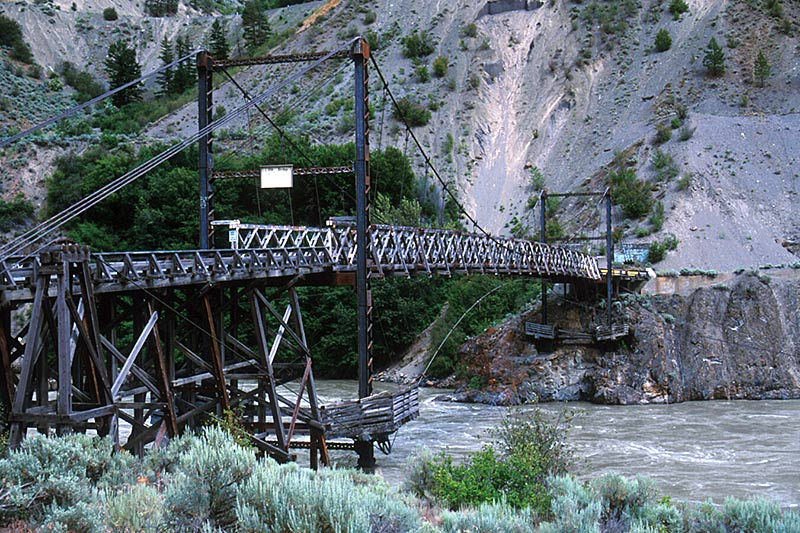
Here's
the eponymous old bridge; it's been fully restored, complete
with bat houses within.
Excitement
arose in 2012 upon the accidental discovery of a large skull that
could belong to one of those by now almost mythic camels. Optimism
was short-lived as it turned out to be that of a horse.
Inspired
by the historic camels, sculptor Myfanwy MacLeod wanted to bring the
story to light in bronze (albeit inexplicably as a dromedary rather
than a bactrian). "Lady" now gazes out at a North Vancouver
street intersection, chosen as one of the public art projects for
BC's cultural history. MacLeod likes to think her Lady is on her way
homeward.

For
such a small community Lillooet is incredibly vibrant; much of its
history has been preserved. Thus besides being a tourist destination
for fishing and outdoor sports, it offers other small town delights.
The area is one of the richest in the world for jade although
commercial mining stopped some time ago. The Jade Trail in Lillooet
is a project of thirty monuments installed to commemorate the
different facets and mining history of the desirable stone.


The
more I read about Lillooet, the more I am fascinated. I
want to go there!!


Sources:
1.
Lillooet
(http://www.lillooetbc.ca/Arts,-Culture-Community/Historical-Sites.aspx).
2.
Stephen
Hume, 20 March 2017, "Canada 150: Salty, fearlesss 'Ma' Murray
edited Lillooet newspaper," Vancouver
Sun
(https://vancouversun.com/news/local-news/canada-150-salty-fearless-ma-murray-edited-lillooet-newspaper).
3.
Anmore
Alternative News
(http://www.anmorealternative.com/HERITAGE.html).
4.
"Margaret
Lally 'Ma' Murray," Wikipedia
(https://en.wikipedia.org/wiki/Margaret_Lally_%22Ma%22_Murray).
5.
Wendy
Fraser, "The tale of the camel skull that wasn't," 11 July
2012, Bridge
River Lillooet News
(http://www.lillooetnews.net/news/community/the-tale-of-the-camel-skull-that-wasn-t-1.1013603).
6.
"Historic
B.C. camels inspire new North Vancouver statue," 5 October 2017
(www.cbc.ca/news/.../historic-b-c-camels-inspire-new-north-vancouver-statue-1.4328951).
7.
Follow
the Jade Trail in Downtown Lillooet
(https://www.northerndevelopment.bc.ca/explore-our-region/success-stories/jade-capital-of-british-columbia-completes-monuments/).
©
2018 Brenda Dougall
Merriman