ABOUT THIS BLOG

Showing posts with label China. Show all posts

04 April 2017

Macau, China 2014


Before visiting, Macau to me represented two alien images: the world's most notorious, dangerous gambling centre, and the opium-addled underworld of evil Dr. Fu Manchu, the Sax Rohmer mysteries I devoured as a teenager with breathless chills. Basically, Macau must be a cesspool of iniquity; can I get rid of my stereotype?

We left Zhongshan in the morning to drive south. I find the bus shelters along the way very attractive. Our leader Lisa reviewed our trip with her map and stars. She also gave some interesting alphabet and pronunciation lessons. The prevalent Chinese colours signify: Red – happiness; Yellow – prosperity; Green – longevity. Love the sing-songy "Ni hao" (hi; hello; greetings).
Lisa reviews the trip

It wasn't easy to follow a local story about the Girl and the Pearl – star-crossed lovers; wicked troublemaker; girl dies/drowns/what?! – but we stopped briefly in seaside Zhuhai where a statue of the girl rising from the sea commemorates the story, well-known here. Again, a popular spot for Asian tourists. A sole man was begging by the tourist buses, looking homeless and furtively alert for police.
There she is
 
There he is
From Zhuhai we followed the wide Zhujiang (Pearl) River estuary to the coast of the South China Sea, along a pleasingly landscaped boulevard. Definitely a warmer, more tropical (humid!) feel to the air now. A five-minute ferry ride took us to Macau, but not until after waiting in the usual queues plus an immigration check. Macau is one of the self-governing territories in China's "one country two systems" policy. Macaoans (and also those in Hong Kong) are quick to make the distinction that they are not mainland "This is not China!" one of them said. And it's still very much a gambling mecca.

Our first stop was the oldest temple in Macau, built in 1488, called A-Ma, dedicated to the goddess of the sea. A little beauty, the Taoist temple pre-dates the Portuguese who were the first Europeans in Asia, very early 1500s.


Wow, we experienced our first crush here — the site is small scale, too small for the ever-growing crowds. It has a very narrow entrance way to these architectural gems. So many Chinese pilgrims ... they are burning incense and bowing and performing little ceremonies with a basin of water and leaves. It's actually a series of temples, each higher (narrow, steep stairs) than the one before. Truly beautiful but the crowding became unnerving by the time we left. Local guide Cheryl charged away not watching for our stragglers.


After lunch to see some UNESCO sites in the old centre of town. The original Portuguese fort has been restored with views over all of Macau (said to be the most densely populated place on earth). Thankfully there were multiple escalators to ascend the heights! There's a museum within I'd have loved to see but ... not on the itinerary. Down below again, we saw the ruins of (Jesuit) St Paul's, the first cathedral built in Asia, begun in 1602. Only the ghostly facade remains, outlined against the sky.


Then we traversed a busy, narrow "walking street" to a small main square by St Dominic's church. Street food and samples at every other stall. More crowds of course, but this was more like the ambiance of many cities we had visited.


Little did we know just then, that was our taste of the "real" Macau. Away we went ... away from the central core ... over a bridge to our hotel Sheraton Macao Hotel Cotai Central for one night. Cotai Island is being developed as the Las Vegas of Asia (international casino corporations), so I admit instant prejudicial dislike at the notion. We could see, in the growing twilight, that our hotel and the Venetian across the street are luxury monsters in a construction wasteland. No doubt all kinds of slums and neighbourhoods had been cleared for Cotai's new moniker "The City of Dreams."
Gamblers' shuttle bus

This hotel was "the biggest Sheraton in the world" with 3,880 rooms (yep). Overwhelmingly huge. With the obligatory casino and its own shopping mall. Finding the the right lobby of several, and the right bank of elevators consumed inordinate amounts of time. From here on I gave up using the camera for the exhausting glitz and miles of high-end brand-name shops; it could just as well have been the Dubai Mall or Heathrow duty-free traps (eye roll).

There was literally nowhere to go outside the hotel, no local neighbourhoods to explore, or even a corner convenience store. We were on our own for dinner and did not want a formal meal. The two hotels; this was it. Someone recommended a food court at the Venetian. Finding the food court first entailed finding the crossover skywalk, then guessing our way through an often deserted (eery) maze of jawdropping decor and the occasional employee whose directions were incomprehensible.

When we found it, seemed like hours later, the food court was surprisingly full of people. Where did they all come from in this wilderness? Oh, right ... the thousands of combined hotel rooms. Are they weary tourists like us? Surely the dedicated feverish gamblers don't leave their machines, or maybe they are dining (celebrating?) in one of the luxury haute cuisine restaurants. A FatBurger was our uninspired choice. Wondering how many times we would get lost on the return trip. But we did discover an outdoor performance with explosions of coloured lights, pumping music, and good cheer.

Old history, new wasteland, contrast on the ground, illusions realigned. It's 95% about the $$.

© 2017 Brenda Dougall Merriman

27 September 2016

Xi'an, China 2014

Xi'an was the terminus hub in China for the old Silk Road. Its overriding fame is for the legions of Terracotta Warriors excavated at the burial site of Emperor Qin Shi Huang. It is believed about 8,000 soldiers exist, most still unexcavated. Previously I had seen a travelling exhibit at the Royal Ontario Museum (ROM) in Toronto.

Our hotel, Xi'an Grand Soluxe International for two nights, is within the large old walled part of the city; the location pleases us very much. First we visit the city wall, seventy-seven steps up (who's counting?). Beautiful view of the well-kept ancient wall, tree leaves are starting to bud. A small temple is situated near us. We stroll around as evening approaches, noting the careful restoration in some areas.


Our dinner venue is "Xi'an Ancient Capital Theatre" with vast seating for meal serving. Because we are having a Special Dumpling Dinner! What a highlight very ornately created, each kind has a poetic description such as "sailing boat-shaped steamed Jiaozi." The names and pictures are being flashed on a video screen as we eat but we are more absorbed in the scrumptious dumplings and their accompaniments. The plates keep arriving at our table, at least thirteen varieties.
  

The restaurant is packed. We are entertained with a "Tang Dynasty" performance of traditional music and dancing. Much easier to relax here than at the Peking Opera. Lovely dancers and notably a woman playing the zither, also an amazing guy making weird noises on the strangest horn.


Next morning we linger in a special park commemorating historical figures poets, philosophers – and a Buddhist temple, while waiting for the Shaanxi Museum to open. I love to see the groups of middle-aged/elderly people daily exercising; some do tai chi or martial arts practice or dance. Mao started this compulsory routine during the Cultural Revolution. A few practice writing Chinese characters with a long-handled mop and a bucket of water. On the edge of the park, army cadets are drilling. 2014 is the Year of the Horse.


The Museum is very rewarding, not crowded, plenty of time to see most exhibits. Always high security at museum entrances. Exquisite inlaid furniture. We see how they make clay replicas of the warriors to sell.


Onward to the obligatory jade "factory." Beautiful jewellery and intricate carvings of all sizes, almost like a priceless museum in itself. Our budgets are more suited to the pearl "factory" on a different day. Getting stuck for a while in a cargo elevator between floors makes for some uncomfortable moments! Outside, a warrior replica begs for attention.


At last, in the afternoon! To the Terracotta Warriors! It's a long walk back and forth to the site. Three pits are open to the public with appropriate exhibits, including a three-floor museum. One of the farmers who discovered the site, while digging a well back in 1974, is still living; he sits in the foyer autographing coffee-table books. The government built new housing for the displaced villagers and farmers (however, that didn't happen for some time).


Emperor Qin Shi Huang died in 201 BC. The burial site was built as an enormous sprawling monument with buildings and special landscaping, full of rare treasures so he could rule even after death. Many, many years to create. The uncovering of some 2,000 terracotta warriors is apparently the tip of the iceberg it's estimated there could be as many as 8,000 altogether. Each is an individually designed figure, originally painted in bright colours that rapidly flaked away upon exposure to the atmosphere. The emperor's actual inner tomb and many geographical features have not been excavated for health, safety, and technological reasons. Not only were mysterious booby traps planted against potential looters, but a great deal of deadly liquid mercury is present. Long-range planning for excavation and conservation is essential until more of the complex and its stunning artifacts can be revealed.
   
Lots of sightseers here, again few non-Asians. We have to keep moving around the pits. Each warrior is individually designed.
 A woman grabs me on our return trek and gobsmacks me by demanding in imperfect English, "How old are you?!" "Not a polite question," I smile, but she's persistent. I show her by extending my fingers. She happily trails us with her friends, excitedly speaking in their own language. Later I learn that age is greatly respected in general and it's a common question, asked admiringly. I still don't know if I was looking really ancient that day or if it was simple curiosity about a foreigner.

An awesome, exhausting day. The return trip into Xi'an is bad; traffic is almost at a standstill, long stops and stalls. Trucks line the shoulders of city expressways because regulations don't allow them on highways until a certain evening hour. We watch one woman get out of a car (as a passenger) and start walking. She had disappeared long before we reach an off-ramp a kilometre away. Unbelievably, we see a driver make a U-TURN in three-four lanes of one-way traffic and start inching back the wrong way. Road warrior!

A large tile wall at Xi'an Ancient Capital Thestre
  © 2016 Brenda Dougall Merriman

08 June 2016

Yangtze River, China 2014

Day 1
Our home for five days on one of the world's best-known waterways. From Shanghai we flew to Wuhan, a major river transportation hub in the interior. On the trip from airport to the ship our local guide peppered us with statistics about China's "urbanization" movement that didn't explain the acres of forlorn, vacant residential towers we were passing.

After a day of airports and coach travel, our cabin on Century Diamond looks roomy and pleasing with the bonus of a balcony. Dinner is typical ship-style buffet, unlike our previous days of family-style round table service. We are at Table 1 for the duration, same faces each meal, designed to keep the staff on track. Our attendant is Coco. We chatter about upcoming shore excursions to unfamiliar places. Sailing upriver gets underway at midnight. 
 
Day 2
SQUAWK!! 
At 6 a.m., yes the ungodly hour of 6 a.m., the overhead tannoy speaker system in each cabin BLARES wild Chinese music at us. Bolting straight up from sleep, my roommate and I stare dumbly at each other. There is no way to turn off the shattering racket. Then we are subjected to shouted instructions about breakfast hours and an excursion that is hours away. Followed by raucous bird noises that we think are meant to be soothing. Happily, the cardiac-arrest business is never repeated on subsequent days. 
 
Today (it's mid-March) is cooler, drizzling rain and windy. Since we are awake anyway (!) we explore the ship. A few shops are on board, including a tailor who makes custom cheongsams for about $200 from gorgeous silk fabrics. The ship library consists mostly of Chinese magazines. There's a definite oversight, no information, about what we are passing along the riverbanks; often mile after mile of industrial mines, smelters, smokestacks. The few available handouts are only regarding the excursions. Some passengers go off to see a battlefield and fort at Chibi, within walking distance.
Fort Chibi

Sun deck; no sun

Nicer just to unwind on the balcony and watch the river activity. We are surrounded by flatlands where the river often widens / wanders into lake formations and seems alarmingly shallow at times. Lots of river traffic, many barges hauling freight. Gravel is coming downstream for construction sites. 


The ship is not full one or two Spanish and German groups, Canadians outnumbering all but meal times at the buffet can be a zoo. The Captain's Welcome Party ensures a fair amount of champagne before the dinner rush. Wine and beer are freely poured at meals which is not the norm otherwise: one glass of beverage at each meal when travelling on land.

Day 3
Excursion later today, good. It's overcast but no fog, just the usual mid-level layer of misty smog. On the ship entertainment program today: "fashion show." Expecting a demonstration of traditional costumes, we grabbed front seats. But it proved to be a sales pitch for the tailor with two live models wearing cheongsams who disappeared rapidly. The cruise director has an unfortunately shrill voice and used the word "actually" about 45 times this does not bode well for the later "fresh water pearl presentation" and "scarf wearing demonstration."

Happily, the sun came out and the sundeck soon filled up. We are passing more signs of life and cities now. The river water is looking deeper and mountain peaks are appearing. Showing a film on the Three Gorges was a bust; the ship does not have the facilities to show a film effectively. Finally, it's time to go see the Three Gorges Dam up close. Into a bus and up, up, up the road past Sandouping, part of Yichang city where the dam workers live.
 
It's a hike at the heights for a magnificent view of the dam and the locks. Hazy, but you can see everything. The size of the whole complex is gigantic. Thirty-two main generators! It must take an army to run the place. Maybe the army does run the place, heh. We can see ships lifting in the locks, as our ship will do tonight. The world's biggest dam is also installing the world's largest ship lift. I quote from our little handout:
"The project produces clean electricity, prevents deadly floods downstream and enhances navigation. ... However, the dam has also flooded archaeological and cultural sites and displaced some 1.24 million people, and is causing dramatic ecological changes, including the risk of landslides. The decision to build the dam has been deeply controversial in China and abroad."

Twilight approaches as we stop at the back of the dam for photo opps. The opps are largely ignored by the female contingent as we discover a covey of scarf vendors. Scarf-buying frenzy ensues as it does at each new locale. It's dark when we reach the ship and some holdup delays our boarding. The casual class of tai chi ladies across the street do their best to entice us into a small outdoor market. It works; we have time. Now the guys delight in the availability of beer in six-packs.

Tonight's post-dinner entertainment is a masked ball. The Spaniards and Germans are really into all this jollity. Some of our group are being felled by colds, not surprising as we are almost two weeks into the trip. At 10:30 p.m. Century Diamond enters the five-stage locks of the spectacular dam. We will rise 101 metres. Once the gates close each stage goes surprisingly quickly. It's awesome on the balcony facing a concrete wall that slowly slides down as we go up. Amazingly, some people have been able to scrawl bits of graffiti here and there (in Chinese characters).

Day 4
First thing, the morning excursion into Shennu Stream (aka Goddess Stream) on small boats, each carrying about sixteen of us. It seems to be one of the Three Gorges, but the ship handouts lack geographical information/identification. This little side trip is a highlight, amongst the soaring peaks. So much was submerged by the dam, turning mountain tops into islands. The boats have rules: wear life jackets; no more than five people outside on the stern. Soon the rules get ignored and photographers crowd at the back. Tour manager Lisa uses her severe voice.
 
There's a stop at a tricky floating dock where we assemble on a rocky ledge. The several boat guides line up, for something ceremonial perhaps? Only the people directly at the front of the crowd can hear whatever it is. Then they do a little song for us. Then they encourage us all to join a sort of happy conga line. The treacherous floating dock claims a few victims with twisted ankles and knees.

Back at the ship, the glorious start to the day has become all grey and cool. The passing scenery now is much more interesting, occasional temples, wonderful bridges, cities, but also "surviving" countryside spared the flood waters where family burial tombs can be seen on the hills. The river is so GREEN now! Wushan (not Wuhan) is one place where reconstruction is going on. A huge riverside sign proclaims it: "China Excellent Tourism City; National Sanitary City." Here we park for a while.

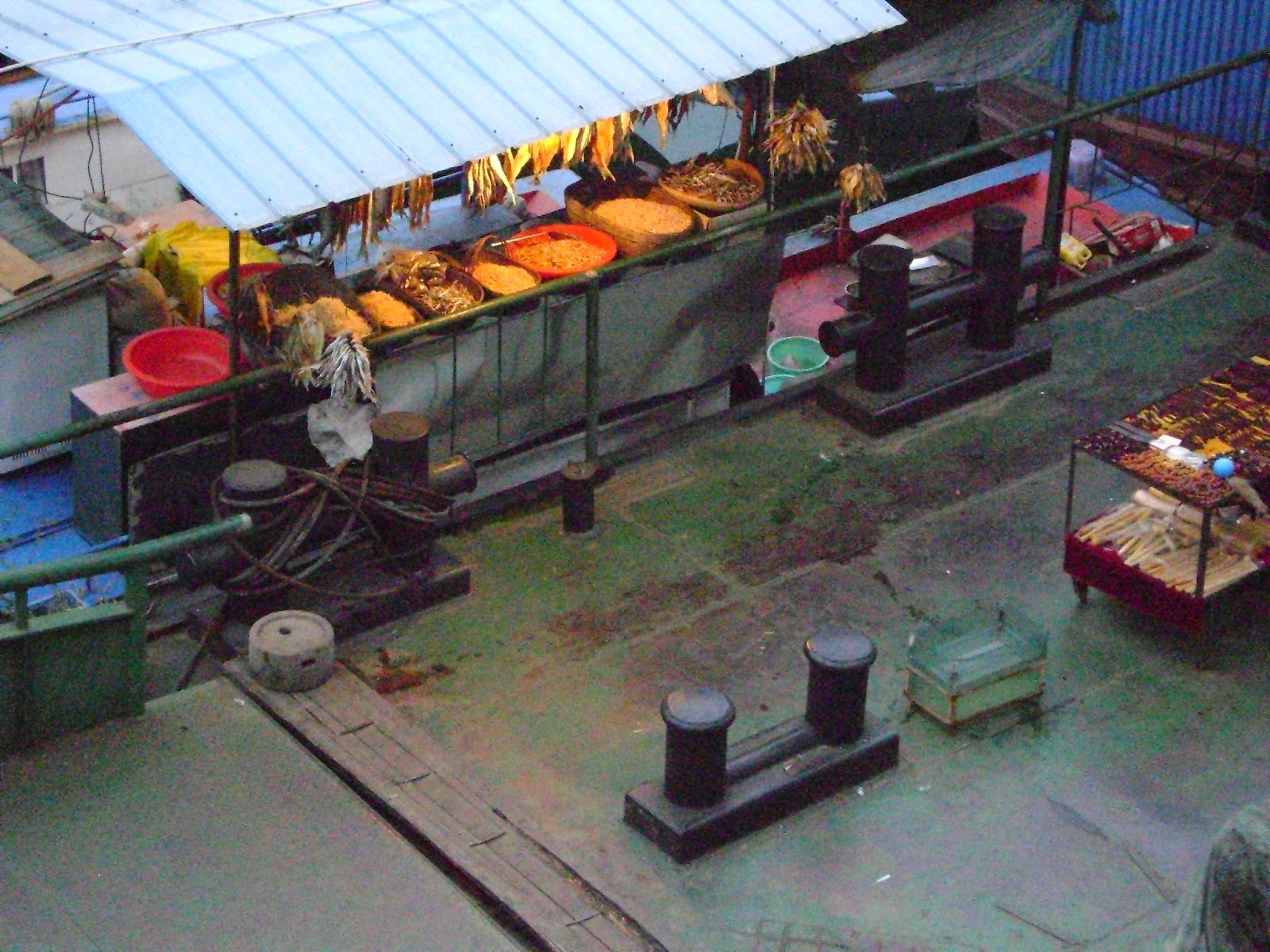
Some groups go to White Emperor City aka Baidi Cheng aka Baidi Temple, an optional tour entailing 1,000 stairs to the top. Luckily many old temples were built on mountaintops and do not have to be reconstructed. Meanwhile we could explore the "street" along the floating dock we're tied up to foodstuffs, dried fish, nuts, drinks, water, tea, snacks, odds and ends.
Docks/wharfs of this type are necessary because they easily adapt to changing dam levels. We see supplies coming along to be loaded onto the ship, all carried manually of course. Bags of their famous oranges, what we used to call mandarins.
 
Mild anticipation at dinner about tonight's talent show. Selected passengers model a few traditional women's costumes (again, a too-brief look), self-consciously sashaying in and out. Our neighbours from Table 2 do a limp rendition of the Expo song CA-NA-DA. The irrepressible Spaniards do an overly long and energetic but rather puzzling operetta (or so it seemed to be); their soprano swathed herself in a bed coverlet to great effect, whisking it expertly around her hips.

Day 5
Wakened at 6:30 a.m. by firecrackers going off on the hill. We have stopped again, at Zhongxian. People are doing laundry in the river at the bottom of steps. This is where we go to visit Shibaozhai, "Precious Stone Fortress." Local guide Romy leads us through the town on the south bank and a gauntlet of souvenir sellers to the fortress, perched way, WAY above us. Aka the Red Pavilion, it's another temple island-marooned by the dam flooding. Twelve stories and ninety-nine stairs to climb. Each level is dedicated to a famous general, scholar, or poet of the 200s AD, with cultural artifacts.
 
However. In order to reach the bottom (entry) level, we must cross a suspension bridge. It's about five feet wide which doesn't lessen the terror of a very long, swaying, bouncy crossing. So call me chicken-heart; queasiness with heights and unsteady sense of balance are in full force. So why not shop instead, the other few cowards suggest.

Not our ship but a reasonable facsimile

Later I am trying to capture more riverside views and burial tombs. The ever-present smog throws a soft cast over all, reminiscent of old watercolours.


Farewell dinner tonight, self-served in the round. Expectation is high for the special menu.
 It is loaded with fish and seafood dishes, to be expected in a marine environment, but severely limits my choices. Love Chinese sausage but had to spit out this version, heavy with fish taste! Apart from my personal allergies, consensus from Table 1 was altogether a disappointing, mediocre meal. Odd, and too bad, probably the least memorable on a 24-day trip of otherwise delicious Chinese dishes.

Next Day
We are at Chongqing, our next destination. Coolies are taking our luggage from the ship across the floating dock to the city; each man carries a mind-boggling four suitcases on a bamboo yoke. We estimate that's a minimum of 120 lbs. Poor buggers (but strong!), wonder what their pay is. Then they return with supplies for the ship which will turn around to take more groups on the downstream trip.

It's really been quite a lovely time on the Yangtze, a lull in the hectic pace of a long tour, somewhat like floating through a distant exotic film. The passing scenes perhaps more than anything convey a sense of the vastness, the beauties, of this country. But we also remember seeing the work ethic, the daily routines, the cheerful greetings; not so different from us after all.
 
© 2016 Brenda Dougall Merriman