ABOUT THIS BLOG

Showing posts with label Russia. Show all posts

17 November 2019

St Petersburg, Russia, 2006 and 2019


Combining the two different visits to St Petersburg became necessary in my mind because the second was quite disappointing. My affinity for this storied Russian city comes from my grandmother's time working there in the 1890s, probably up until about 1908. Both visits had the added (but sadly limited) personal agenda to photograph the mansion where she lived with the Baron Kusov family. A great deal of post-cruise anguish ensued in matching mixed up photographs and making online comparisons until we finally managed to pinpoint the relevant building. The confusion (and embarrassment) is outlined in https://brendadougallmerriman.blogspot.com/2019/11/a-misplaced-grandmother.html.


A partial shot of the mansion, 2006

In 2019 the most striking sights in St Petersburg were the massive, relentless tourist throngs and their accompanying buses. At every famous site. Even lined up for canal rides. Old streets and thoroughfares were jammed with traffic, shortening the time to be spent where it matters. I do not recall such hordes in 2006. We were told that the city now gets over seven million tourists in a year and the figure keeps increasing. Both my favourite churches, St Isaac and Church on Spilled Blood, were not only half-shrouded with scaffolding, the tours did not include entrance tickets! ... sadly missing the essence of their awesome, inspired, and inspiring interiors.


St Isaac in non-repair mode
Church on Spilled Blood, 2016
The opportunity to shop at a large crafts market was greatly anticipated until it proved to be an outlet for mass-produced souvenirs and high-priced jewellery. Oh well, it was the least crowded place of all.

Two venues were the most worthwhile, to my mind; two I had not seen before. Yusupov Palace was the city home of the most aristocratic family of Imperial times, one of scarcely-imaginable wealth. Prince Felix Yusupov's wife was a niece of Czar Nicholas II. The popularity of this tour meant wall-to-wall throngs being managed by stern attendants and guides. What I was waiting for:


One winter evening in 1916 Felix and some friends invited the dubious monk Rasputin to join them. With nefarious intentions.


Rasputin was considered suspicious and sinister by the nobility and far too influential in the royal court. The conspirators plotted to poison him. Pure drama.
Felix is wondering if the poison worked. It didn't. But Rasputin knew he'd been tricked and tried to leave. A gunshot didn't stop him, either, as he fled bleeding. They finished him off by throwing him in the canal where he drowned.
The canal in front of the palace


Beyond that historical highlight, the palace itself is full of fascinating riches in architecture, decor, and furnishings, requiring rapt visual and audio attention. However, most of the vast and renowned Yusupov art collection ‒ second in abundance, perhaps, only to that of Catherine the Great – was confiscated in Soviet times, to be placed in the Hermitage and other state museums. As the inexorable momentum of one tour group after another hustled us by, we had little more than fleeting views of great beauty and master-crafted details.


It's Peter the Great's city, of course, and I'd missed seeing the Peter and Paul fortress before. A church has existed here since the founding of the city. In this case, we did enter the cathedral (thank you), magnificent resting place of most Imperial rulers and some nobility. The sarcophagi, including those of Peter the Great and Catherine the Great, are white marble with gold crosses, displaying the Imperial double-eagle on corners. Two anomalous standouts vie for attention, one carved from green jasper for Alexander II and the other from rose-coloured rhodonite for his wife.
Borrowed from a postcard (obviously)


To this sacrosanct place were brought the remains of the Romanov family some eighty years after their assassination. Now canonized as an Orthodox saint, Nicholas II might truly rest after so many revisions to their saga. A distant glimpse of the quiet, simple room is the best we can do. The perpetual motion of the crowds was a continual challenge for a decent camera angle or a steady moment ("Dear Guides! Please do not stop groups here"). One likes to think there was some pattern to the unrelenting movement, perhaps known only to the shouting, frustrated tour leaders, but the push and pull of the mob had a mind of its own.


A canal cruise was fun ‒ although some have been infilled, it’s still a city of waterways. An enterprising young man waved at us from each and every of the many low bridges we passed under. He had to run like crazy from one to another, providing much amusement and encouragement. No one was exactly surprised as we found him waiting modestly at our docking point. With his hand out. I fully expect there is an entire coterie of such youth, scrambling the canal streets to earn a few rubles.


An unexpected treat in the port terminal was a good look at the “superyacht” Black Pearl. Berthed near us for a while, then leading us out of the harbour, the sleek Dutch-designed yacht has a DynaRig sailing system, rotating masts, hybrid propulsion, waste heat recovery, and many other high-tech innovations. Well done, Mr. Burlakov!


(although it was not under sail then)


Still, so many places that will not get seen—Alexander Nevsky Monastery and its cemetery of famous musicians and literati―would they too be impossibly thronged with sightseers? This time we did not even see the outside of the Mariinsky Theatre. 

Then there's a loose end to a very long drive in 2006 across the Russian steppes. Congenial Ulf, our Norwegian tour leader, thoughtfully entertained us with a showing of "The Barber of Siberia." The movie was unfinished as we pulled into our destination and to this day I don't know how it ended. I will catch up to the puckish Richard Harris one of these days, one way or another ...


Credit and thanks to CDM for a better grasp on photography :)


© 2019 Brenda Dougall Merriman

31 July 2017

Imperial Palaces, Russia 2006

No expense was spared when imperial Russian rulers decided to build. Celebrated international architects, sculptors, craftsmen, and landscape designers were employed to showcase opulence and power. The attention to detail is overwhelming; they all took years of construction plus subsequent additions or improvements. Such monuments inevitably suffered during the Revolution and the Soviet era, but restoration has been careful if not to the same degree at every site.


Tsarskoe Selo is/was a town south of St Petersburg meaning "Tsar's village." Before actually seeing it, my mind was brimming with romantic Russian tales and novels―this was the magical place where generations of royal family and nobility came to the country to play. For me the words triggered imagined scenes of nineteenth century summer frolics and intrigue. For once, the image came true to life, only lacking the live, historical figures.


Two imperial palaces dominate the "village" ... the Catherine Palace and the Alexander Palace. The first was commissioned by Peter the Great for his wife Catherine in 1717 but reconstructed by Empress Elizabeth I in the mid-1700s. The second was built later by Catherine the Great for her grandson, the future Alexander I. It is not possible to see or appreciate both palaces in one day, nor indeed the full extent of even one. One, on our tour.

On my way to the Amber Room!
Catherine Palace, aka the Summer Palace, is the rococo architectural style. Probably the most-viewed treasure of all is the famous, unique Amber Room. Installed by 1770, the panels were fragile and had a dedicated caretaker for maintenance. In 1941 Nazi troops dismantled the room into crates that were hidden no-one knows where now. For the Tercentenary of St Petersburg in 2003, recreation of the Amber Room was completed after twenty years of labour. It was as stunning, as lush, as brilliant as the eyes could absorb.
In 1917; Wikimedia Commons
 
Just one corner of the restoration

Also in the country, on the Gulf of Finland, the Peterhof Estate is another major tourist draw. Peter the Great began the creation of one of the world's most spectacular parklands. The renowned fountains are the most memorable features in acres where you could stroll all day, coming upon one scene after another. Peter's descendants continued to add further water features of engineering ingenuity. "Peterhof is like an encyclopedia of park design through the age of empire."[1] 


The most famous ensemble of fountains, the Grand Cascade, which runs from the northern facade of the Grand Palace to the Marine Canal, comprises 64 different fountains, and over 200 bronze statues, bas-reliefs, and other decorations. At the centre stands Rastrelli's spectacular statue of Samson wrestling the jaws of a lion. The vista of the Grand Cascade with the Grand Palace behind it, the first sight to great visitors who arrive in Peterhof by sea, is truly breathtaking. The Grotto behind the Grand Cascade, which was once used for small parties, contains the enormous pipes, originally wooden, that feed the fountains. 
Elsewhere in the park, the range and diversity of fountains is astounding, from further monumental ensembles like the Chess Cascade and the Pyramid Fountain, to the ever-popular Joke Fountains, including one which sprays unwary passers-by who step on a particular paving stone.[2]

Samson

The Winter Palace complex in St Petersburg includes the Hermitage Museum among its many buildings. Constructed in baroque design under the extravagant eye of Elizabeth I, it was Catherine the Great who added the neo-classical Hermitage and Nicholas I who opened it to the public as a museum. I visited the Hermitage only, a wonderland of art collections that it's estimated would take a person eleven years to explore each exhibit. Endless galleries represent the finest artistic masterpieces the world has seen.


Sprawling across the connected buildings of the Winter Palace, the Small Hermitage and the Old Hermitage, this vast, chaotic and incredibly rich collection is unquestionably the biggest draw for visitors to St. Petersburg. Founded by Catherine the Great who bought up artwork en masse from European aristocrats, embellished by each of her successors, and then massively enriched by Bolshevik confiscations and Red Army seizures in conquered Germany, the Hermitage collection is incredibly varied, ranging from ancient Siberian artifacts to post-impressionist masterpieces by Matisse and Picasso. Equally impressive are the lavishly decorated State Rooms of the Winter Palace, testament to the incredible wealth and extravagant tastes of the Romanov Tsars. [3]


What a privilege to see these historical treasures and revel in beauty while marvelling at the hubris of humankind.

[1] Saint-Petersburg.com (http://www.saint-petersburg.com/peterhof/fountains-peterhof/).
[2] Saint-Petersburg. com (http://www.saint-petersburg.com/peterhof/peterhof-park-and-gardens/).
[3] Saint-Petersburg.com (http://www.saint-petersburg.com/museums/hermitage-museum/winter-palace-and-main-museum-complex/).


© 2017 Brenda Dougall Merriman

03 March 2017

Novgorod, Russia 2006

The city of Novgorod was an unusual inclusion on our itinerary, not then visited by most tourists, but it was an appropriate break on the long drive between St Petersburg and Moscow. That's aka Novgorod Veliky, not to be confused with Nizhny Novgorod, east of Moscow. It was an interesting prospect since it is older and much more historic than both the principal cities.

 Novgorod is revered territory as the birthplace and fatherland of Russia. First documented in 859 AD before Christianization, it was politically tied to Kiev (Kievan Rus') for some time, then became a princely republic in its own right, controlling wide areas beyond. Its location at the end of the Silk Road and its trade with the Hanseatic League network made it a wealthy, powerful state until Ivan III of Moscow (Ivan the Terrible) sicced his oprichniki on them in 1570. Novgorod declined and Moscow ascended.
Our local guide Galena met us on our arrival to make a tour, since we would have a much longer drive, and early call, the next day. She took us to the ancient kremlin, a UNESCO World Heritage Site. According to Galena, the bridge between the kremlin and the old town is where early citizens would meet to resolve problems; debates often accelerated with much shouting or sometimes physical blows. The peaceful 30-acre kremlin grounds appeared a bit neglected; gigantic old bells were sitting dormant in a courtyard.
 

 St Sophia is the patron saint of the city, thus the name of the eleventh-century cathedral. Bells in the tower were pealing at the time and the faithful were approaching for a church service — by no means all old people, as I'd expected. We learned the symbolism of the “onion” domes of the Orthodox churches. Of course they are not onions. They are candle flames. Three on a church = the Trinity. Five = Jesus & the four New Testament authors. Thirteen = Jesus & the twelve apostles. Pretty well everywhere we saw in Russia, the domes were painted with gold leaf.

The most famous native son was Alexander Nevsky, Prince of Novgorod 1236-1252. I did a little more research later on ... acclaimed for defeating invading Swedish forces in 1240, he also frustrated the Teutonic knights on a bloodthirsty incursion, keeping both at bay. His alliance with the Mongols, who had reached their doorstep, saved Russians from full-scale oppression. Nevsky's acknowledged leadership of the times, supported by church and boyars and other princes, saw him canonized by the Russian Orthodox Church some three hundred years after his death.

Some vendors on our way out of the kremlin made much of birchbark paintings and souvenirs. We had been told many times that many of the poor try to develop a little extra income by selling roadside products like potatoes, mushrooms, berries, dried/smoked fish or crafts. They were not aggressive vendors and we were happy to oblige.

That evening travel buddy and I walked down to the Volnya River which divides the town; lovely place where some men were fishing, an obvious picnic-lovers’ spot. Reality check: a moment grasping a feel for 1,200 years of clamorous events. History, here.

© 2017 Brenda Dougall Merriman

20 January 2017

Novodevichy, Russia 2006

A stroll along Swan Lake in Moscow leads to the extensive Novodevichy complex. It's said that this lake inspired Tchaikowsky to create one of his best-known works. The Cossak-like army cadets here and there in the park invoke a retro nineteenth century feeling. Our local guide Vera is articulate and irrepressible.
  
Fourteen buildings comprise the complex including Smolensky Cathedral among other churches. The sixteenth century convent is a UNESCO World Heritage site of outstanding historical "Moscow Baroque" architecture. The convent was the destination for women of aristocratic families who preferred the cloistered life. It was also where a wealthy nobleman could stash a wife who didn't please him. Ironically it became part of the old city's defence network with twelve watch towers along its high walls.

 Burials of earlier centuries are in the old Necropolis, a desirable, prestigious resting place for the nobility and even some royals. Time constraints ― always the bugbear on a tour ― allowed us to visit only Novodevichy Cemetery outside the wall. Opened in 1898, it too features prominent citizens along with political, military, and cultural heroes.

 Here lies Krushchev because he did not die during, but after, his official service as Soviet leader; otherwise he would have joined some predecessors in the Kremlin. Many of the Soviet-era monuments are particularly stark and ugly; this one is not too extreme.

RIP Gorby's beloved wife Raisa. She was a novelty as "first lady" in the Soviet Union, very visible at charity fundraising and promoting women's participation in politics. We in the west loved her high profile and Russian fashions, but she was not popular at home. Most Russians thought she was immodest and should remain faceless like her predecessors. According to Vera, Gorbachev is not well-liked in Russia, being called "Man of the Past," but she forcefully stated the country would still be in the dark ages if not for him. His reforms were too much, too fast. Gorbachev will join Raisa here one day. His successor Boris Yeltsin was buried in Novodevichy six months after our visit.

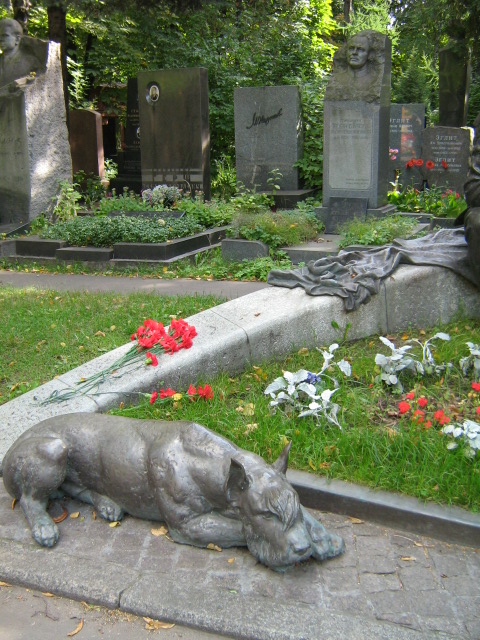
Unfamiliar to us, but this great Russian actor-comedian, Yuri Nikulin, has perhaps the most memorable monument of all. His dog Mouftard is immortalized near his feet. The plot is always strewn with flowers.

Writer Anton Chekov was one of the first to be interred in the new cemetery. Some of the other artistes here are the writer Gogol; composers Shostakovich, Prokoviev, Scriabin; singer Chaliapin; musicians Oistrakh, Rubinstein, Rostropovich; theatre director Stanislavski.

  Guide Vera, by the stone for Stalin's sad wife. Vera only hinted at the rumour that Stalin murdered her but having recently read Sullivan's biography of their daughter Svetlana Alliluyeva, I tend to agree. You can see the weather-protective covering used on some monuments.

My personal heroine in younger days, supreme ballerina Galina Ulanova, 1910-1998. Ulanova embodied, symbolized, the fabulous tradition of Russian ballet. In 2001 her apartment became a museum, a part of Moscow's dedication to theatrical history.

Unknown; he's far from being the only smoker depicted in stone holding a cigarette!

And this. Also unknown, a huge chunk of amber. An extravagant statement of lost love?

The brave journalist and political critic Anna Politkovskaya was assassinated in her Moscow apartment building two weeks after our visit. The world reacted in horror. Suspects were originally acquitted at trial and rumours of the highest political involvement were never confirmed. She is not buried in Novodevichy.

What a paradox is this great sprawl of a country. Muscovites like to joke (says Vera). One of them is about the proliferation of expensive and beautifully decorated restaurants ... that they are like churches. When you enter you are dazzled and say Jeezus! Then when you get the shocking bill after dinner you say Christ! 
Some of our group are probably not into irreverent humour. 

© 2017 Brenda Dougall Merriman