ABOUT THIS BLOG

Showing posts with label Muscat. Show all posts

15 February 2020

Oman's Great Treasure


With some sadness I noted the passing of Oman’s Sultan Qaboos bin Said on January 10th this year. For fifty years he was the figurehead of one of the Middle East’s most stable countries.

As the omnipotent ruler of several million people, the Oxford-educated Qaboos inspired widespread personal loyalty for his progressiveness. In 1970 when he took power from his reactionary father with British support, the scattered tribal country was divided and underdeveloped. In addition to an advisory Council of State, Qaboos established an elected Consultative Council. He used Oman’s comparatively modest oil resources to fund modern infrastructure and communications.

Education became paramount: it is free, but not compulsory, through secondary school; internal and external scholarships are available for university and colleges. Free national health care; universal suffrage; slavery was banished. Early on Qaboos had the foresight to plan for developing alternate resources, knowing oil is exhaustible.

Birthplace of Sultan Qaboos, Salalah

It wasn’t all roses during Qaboos’ rule, of course. The ripples of the Arab Spring (2011) were relatively minor in Oman with largely peaceful demonstrations for reform, although on occasion security forces did use tear gas and other measures to dispel crowds. Two people died, and more were arrested, charged with illegal gathering. Qaboos complied with reforming to a degree; he weeded out perceived corruption in his State Council and extended the Consultative Council’s powers. Despite being more liberal than its neighbouring Arab states, Oman nonetheless is under Human Rights Watch for the rights of women and immigrant labourers, as well as for harassment of political critics.

As a younger man
Oman has a majority Ibadi Muslim population, which partially accounts for it avoiding the Sunni-Shia sectarian conflicts in other parts of the Middle East and Africa. Smaller (but historically slightly older) than the two main sects of Islam, it is considered more tolerant and prone to justice without violence. Omani law protects all religious faiths.


Internal policies aside, Oman is a great pleasure to visit. The pleasure comes from not only the great variety and beauty of its expanses, but the genuine, warm friendliness of its people whether you meet them in urban or rural settings.

Palace gate, Muscat
The man himself, who united his country and inspired that personal loyalty, was intelligent, soft-spoken, and globally respected; Qaboos’ diplomacy in mediation was sought by all major powers in countless Middle East negotiations. And so he leaves a profound legacy inside and outside of Oman. 


Inshallah — may his successor, Sultan Haitham bin Tariq, continue to earn such respect and extend human rights goals. I end with a quote:
Oman today ranks at the top tier of most human-development indexes but with little of the conspicuous consumption or flash of its richer Gulf Arab neighbors. Out of a fractious population of several million, riven by tribal and confessional differences, Qaboos shaped a sense of national identity in a region where sectarian divisions were multiplying. -- William J. Burns, 13 January 2020, “The Death of a Temperate Leader in an Intemperate Region,” The Atlantic (https://www.theatlantic.com/ideas/archive/2020/01/sultan-qaboos-oman/604807/ : viewed 10 February 2020).

17 March 2019

Muscat, Oman 2013-2018


The gleaming city of Muscat sits in folds of the western el-Hajar mountains, sloping to a natural harbour. Facing north and east into the Gulf of Oman, this is largely a twentieth-century developed city. Refreshingly, it avoids the ostentatious sky-high architecture of many oil-rich cities. Oman's iconic frankincense burner dominates one hill, symbolizing a long history of tribal/nomadic trading.

Muscat and indeed the entire country are proudly conscious of their Bedouin traditions. A charming diorama at the lovely small Bait al Zubair Museum displays the city origins, not so long ago. Certainly it was long known as a trading port.

Oman's national animal the oryx; a handpainted display at the museum
The enlightened Sultan Qaboos bin Said has led his country for almost fifty years. All power rests in him as king and benign dictator. He modernized Oman from poverty to prosperity with impressive infrastructure, universal education and health care, and freedom of religion. His likeness, at varying ages and stages, can be seen everywhere in Muscat.


Playing a mainly neutral position in Middle East politics, and also between the West and Iran, peaceful diplomacy is more the Sultan's style. The question of succession hangs over his people: he has no children, but he has a number of other family candidates to choose from. His principal palace here in Muscat is not open to the public. On the royal shield (and national flag), the khanjar (curved dagger) is another distinctive Omani symbol. Known for centuries in this area, it represents heritage and, depending on the engravings and precious-metal workmanship, social status.


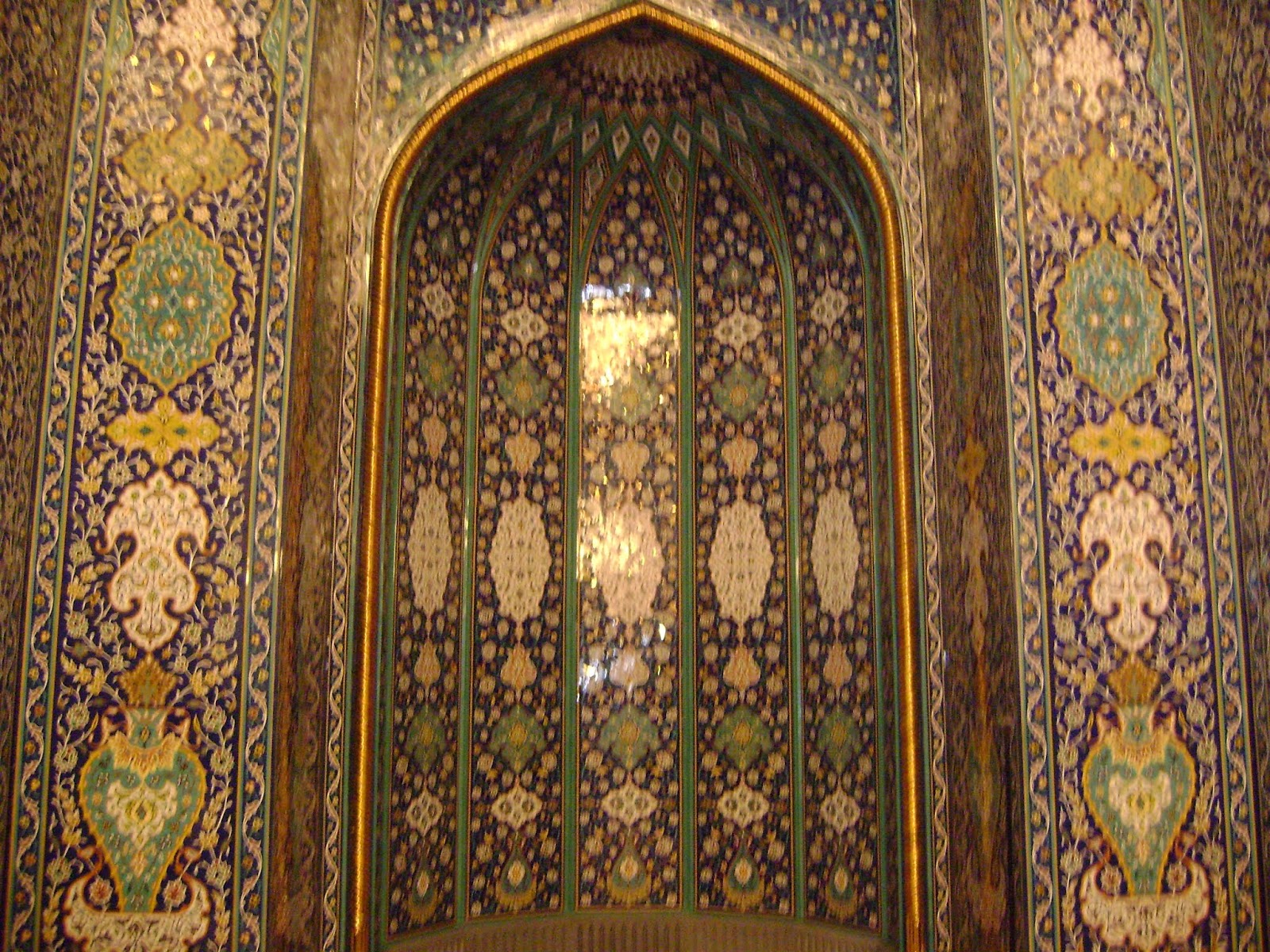
But the Sultan Qaboos Grand Mosque is open to visitors. Non-Muslims are welcome ‒ requiring modest, covered-up dress and doffing the shoes. One can only gape at the spectacular interior — the massive chandelier, the enormous handwoven carpet, and stunning mosaics. Outside, all around the mosque, are acres of space and gardens, areas for placid reflection and admiring the graceful lines of the architecture.


A central gathering place in Muscat is one of my favourite markets, Mutrah Souk. Colours glow and textures commingle, tempting one to choose a souvenir that will recall the ambience. The stall fronts can be deceptive; behind them, merchants often have a large inventory they will eagerly search to find just want you want. If you look like a serious shopper, they will sit you down and serve you tea. To be sure, haggling over prices is customary, but there's little pressure to make a purchase, as Omanis are generally polite and respectful.


By evening light, traffic seems to hush on the Corniche and the call to prayer echoes across the harbour. Peace. The dhow is another well-loved symbol, the fisherman's traditional boat.
A dhow sits in front of the Sultan's private yacht.


Muscat, don't change! Oman, stay stable!


© 2019 Brenda Dougall Merriman

11 February 2016

Oman Overnight 2014 - Part Two

Up from sleep I stagger at dark o'clock, determined not to miss the camels, thanks to the crazy timing of early morning departure. What I really want is to greet the sunrise slowly, lazing in my princess-in-the-desert bedroom tent. The giant green insect watches as I do the necessary hygiene (sorry sir, for occupying your bathroom). I get to see what my tent looks like from outside, in a murky pre-dawn. The camp is silent. Wishfully, fruitlessly, I hunt for some coffee. Where is everyone? We are supposed to be leaving in half an hour.

At the reception area I find two of our couples who are racing back to Muscat at any moment. They insisted on touring the renowned mosque there, which was mentioned in the original itinerary; its visiting hours close at 11 a.m. Good luck. Our itinerary/agenda has been re-shaping itself.

But here come three camels dutifully at 6 a.m. They have no saddles, just a blanket tied on with a rope. Good. I am taken on what is very likely a well-worn route through part of the camp. Fifteen minutes? But try as I might, I can't communicate that I want a long ride ... all around the camp.


Arriving back at the dining area, I see a bit of activity and am directed to the hot water and instant Nescafe. Nescafe? The place is still deserted except for a couple of staff. At 6:45 I chance upon Mahmoud and ask where is everyone?! Sleeping, he shrugs. I thought we were to leave now! Oh, that was changed to 8 a.m. ... (moi: silent expletive).
As fellow travellers trickle in for breakfast, they tell me they called a meeting with Mahmoud after dinner, after I went to bed. Evidently the promised itinerary was far too ambitious, and today we could start the day later and do most of the things on yesterday's agenda. No-one wanted to wake me up to tell me (not knowing of my ultra-early-bird plan). There is something absurd about this. 
I have coffee at the same table as last night, feeling a bit uncharitable flummoxed by now, especially since yesterday's backseat chatterbox comes to sit with me. Orange-papaya juice and a tasty bean dish help. Then I go for another camel ride. Same circuit, same language barrier, lost confidence in my sign language skills. The hazy morning light makes for poor photography. At least I can see the extent of the camp where I would like to spend more time.

Our group readies for departure The chatterbox beats me to the front seat beside Musa. Fair enough. I am in the back with one of the ship's speakers and his wife. The man has lived in Bahrain and other Middle East places; his lecture on pirates was greatly informative and entertaining. Goodbye, 1,000 Nights Desert Camp. We didn't do you justice!

Going down the dread sand mountain is not so intimidating in daylight. In fact, I suspect we are going around it which indicates there was another route. Heart, be still (ditto mouth)! We head into the Hajar Mountains, spectacular scenery as we travel upwards and then down. Am losing track of which direction we are taking, where is my map. Two hours later we arrive at Wadi Bani Khalid which we learn from a sign or two, not that Mahmoud or anyone tells us anything. We unload in a parking lot where he suggests a "20 minute" stop, then promptly does his disappearing act.
Somehow someone understands we are to follow a tricky footpath along a wadi watercourse that has a bit of running water in it. Interspersed with fallen rocks, a partial trail has been constructed, partly with a cement curb that in many places is the only narrow way to advance. It's a challenge in balance and concentration, especially since the sun is in full blistering mode.

Along the way we pass an impressive buffet tent ... is it for our lunch? Is it for a special occasion? Is it for ordinary visitors to partake, like pay as you go? How do they get the food here? No answers available.

Finally at the oasis pool, it's a lovely setting of green pools where Omanis come to picnic and swim. It looks like our leader and drivers scrambled ahead to sit in a pavilion way over there drinking coffee. The pavilion looks almost inaccessible from here. It's too hot to try hiking over there. Over an hour has passed by the time we straggle back to reassemble at the jeeps, seeking elusive bits of shade. My nemesis -heatstroke - feels close.
Thank goodness Musa turns on the A/C for us as the drivers confer with our leader. Suddenly Arab pop music bursts loudly from the front seat, on and on and on. I of course love it; chatterbox woman is frantic to stop it, pushing every button on the jeep dashboard making me choke with helpless hysterics ― it's the ringtone on Musa's phone. For most of the day's journey I am on the sun side of the jeep so I'm grateful Musa rigs up a shade on the window next to me. It takes an hour of A/C before the sweat stops dripping.

What's next? Some sightseeing in Muscat was on the list. Where is lunch to be, we wonder. It's about five hours since breakfast. We extract from Musa that we are 150 miles from Muscat. He may also have explained unforeseen detours or some roads being closed. It's a long drive southeast where we find ourselves not at Muscat, but at Sur on the coast. For a while on the coastal road there is dramatic scenery, the slopes of the eastern Hajars, gigantic slabs of rock plunging into the sea. But pit stops have been abandoned on this endless drive and now I can't even find a photo to borrow that adequately shows the dramatic route.

When is lunch? Two hours after that most of us are starving and stiff from sitting, hoping a restaurant will materialize overlooking the sea. Nope. Not until we reach Muscat about 3 p.m. and stop at the Jungle Restaurant. It has a salad bar buffet, then we are served a couple of curries. And fruit dessert. Slow motion and lingering took an hour and our ship is sailing at 4:30. I am impatient for the promised visit to the souks at the harbour, although I have been there before.

The only instance when Mahmoud stuck to his timed stop of fifteen minutes.
The ship did not leave without us J

Brenda's desert adventures ... this is one expedition that promised much and unfortunately delivered less. As a trial run, the camp itself is exemplary; it's the intermediary tour company that needs to re-think the itinerary. Oman is a friendly, progressive country of awesome sites ‒ with great distances between. Luckily I've seen many, but not enough of 1000 Nights Camp! Wahiba Sands Desert, returning in 2016.

© 2016 Brenda Dougall Merriman