ABOUT THIS BLOG

Showing posts with label Mexico City. Show all posts

09 December 2019

CDMX: Diego Rivera


The artistic works of Diego Rivera (1886-1957) are on view in many Mexico City buildings and attract hordes of tourists locals and international alike. The Palacio Nacional (with Rivera's "The History of Mexico") and Palacio de Bellas Artes are but two instances of many; the home he shared with Frida Kahlo is another. Rivera is an artistic icon, one of the world's greatest muralists; his frescoes are usually of epic size, a medium in which he truly found his expression. Tumultuous times affected him the Mexican Revolution, the Russian Revolution, social injustice; his Marxist and anti-religious convictions made him personally controversial yet they drove his creative energy. The impoverished working classes and indigenous images are often his subjects.


What we wanted to find were slightly offbeat sites or possibly less-crowded venues. Tipped off by a friend, we headed across Alameda Park to find the Diego Rivera Mural Museum. We did find it after circling several blocks, distracted not unhappily by sidewalk vendors.


But find it we did. The small museum is devoted to one fresco, "Dream of a Sunday Afternoon in Alameda Park" (1947), certainly one of Rivera's best-known works. Originally created for a hotel, it was saved from demolition at one point and moved into its own custom space. It's fifty-one feet long, but being populated by some 400 figures is perhaps a better way to measure it!

The historical panoply amazes and captivates. From Conquest to twentieth century, Rivera has inserted people and scenes that offer a story or social commentary. Disdain of the upper classes was perhaps his mildest theme. Printed diagrams will show you who these people are, or who they represent, all partaking of a fine day in the park, in his dream. In a prominent section, the artist depicts himself as a youngster with his wife Frida behind him. Holding his hand is the now-famous Catrina figure created by José Posada, also portrayed (not shown here) on the skeleton's left.


There's no shortage of information out there about Rivera, but I did like this charming essay about Dream of a Sunday Afternoon:

Directions to reach our next destination were rather vague but eventually a quiet section of Chapultepec Park provided the ultimate reward.


Meet TLÁLOC, Meso-American god of rain. This is not just a fountain. When the city decided to completely repair and update its water system, Rivera was commissioned in 1950 to create a public monument celebrating water as life's essential element. The resulting Fuente de Tláloc, to my mind, is a masterpiece, exhibiting his deep feeling for indigenous lore. Sculpture makes quite a difference from painted frescoes although it's not the first time he used mosaic tiles.


The small adjacent building (El Cárcamo del Dolores) that houses the pumping station now displays photographs and articles about Rivera's work there. He painted a mural on the four sides of the water tank, paying tribute to the precious resource; you have clear views of each colourful side of the concrete tank (no longer in use).


Ironically, the mural deteriorated so badly over fifty years of water flow that the complex was finally closed to the public. But funds were raised in 2010 to restore it. A unique bonus is the ingenious sound installation by Ariel Guzik the technological terminology of the engineering is beyond me but "basically a real time sound interpretation of three elements: the sun, the wind and the water."[1] It's a type of organ playing natural sounds we can't ordinarily hear, quite ethereal.


A mere handful of visitors were around while we were there. Outside in the park itself are four large garden-like circles of low walls, each surrounding a tower below which are huge water storage tanks. By walking around them we discovered that each circle was actually a sculpture of the Quetzalcoatl serpent.

 I find this photo extraordinary. Taken almost as an afterthought. This is the back of Tláloc's head, facing the Cárcamo. So unlike the typical, implacable Tláloc face of the recumbent figure. Water used to flow through his mouth here from the fountain pool. How can a creation of cool mosaic tiles make such eyes that beguile me? Is it merely the angle, the slight cast of shadow, that capture my gaze? I feel a certain tenderness, verging on sadness, in that expression.


Rivera was a "countercultural symbol of 20th century, and created a legacy in art that continues to inspire the imagination and mind." ... "Additionally, and perhaps most importantly, Diego Rivera took art out of the gallery and into the public domain so that more people could enjoy and appreciate its beauty. "[2]

© 2019 Brenda Dougall Merriman

[1] "One of Mexico's Hidden Treasures," Apartment 25, (https://apt25.com.mx/blogs/news/one-of-mexico-s-hidden-treasures).
[2] diegorivera.org.


19 July 2019

CDMX Sor Juana


Illegitimate child Juana Inés de Abaje became Sor Juana de la Cruz, a celebrated seventeenth-century writer. Falling in love with Sor Juana de la Cruz is easy when you view the Netflix series called Juana Inés. In her lifetime, her intellectual gifts were recognized in both the Old World and the New. Not without a price to pay.


Unattributed portrait at https://www.biography.com/writer/sor-juana-ines-de-la-cruz

Many details and intimacies of her life ‒ four hundred years ago ‒ are opaque or unknown. Clearly her humble birth (circa 1650) did not hold her back; sent to relatives in Mexico City, she flourished in self-learning. Her devotion to scholarship attracted the attention of the Spanish vice-regal court where she became a lady-in-waiting. At one point she ‒ this anomalous female prodigy ‒ was tested on a range of advanced knowledge by doubting Church authorities, leaving them astonished at her erudition.

Consumed with learning and writing, and with no interest in the customary path of marriage and domesticity, Juana's destiny was the convent. She chose to be cloistered within the Hieronymite order at Santa Paula convent, Mexico City (aka San Geronimo convent), where she also taught. The convent was not terribly strict; inhabitants were allowed visitors and gifts. Sor Juana and her apartment were "protected" for years by the vice-regents Marquis and Marquise de la Luna who published her works in Spain. It's reported that she had one of the largest private libraries on the continent.


San Geronimo convent
The convent was next door to our AirB&B lodgings. Fittingly, today, it is an active hive of university programs.

Over the years she created a prodigious amount of writing: poetry, philosophy, hymns, letters, theatrical drama. Among other attributes, her sharp wit and staged plays gained a popular following. Secular love as well as sacred is evident in her poetry. If the Netflix script were to be believed, gossip hinted at a special relationship with the marquise. Sor Juana's distrust of men being all-dominant in every walk of life was not hidden; she was a pioneer feminist who deliberately challenged conventional ideas of women's nature and "place" in the world, advocating their right to access education and knowledge.

Such an unequivocal attitude did not sit well with the Church, of course. As her stature and admirers grew, so did disapproval in the religious hierarchy. Among other events, an argument with her confessor and the departure of her vice-regal supporters in 1688 left her vulnerable to criticism of her spiritual commitment. She was not without humility and self-reflection. By 1694 she had retired as a public figure.

A few quotes are scarcely sufficient to give the flavour of her varied output:

"I have this inclination to study and if it is evil I am not the one who formed me thus – I was born with it and with it I will die."
"I believed, when I entered this convent, I was escaping from myself but alas, poor me, I brought myself with me!"
"In my opinion, better far it be to destroy vanity within my life than to destroy my life in vanity."
"I walk beneath your pens, and am not what I truly am, but what you'd prefer to imagine me."
"You foolish men who lay the guilt on women, not seeing you're the cause of the very thing you blame –"

The Cabrera portrait is the usual image associated with Sor Juana. A curiosity is the breastplate, or shield, on her habit. Typical of Hieronymite nuns of the time, the shield displayed a pictorial devotion to the Virgin Mary.

A celebrated (and sometimes castigated) person, no one can deny the stunning integrity and magnitude of her opus — words and thoughts that reverberate today. "A woman of genius" is the common judgment, as per Britannica, which has an excellent biographical sketch (https://www.britannica.com/biography/Sor-Juana-Ines-de-la-Cruz).


© 2019 Brenda Dougall Merriman

28 May 2019

CDMX SCENES


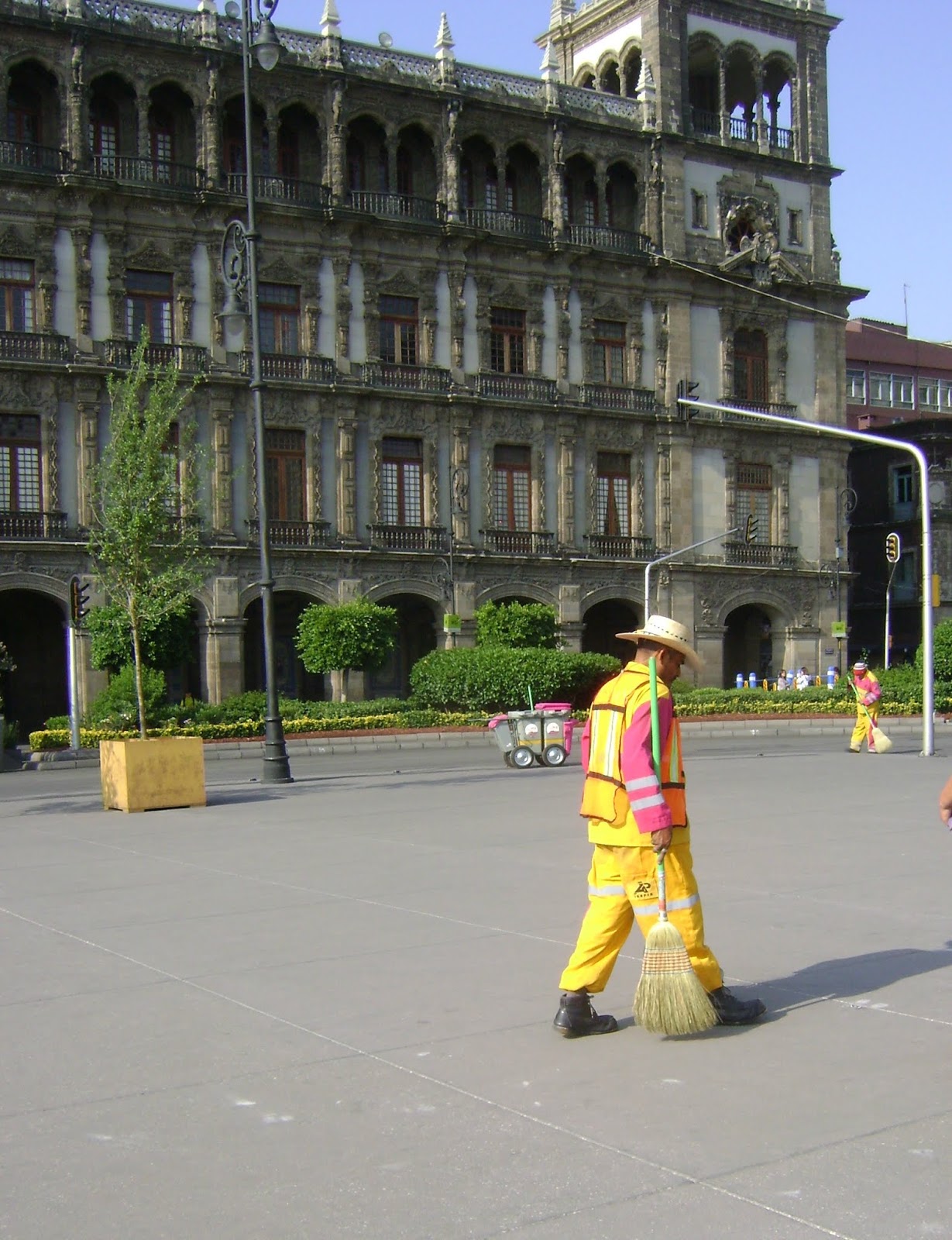
A visit to Mexico City ‒ CDMX for Ciudad de Mexico ‒ imprints images in the mind and heart. The sounds and colours of a city in perpetual motion. Yellow uniforms of the street sweepers who start at dawn; bold designs of street art everywhere; the smooth hissing of the Metro; a ceaseless flow of passersby day and evening; sidewalk sales of shoes, hats, handbags, vibrant merchandise; the clamour of market vendors; shimmering feathers of indigenous costumes; painted buildings contrasting with stately stone; the iconic Frida Kahlo appears everywhere, in every medium.


Street performance is a time-honoured Mexican tradition, buskers of every stripe will pose with you, like an awesome mime in faux-bronze. Old-fashioned organ grinders ply a waning trade, competing with live music in the evening that induces impromptu street dancing. Children up till all hours (well, it was Semana Santa).


Many colonial family mansions have been re-purposed into museums, art galleries ... and restaurants.


The unexpected always delights:


A Moorish pavilion in Santa Maria la Ribera park
Panteon San Fernando
Queen of the harp, Plaza Garibaldi
Festival de la Cartoneria

In the side streets of the historical centre, the bustle slows down somewhat by late evening. In our neighbourhood's pedestrian streets, coffee houses and bars emit a warm, inviting glow; restaurants entice with signboards; street art murals abound. A vertical garden faces the entrance to Regina Coeli church. Across from a row of cafes, a convent has been re-purposed for university programs; do the students ever sleep?


Has a major city ever been so clean? Has a subway system ever worked so well? ... among the many things we could possibly learn from this amazing city. More to come ...


© 2019 Brenda Dougall Merriman