ABOUT THIS BLOG

Showing posts with label United States. Show all posts

12 October 2015

Road Trips - U.S.A.

Forty-nine states and counting. By car on highways and byways. Many trips on those byways. Back then who thought to take photographs? Rarely I, she said. And sometimes when she did, the context was lost, like this:
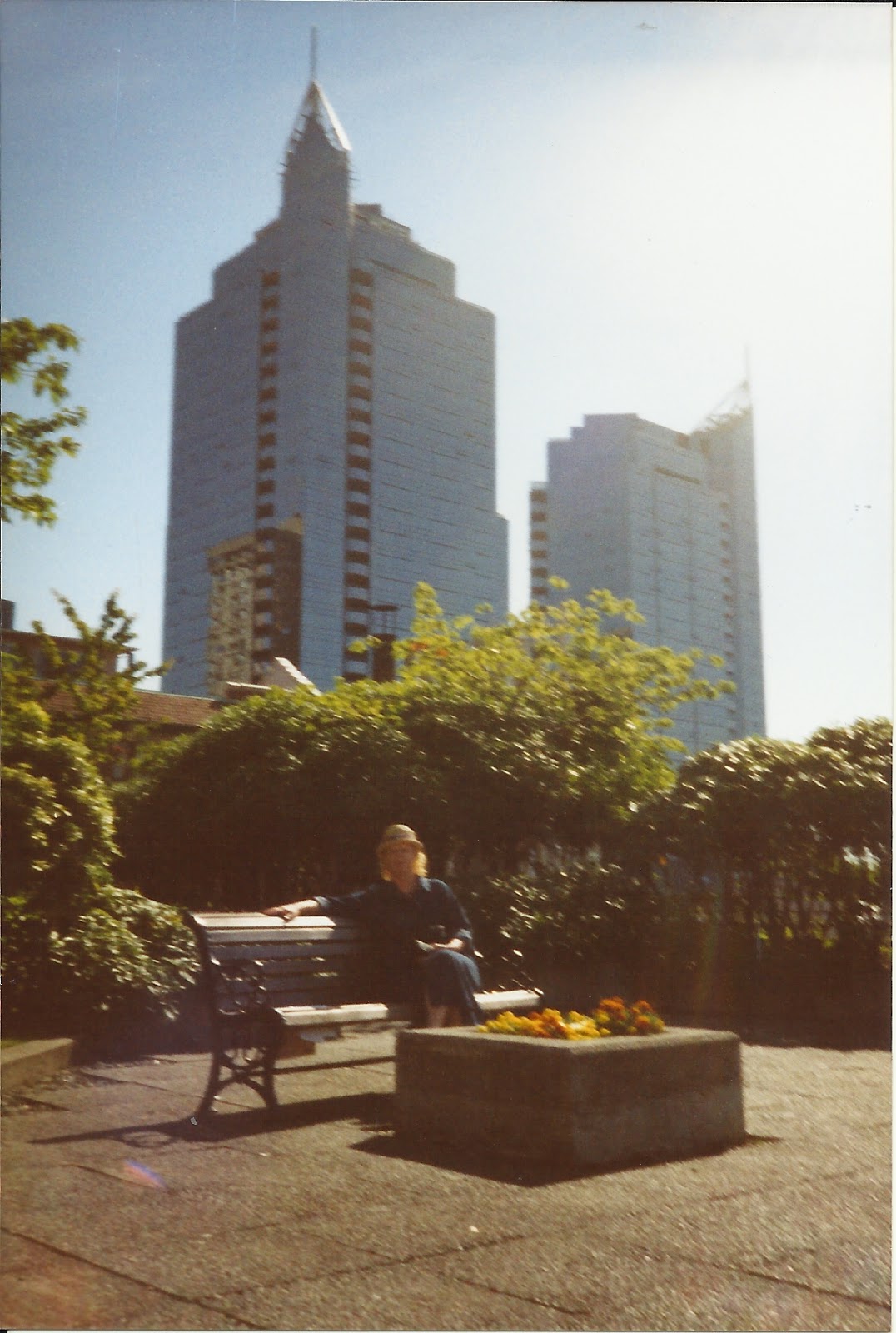
Any clues to this geographic location? Willing to accept all suggestions.

Thus, no fond photos of Santa Fe, NM; St Louis, MO; Fort Benton MT; Portland OR; El Paso, TX; Sturgis, SD; Lime Rock CT; Sandpoint, ID. Also missing: The biggest-ever, red moon rising on the Kansas prairies. The amazing evening flight of hundreds of parrots coming to roost in the trees in Brownsville, Texas. The Sonoma Valley vineyard towns with a seldom-seen dear friend. Staying up all night in Vegas (groan).

But a few memories captured:
Carlsbad NM - Looks like I'm about to pass out, right? No, but my friend had terminal claustrophobia.

Los Angeles CA - Woodland Hills, motion picture and television retirement community now called Wasserman Campus. We were given a tour as goodwill reps from Performing Arts Lodges in Canada. We have a long way to go to emulate some of their services.

Savannah GA - Waking to all-enveloping summer mist ‒ dumbfounding, palpable humidity ‒ so thick you couldn't identify someone ten feet away. It cleared up enough to explore Bonaventure Cemetery, not quite midnight in the Garden of Good and Evil.

Minnetonka MN - Delightful summer home of extended family.

Florida - Somewhere near St Petersburg. Aren't all Florida restaurants crazy?

New Orleans LA - doesn't everyone take this picture in the French Quarter?

Dollywood TN - Overcome at the wondrousness of it all.

Canyon de Chelly AZ - Much more wondrous, one of many explorations of Native reservations.

London Town MD - Colonial history, reconstruction, gardens, and a tour guide with invested interest.

Eureka NV - Also happens to be the windiest road.

Gallup NM - Once known as Drunk City; El Rancho Motel, beloved of bygone movie stars and film sets.

A few (un-photographed) important moments:
§ Sweetwater TX - Breakfast at a greasy spoon and a local cowboy invites us to the rattlesnake festival. Looking at our licence plate he asks, Is Ontario one of those northern states?
§ Hope AR - One of those ― your car just croaked its death rattle, you are screwed ― moments. Overnight in Bill Clinton's birthplace while guys at Jimmy-Bob's mechanical services did some miracle patching. Not to ignore same expert assistance in Grand Junction CO where plucky old car needed a coronary bypass after climbing the Rockies.
§ New Hampshire - Small town to remain anonymous, filling my tank with gas and driving away. My mind was on genealogy of course (thanks, American-Canadian Genealogical Society ...). So mortifying to reappear half an hour later and sheepishly pay.
§ Clear Lake CA - The algae. OMG the algae.
§ Brady TX - Imagine being in taxidermy heaven. No, I couldn't either, till I was there. What a fascinating shop. Managed to leave with only a lynx skin and no stuffed animals.

More quiz: Help, where am I here?

© 2015 Brenda Dougall Merriman  

05 April 2015

Racing

Camel racing is BIG in many countries, notably the Middle East. Probably the most intensive business and the highest stakes are in the United Arab Emirates (UAE). Camel farms are an industry. Huge prize money is awarded to owners of the swiftest animals. A few years ago, some countries bowed to human rights concerns and stopped the practice of using small children as jockeys. Now, it's mechanical robots that ride the camels.

Lars Plougmann, Wikipedia.org
Camels and owners had to re-train to adjust to the change. The tiny, lightweight things wear jockey hats and racing colours to appear less freakish to the camels. Owners drive in their SUVs beside the track, monitoring the camels' speed and heart rates. They can move the reins and a whip with two-way radio controls to the robots' little hinged arms. Weird. I wonder how many SUV pileups they have. Camels are fast!

Luxor
 Other countries and towns around the world have adopted less intense versions of racing, with adult riders. Some have token prize money, some have annual cups. Often the races are held in conjunction with a local festival. More often than not, amateurs are welcome to try their skills from a stable of camels at hand.

Australia 2009
It's not surprising that Australia seems to have the most fun with them. Alice Springs holds the annual Lasseter's Camel Cup in July, only one of many venues in that country. I quote from their website:
"The family and fundraiser event is well known for its unpredictable and very entertaining camels as well as the brave and crazy riders. ... Racing them can prove a nightmare for riders and handlers but fantastic viewing for spectators."[1]

Alice Springs 2012
More surprising is the enthusiastic American adoption by Virginia City, Nevada for several days in September. Camels were not unknown there in the nineteenth century as pack animals. Today, experienced riders and amateurs alike participate. Last-minute coaching advice:
He does his best to talk us all out of it, telling us we can back out at anytime, that is until the chute gate opens, then you better just hang on. He warns riders of the hazards of climbing about seven feet atop the beasts of burden that weigh anywhere between 900 to 1,700 pounds. “I have some of the best camels in the country, but they’re still animals,” he told us one year. “The camels will have more control than you will, and they have an attitude of their own. We don’t need any wusses here.”[2]

Pushkar, Rajasthan
Kind of reminds me of Pushkar where our tour leader had once been bullied co-opted into the free-for-all camel race open to all comers. He tells me this news after the day's races are over. Coulda, woulda, shoulda. Seriously.


[1] "About the Cup," Lasseter's Camel Cup, http://www.camelcup.com.au/.
[2] Teri Vance, "Teri's Notebook: No joking matter, I'm in the camel race," Nevada Appeal (http://www.nevadaappeal.com/news/local/12801274-113/races-camel-friday-camels : accessed 6 September 2014).

16 January 2015

Hi Jolly

Photo credit: It appears so often on the Internet,
difficult to tell the real origin; this is from the
Quartzsite Yacht Club
He was called Hi Jolly. His name was Hadji Ali (Ali al-Hajayah). He was a Moslem Ottoman, the man most closely associated with the United States Army Camel Experiment. Or perhaps he was Syrian. Or Greek. It's a story not well known in the U.S.A., let alone Canada.

In 1856 the U.S. Army imported altogether seventy-five camels from the Middle East as the "answer" to facilitating American expansion across the southwestern territories. Who but a man of the Middle East to handle the animals and train the soldiers to adapt. Actually more than one man was hired from the Levant but Hi Jolly, as the Americans quickly dubbed him, became the legend. He was capable and well-liked by all accounts.

Courtesy Doug Baum
The project was the brainchild of Jefferson Davis, then U.S. secretary of war. His own experience in the southwest and understanding of camels' role in distant desert areas led him to the bold experiment. Camels would fare so much better as pack animals in the arid terrain than horses. And they did. The camels were stationed at Camp Verde, Texas, near San Antonio. They first fulfilled their promise in the 1857 Beale Expedition, a successful trip transporting supplies and surveyors across Texas, New Mexico, Arizona, and California to Los Angeles. For several years their use was continued even after the Confederacy took over in southern areas.

Then what? By the time the Civil War ended the Camel Corps project had evaporated along with Davis's political power. Congress declined further funding; some said that camels frequently spooked the horses and other animals, causing disruption and timing delays. A plaque at the Hi Jolly Memorial in Quartzsite, Arizona, reads in part: "Officially the camel experiment was a failure, but both Lt. Beale and Major Wayne were enthusiastic in praise of the animals. A fair trial might have resulted in complete success." Some of the "failure" has to be attributed to uninformed poor treatment of the animals.
Wikimedia.org

"Legends" beget more legends and it's not easy to separate facts from the apocryphal. Many camels were auctioned off by the government but others were set free in Arizona to roam the desert. Camels were still being reported in the American desert in the 1930s. More or less abandoned, Hi Jolly was out of a job but unlike his few colleagues decided to remain in the United States. Among other occupations he became a prospector and a mail courier. Known as Phillip Tedro after his naturalization in 1880, he married, had two daughters, and died in 1902 in Quartzsite, Arizona. There, much later, a memorial was erected to him.

Doug Baum, likely the most camel-knowledgeable man in North America, created the Texas Camel Corps partly to commemorate the Beale Expedition, and also to spread the word about these hardy and fascinating animals.  

Courtesy Doug Baum
His Facebook page says it: "The Texas Camel Corps was established to educate the public on the historic use of camels in America in the 19th century." Demonstrating historical re-enactments of the U.S. Camel Corps is only one of dozens of educational events he conducts or participates in all year long. I greatly anticipate the book he will publish in 2015.

This photo I took unsuspectingly about ten years ago is one of several you might come across in Arizona ― tributes to the legend of the camels and Hi Jolly. Quartzsite remembers its most famous citizen.

Addendum August 2015: A perfect example of how legends grow is an article in Smithsonian.com - http://www.smithsonianmag.com/history/whatever-happened-wild-camels-american-west-180956176/?no-ist


Sources:
● Doug Baum, "The status of the camel in the United States of America," paper given at the 2011 Camel Conference of the University of London's School of Oriental and African Studies (https://www.soas.ac.uk/camelconference2011/file84331.pdf).
● Doug Baum, April 2014, "Confederate Reunion Grounds," The Camel's Tale (www.texascamelcorps.com and https://www.facebook.com/pages/The-US-Army-Camel-Experiment/).
● Ibraham Kalin,"From Hadji to Hi Jolly," 6 December 2014, Daily Sabah (Istanbul) (http://www.dailysabah.com/columns/ibrahim-kalin/2014/11/25/from-hadji-ali-to-hi-jolly).
● Forrest Bryant Johnson, The Last Camel Charge: The Untold Story of America's Desert Military Experiment. New York: Penguin, 2012; preview on Google books.
● "Hi Jolly" and "United States Camel Corps," Wikipedia (http://en.wikipedia.org/wiki/Hi_Jolly and http://en.wikipedia.org/wiki/United_States_Camel_Corps).
● "The U.S. Army Camel Experiment," 2014 Tour Schedule, History America Tours (http://historyamerica.com/tours/14-CamelCorps.html).

© 2014 Brenda Dougall Merriman