ABOUT THIS BLOG

Showing posts with label Rajhastan. Show all posts

06 March 2018

Our Lady of the Camels (1)


Yours truly is far from the only first-world person extraordinarily interested in the lovely beasts called camels. But some go well beyond the dilettante stage of enjoyment. Some spend their lives raising, nursing, training, mending, and tending camels. Gradually I became aware of a few who make a difference in their worlds. Ilse Köhler-Rollefson, a German veterinary surgeon, is the first one I will feature.

Raika tribe families in Rajhastan, India, have been struggling to preserve their camel culture way of life. Camels are treated with love and respect for their milk, wool, and as superb draft and transport animals. Families have been dependent on having camel herds for sustenance and trade. But changes in economics and ecology plus disease are decimating the number of animals, especially in remote settlements.


Köhler-Rollefson came there over twenty-five years ago to study for her Ph.D. And she stayed. The intimate bond between the families and their beasts impressed and inspired her. Despite being an outsider she was eager to help revive and improve the situation.
Written of a local camel fair:
Like many people in the northwestern Indian state of Rajasthan, she [a camel handler] reveres camels the way that Hindus worship cows. Many who have brought their camels here are Raikas, a special caste of camel breeders, who believe they were created by Shiva to be camel guardians. They worship the camel god Prabuji. (1)

Very gradually, being able to treat sick camels, Köhler-Rollefson was accepted. Treatment now involves both modern and traditional medicines, the former still rather difficult to obtain. She set up an NGO called Lokhit Pashu-Palak Sansthan (LPPS) to facilitate supplies and raise money. Thus she became an advocate and an activist on behalf of the Raika whose very identity is wrapped in camel culture. Nevertheless, Rajhastan's camels and rural livelihood are still in critical danger of eclipse.


From her blog:
"Meeting the herders is a humbling experience, seeing how the old Raika philosophy of “first the camels, then us” is still alive, the hardships and hard work they perform to keep their camels healthy, how many farmers appreciate the manure that the camels deposit on their fields as organic fertilizer, how closely the herdsmen observe nature and the effect of camel browsing on the trees of the Aravalli Hills. One can feel how camels are a crucial part of the agro-ecological web whose disappearance would undermine both local food production and ecology."(2)


Camel Charisma (https://www.camelsofrajasthan.com/) was a concept she created originally to operate a camel dairy. Now numerous projects have grown to support camel breeding, camel-related products, and biodiversity within the Raika camel culture heritage.


A pastoralist, Köhler-Rollefson in her words:
"Now I do everything that I feel is necessary to work towards policies and practices that support socially responsible and ecologically sustainable livestock development, and to develop alternatives to the “Livestock Revolution” which is one of the socially and ecologically most disastrous trends globally.  So I am variously a researcher, a writer, an activist, a fund raiser, a teacher and trainer." (3)


In 2016 Köhler-Rollefson received the Nari Shakti (Women Power) Award from the President of India, the first foreigner to be so honoured, for her contributions to the Raika pastoral community. It was *** a string of recognition awards. Her book, Camel Karma: Twenty Years Among India's Camels Nomads is available on Amazon.


Imagine dedicating your life to help renew a unique culture and livelihood that was slowly fading. Changing the course of her life helped change the lives of many Raika.

Our Lady of the Camels ... passionate, compassionate, and tireless.


(1) Jasvinder Sehgal, 18 December 2017, WorldCrunch (https://worldcrunch.com/culture-society/where-indian-camels-are-as-sacred-as-cows-but-vanishing-fast)
(2) and (3) ilse-koehler-rollefson.com


© 2018 Brenda Dougall Merriman

02 August 2014

Pushkar, India 2009

My introduction to the Thar desert in India’s province of Rajasthan was on a sorely tested digestive system. Delhi-belly felled my group one by one and the wonderful curries for breakfast, lunch, and dinner temporarily lost their appeal. So we are happy to have tents with toilets and limited wash facilities, despite water rationing. The ropes at the back of the tent look like an unobtrusive way to hang a bit of laundry, whereupon we discover the waste from our facilities flushing into open trenches that may or may not be moving along. Along to where, one wonders. 

Night temperatures drop from over 40 degrees Celsius to about 15. It’s the desert, alright! And the Pushkar Camel Fair has more camels per square foot than anywhere else on earth. To fully embrace this experience, all I have to do for three days is not eat anything ... thus avoiding more internal combustion! Experienced sufferers advise that bananas are tolerable on a weak stomach. 

The first foray into the fairgrounds is on a camel cart rather awkward and difficult to climb into. It takes a half hour to get there, four people on a cart, bumping along like peas on a drum. Children begin appearing out of nowhere to beg for money and shampoo. They are from the gypsy camp relegated to the outskirts of the vast fairgrounds. Pleas of “hello, hello” vary with “mama, mama.” A couple of them play Frere Jacques on their screechy little string instruments. Older and bigger hawksters start pestering us. 


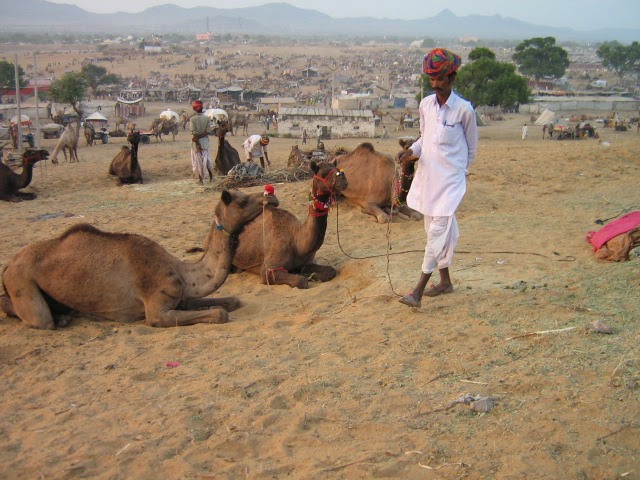
The small town of Pushkar holds an annual religious festival devoted to the god Brahma, along with the famous livestock market. Camels take precedence; horses and cattle are a minority. Thousands of people milling on the fairgrounds have staked out their spaces for tents and the animals they want to sell or trade. Many come from remote villages; some have never seen foreigners like us before. All the camels I could ever imagine, extending to the horizon. This desert area has been drought-stricken for three years. Cement pools here and there hold water for many purposes. Presumably it is well boiled for the ubiquitous chai. 


Our guide explains how the camel bargaining goes, among the uneducated tribespeople who don’t understand paper money. Buyers and sellers thrust signals to each other in intricate hand clasps that have a known value, conducted discreetly under a piece of cloth. 


At last: next day at 6:30 a.m. is my specially requested sunrise camel ride. The digestive tract is slightly more under control. On the spot financial transaction somehow results in charging me double; lack of coffee makes me acquiescent. Impassive camel tender Sadao leads me and Rahma the camel toward the familiar fairgrounds again. Solitary men here and there are squatting in the semi-darkness, enjoying a certain morning-type relief. Women seem to be invisible. Beware of thorny bushes along the track so not to rip your legs to shreds. Some camels are mean that way, deliberately rubbing up against injurious obstacles. But Rahma seems as oblivious as Sadao. Likely they didn’t have any coffee, either.

When we reach the tribal camping grounds everyone is busy preparing breakfast and morning chores. Fascinating to see all the small fires of each little campsite—the smell of wood-burning smoke has been universal in this country since we stepped out of the airport an age ago. Vendors offer a variety of puffy deep-fried delicacies. A foreigner on a camel at this hour is a novelty. As we wander the camp, a man greets me as the owner of Rahma and invites me for chai. Without the backlash of Delhi-belly and visions of the stagnant water source, I would have accepted.
Sadao signals, time to turn back. Along the track he temporarily abandons me. This is more like it. I’m free to choose my forks on the trail, having figured out the steering mechanism. He trusts me as an experienced camel rider, right? Meanwhile, the temple of Savitri, wife of Brahma, glows on a hill in the rising sun. Glancing over my shoulder I glimpse a back fling of clothing as Sadao does what comes naturally onto the sand. Several tractors are warming up and zooming off to work (in the fields irrigated by our waste water?). They are playing pop Indian music at earsplitting decibels. Rahma and I are in synch. Sadao catches up to me just before we reach tent city. Hawksters are at me brandishing photos. They are rather good; fast turnaround.
More swaying, banging, bruising camel cart rides back and forth to the town. Once, a dialogue with camel behind us as we sway and bang along. His driver teases us by allowing the camel close enough to put his head under our awning. Breakfast bananas are swiftly stowed out of sight. The drivers love our shrieking. Comes to mind: “If the camel puts his nose in the tent, can the rest of the camel be far behind?” Indeed. 

Each time we disembark is a testing of our stiff limbs. We spend long hours exploring the holy sites, watching the contests and exhibitions in the arena, dazzled by the colours and commotion all around us. We pass stalls selling camel ice cream and camel dung paper. Only one pickpocket incident, during the mustache contest;  Continual rehydration is necessary. Late afternoon “resting” in our tents is like baking in an oven.

A dozen of us go for a sunset camel ride, in a different direction. My camel is gratifyingly colourful but the local photographer-hawksters are mysteriously absent. We stop near a nomad tent with goats to watch the obligatory sunset. One camel handler lights up a cigarette. We see his camel likes to inhale the cigarette smoke. Puts his head down, sniffs heartily, and then tosses his head back in apparent enjoyment. Me with dead camera batteries. Is this how Camel cigarettes began?
Reading the newspapers later, we learn that some camel vendors will turn their unsold camels loose. In this economy the price of feed has escalated and they’ve lost the potential income from a sale. They can’t afford to take the animals back home and maintain them.It’s said they love their camels and treat them like family. The camel population of Rajhastan has dwindled alarmingly in the last few years. Very very sad. 

© 2014 Brenda Dougall Merriman. All rights reserved.