ABOUT THIS BLOG

Showing posts with label Tunisia. Show all posts

05 April 2020

Cemeteries - Tunisia


Some cribbing and commingling from a much earlier posts.

Tunisia is a secular country, estimated at 97% Muslim. In 2012 I noted it was the most liberal Arab country I had visited at the time. There I had opportunity to view a Muslim cemetery up close. Burials are generally made within a day of death, avoiding the embalming process that interferes with the body. While all mourners attend the funeral prayers led by an imam, only men accompany the body to actual burial in the cemetery. The deceased are buried on their right side facing Mecca. In general, elaborate grave markers and flowers are not encouraged; prayers are preferred as memorials.


The town of Hammamet is about 60km southeast of the capital, Tunis; a place of lovely beaches for holidayers. Apart from seaside attractions, it has a fascinating medina (old town) dating from the 15th century. After climbing one of the protective walls to enter (on a ramp), one meets a maze of narrow streets zigzagging throughout, bursting into colourful small piazzas of shops and vendors. Photographers’ delight!

A cemetery is located outside the walls along the Mediterranean seafront. Many tombs have traditional mosaic decoration. Here, the customary marker is the representation of a book: the left hand page identifies the individual with name and dates; the right hand side has a quotation from the Koran. Grounds maintenance does not seem to be a priority. We saw litter dumped in one section. A small Christian cemetery is nearby with many Catholics of Italian origin.


Some years ago, preparation for new construction in Hammamet unearthed an extensive Roman necropolis among remnants of the ancient settlement known as Pupput. We did not see that particular area, but signs of the old Roman occupation are everywhere across the country. Many museums exhibit excavated burial markers – stelae – and funerary objects, some as old as the 1st century AD. Most stelae commend the departed to the pagan household gods (dis manibus sacrum – DSM). They usually give the person's name, age, parents, status, and name of the person who erected the stone. Date of death does not seem to be the norm! That the inscriptions have survived so long is likely due to being covered by soil as new communities developed on top of them – inadvertent conservation.

Two photos above at Sousse Museum
Even older! Near the ruins of Carthage, that legendary city ultimately defeated and ruined by the Romans, parts of the excavated Tophet cemetery show stelae from the time of Carthage’s great power BCE. These were all child burials; the indicative geometric sign appears often. I diligently took many photographs, only to learn later my new SIM card was corrupted. The two photos below are thanks to Atlas Obscura and the individual photographers who shared.

by Patrick Giraud
by Dennis Jarvis
Tophet has long been a locus of serious controversy; scholarly and scientific researchers debate whether it was a place of infant sacrifice. My discovery of a blog called Bones Don’t Lie was serendipitous; here’s a great discussion:


The city of Kairouan ‒ inland but still considered coastal region – with its Great Mosque is Tunisia's spiritual centre. In fact, the Great Mosque there is the holiest Muslim site in Africa; the original portion is from the 9th century. Overall it is the fourth holiest site for (Sunni) Islam after Mecca, Medina, and Jerusalem.

In the courtyard

Outside the walls of the medina can be seen (with the mosque's minaret in the background) the small old Ouled Farhane burial ground named for the tribe that had once requested this location close to the mosque. I can’t ascertain when the burials began or the age of the stones. All inscriptions have long vanished over time and whitewash is the only memorable feature.


And then to modern times. A visit to the small town of Monastir included the mausoleum of Habib Bourguiba (1903-2000), the enlightened and revered father of modern Tunisia. He became the first president at the time of independence in 1956. Among other reforms such as banning the burkha and niquab, Bourguiba instituted universal health care and compulsory education up to full high school level. A processional avenue leads up to his grandiose monument with its golden dome, within the town's extensive el-Mazeri cemetery.

The interior has private rooms for family visitors and a public room serving as a small museum of Bourguiba’s life. Separate rooms have comparatively plain burial slabs for members of his and his second wife's extended families.


Thus, the deceased provide quite the contrast in time periods, cultures, even empires, in one rather small country.


© 2020 Brenda Dougall Merriman

23 April 2017

Kairouan, Tunisia 2012

Today is one of those blogaversary days ... ever since the camels clamoured for their own space. Travel demanded babble at the same time. And it happens to be my ninety-ninth post on the blog. Here's to another three years, insh'allah!

Kairouan, the holiest Muslim place in Africa and a UNESCO World Heritage site, was a special stop on our way south in Tunisia. Olive trees and sheep abounded at first in the scenery; for some reason lamb was expensive and not common on restaurant menus or buffets. Many fences consisted of prickly pear cactus plants that can grown to ten feet tall. A very effective fence! They grow a red fruit, an acquired taste (often featured in weird cocktails); talk about intensive labour, to collect them. We reached very flat country, dotted with salt lakes. On the city outskirts, we passed camel butchers set up on the roadside. The head of the animal is always displayed to indicate what kind of meat they're selling and that it's fresh.

The "pools of the Aglobites" (spelling varies, Aghlabids, etc) were actually cisterns for rainwater collection built in the 9th century, during the Arab Aghlabid reign ― the golden age of Kairouan. A technically complex project, it was an engineering marvel of the time; four of the fourteen pools have been excavated. The view was excellent from the adjacent small tower. The pools or basins are only one part of the UNESCO designation for the city that includes outstanding architectural heritage and rich spiritual roots. For many centuries Kairouan was the capital of the Arab-Moslem world in Africa.

A camel with a hopeful owner/handler awaited outside, a ride I had to pass up. The same applied to the prickly pear jam in the small gift shop, but I did load up with some "worry beads" (seen hanging in all Tunisian vehicles). You never know what stress they will relieve. The ubiquitous mint tea was being served; our leader Samy drank almond tea instead; the small glass was half full of almonds.

 We moved on into the medina to see the restored mausoleum of a Sufi saint, Sidi Abid el-Ghariani (sidi = Moslem saint or holy man). Gorgeous architecture here, dating to the fourteenth century. The amazing ceilings were painted cedar, elaborate decoration. Sufism (tasawwuf) is a mystical, ascetic sect of Islam, particularly noted for scholarship. The most visible manifestation of Sufi to the uninformed is their dervish dancing performances.


On to the Great Mosque itself (we were not allowed in the prayer hall). Besides its status in Africa, it is the fourth holiest place in all Islam. Seven pilgrimages here are the equivalent of one Haj to Mecca and means being reborn, all sins wiped out. That's why many reserve it for when they're old. 

A glimpse of the interior

Originally built by the city's seventh-century Arab founder, it was rebuilt within the next two hundred years with some features added again from time to time. The courtyard is huge but not quite as big as the Hassan II Mosque in Casablanca, biggest in the world we were told. There's a huge cistern below the courtyard, more evidence of how parched is the general countryside in this inland region.


Trailing through part of the very clean-looking medina again to a most impressive house I thought at first was a small hotel. Another amazing ceiling. It was a venue for showing a promotional film about Tunisian history and culture. Unfortunately the film director used every sort of hackneyed trick with images and superimposure, whatever the proper names are for those techniques. With our irrepressible guide Samy constantly at our side, it's not as if we weren't being exposed to loads of information about the beauties of Tunisia!
 
That's the ceiling


And finally ... ah well, to be expected, somewhere on the tour ... the carpet shop visit with hospitable mint tea. It's near the medina entrance, across the street from the old tribal cemetery outside the walls. I could not learn how old the burials were, stones were whitewashed, inscriptions worn away. Luckily the carpet demonstration was not too long so we didn't feel too guilty at not buying. A woman was demonstrating the process. I liked the small pieces with more primitive depictions and symbols of Berber life but was not disappointed when I couldn't get a salesman's eye; they only want to sell the expensive, good quality carpets. On to a luxury hotel in the former kasbah for buffet lunch, arriving just in advance of a huge crowd of what looks like convention delegates.
 

What a privilege to visit this historical landmark of a city, a full morning of cultural basking.


© 2017 Brenda Dougall Merriman

23 May 2016

Matmata, Tunisia 2012

~~ Star Wars Alert: Tatooine (Tataouine) is a real place. 
It is a province and a town in Tunisia. 
Matmata is a small town at its north end. ~~

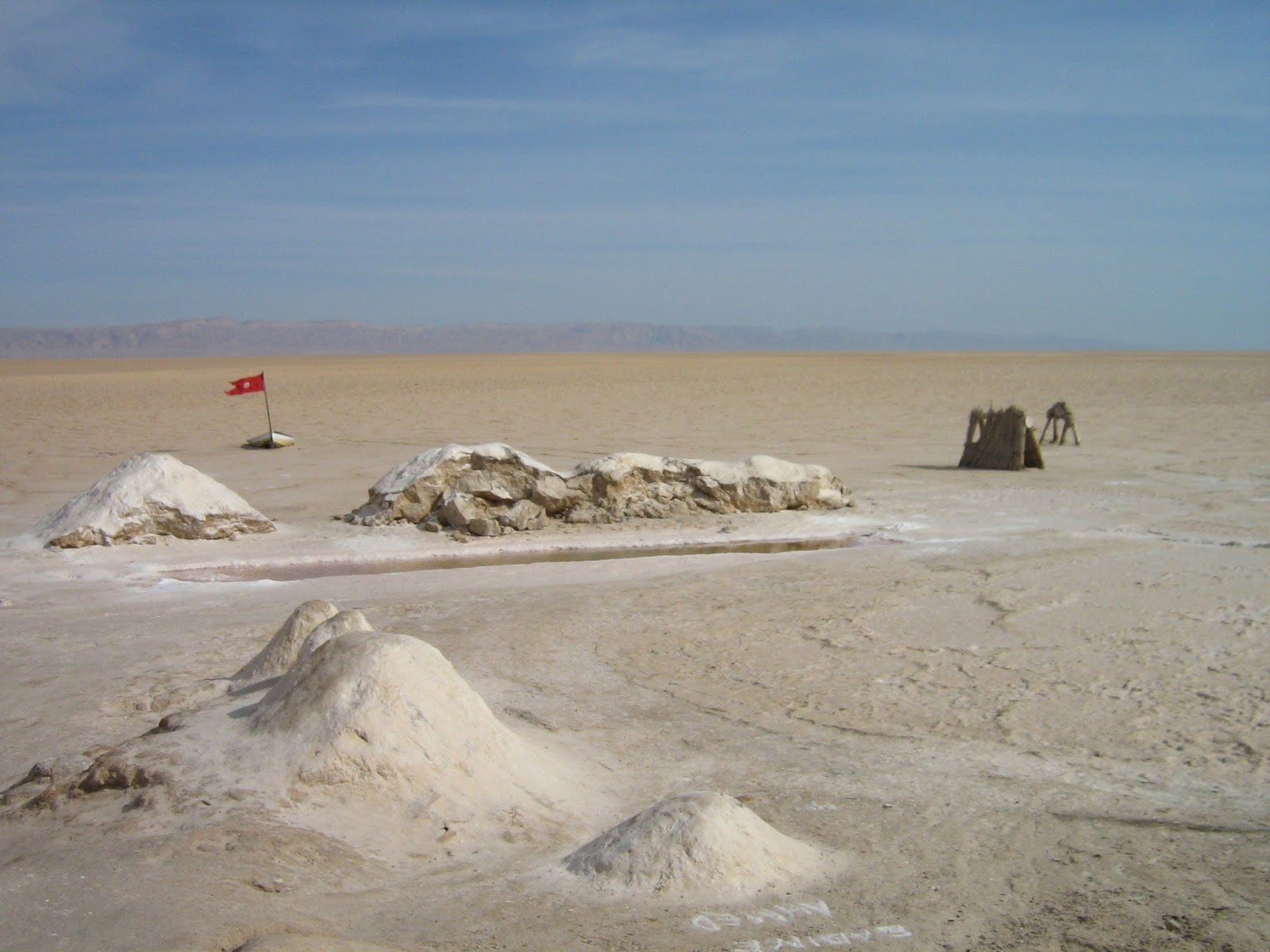
Salt flats, northern Sahara
The little Berber town of Matmata has a lifestyle unto itself. Here be troglodytes. We have driven east from Douz in a beautiful amber light, sun obscured by the sand haze in the air. As we pass away from desert and salt flats the terrain becomes hillier, we begin to see man-made entrances to caves dotting the hillsides. Or are they caves? Most homes are like circular craters, dug into the ground, the central portion open to the sky, with rooms carved out of the surrounding sandstone. Light from the centre illuminates the interiors that have no windows, just doorways.
 On the town outskirts our van stops at the side of the road and we are about to find out what it's like to live underground. Only the whitewashed exterior and a few pots mark the door. A long dark entrance leads to the courtyard; we pass a man who's been having a nap on a small bed along the narrow entry lined with some household utensils and the odd bit of clothing.

Roadside homes are often prepared to receive spontaneous passing visitors; it's a way to supplement their meagre incomes. It's almost a cottage industry, you might say, but the native hospitality has been eroded by their exposure as (reluctant) objects of curiosity. Our guide Samy gives us little advance information of what to expect, acting as the cheerful host. I'm not at all sure he, being from a different, urban part of the country, is even conscious of the dwellers' sensitivities.


The courtyard is sunny (it's still morning and the day is hot), deserted, and shows half a dozen doorways. A pet called a gundi, of guinea-pig resemblance, is in a cage. Oh ... a small girl about six or seven years old peeks around a doorway that leads to a yard where an outhouse can be seen. So this home is not a perfect crater. A family member will undoubtedly be out somewhere tending the goat flock. We gawk around, encouraged by Samy to investigate the rooms. It seems quite intrusive; most of us feel diffident.


Several rooms have beds arranged with colourful, patterned hangings and blankets. The clothing hanging on wall pegs is spare. The kitchen has something like a primus stove, some pans, and many clay pots for storage. It's hot as hades in there as if someone was recently cooking. Normally the temperature here would be cooler than up on ground level.  


The little girl is now hanging out in the courtyard looking bored. Suddenly, or so it seems, an elderly woman in black dress appears seated in the courtyard.
Since she looks posed, we take turns being photographed with her (still feeling uncomfortable). Naturally she doesn't know any English and seems disinclined to engage in talk. But our companion Alice strikes a chord with her and they have some amiable exchanges. Instinctively we give donations for taking the photos, only half-understanding that it was expected.

Samy directs us to the living room where a spread of pita, olive oil, and mint tea has been set out for us. A typical breakfast for the family. It was cooking the pita that likely sent the interior temperature shooting up. The woman does not appear again, so we serve ourselves, a sign (to me) that this must be a tiresome business for her. However the little girl does join us, looking annoyed and slightly sullen; no doubt her presence was ordered to add more atmosphere.
She is sitting apart not far from me. My companion found the perfect recipient for the bag of jujubes she'd carried all the way from Canada. The kid's eyes light up and she actually smiles. Earlier we were reminded that it was Remembrance Day. It is quite touching when over this little feast, someone starts the poem "In Flanders Field" and we all recite as best we can.

Onward as lunch time approaches, into the town of Matmata. Here, an obligatory visit to a small underground hotel, one of several in the town, based on the circular pit concept. We peer at it from above; we enter its courtyard from below for a different view. This hotel, Sidi Driss, is billed (and immortalized) as "home to Luke Skywalker" yes, one of Tunisia's many Star Wars locations. You too can sleep here. And so even the dullest of us (not mentioning my name) finally gets the long-lasting impact of filming in this area. We are not shown an actual bedroom, but a group of tourists is having a fine time lunching in the underground dining room off the courtyard.
Then to a "regular" hotel for our lunch ― Hotel Matmata is perhaps the only other hotel open in off-season ― an old and interesting place needing attention to maintenance. The cool, vast marble lobby is lovely. Lunch is a small but nice buffet lacking, very oddly, any sweets; no complaints about apples and oranges but not typical for desserts here. One has the sense everywhere of cutting corners.

 A stuffed goat kid is part of the dining room decor. One of the courtyards has molded clay depictions of a woman making pita bread, a large camel with a broken tail. Despite its rundown condition the place has much more charm than our occasional plush, generic hotels.

Star Wars probably started a new tourist invasion in the 1980s and keen fans still come to look. The location sets generally survive in good order for visitors ― others are west of here in Douz and near Tozeur. However, the latest Star Wars movie (The Force Awakens) did not film here.[1] Tourist boom time for this region may be over. Long known as a smugglers' route, extremist activities have been taking advantage of its relative isolation.


[1] Conor McCormick-Cavanagh, "Tunisia's Star Wars Fans Battle to Bring the Force Home," Middle East Eye (http://www.middleeasteye.net/in-depth/features/tunisia-has-potential-establish-itself-star-wars-fan-paradise-599714959 : accessed 28 December 2015).

© 2016 Brenda Dougall Merriman
01 October 2015

Tozeur, Tunisia 2012

Tozeur is a small town built around a desert oasis. One of its notable features is the distinctive brick-pattern designs in buildings all over town. The oasis is large and well-managed; we learned about the seasonal stages of harvesting and maintenance of the life-giving date palms.


After some free time in the peaceful medina streets we plunged into the contrasting fray of the morning market. The butchers customarily display the head of the meat they are selling; it signals that their meat is fresh.

 
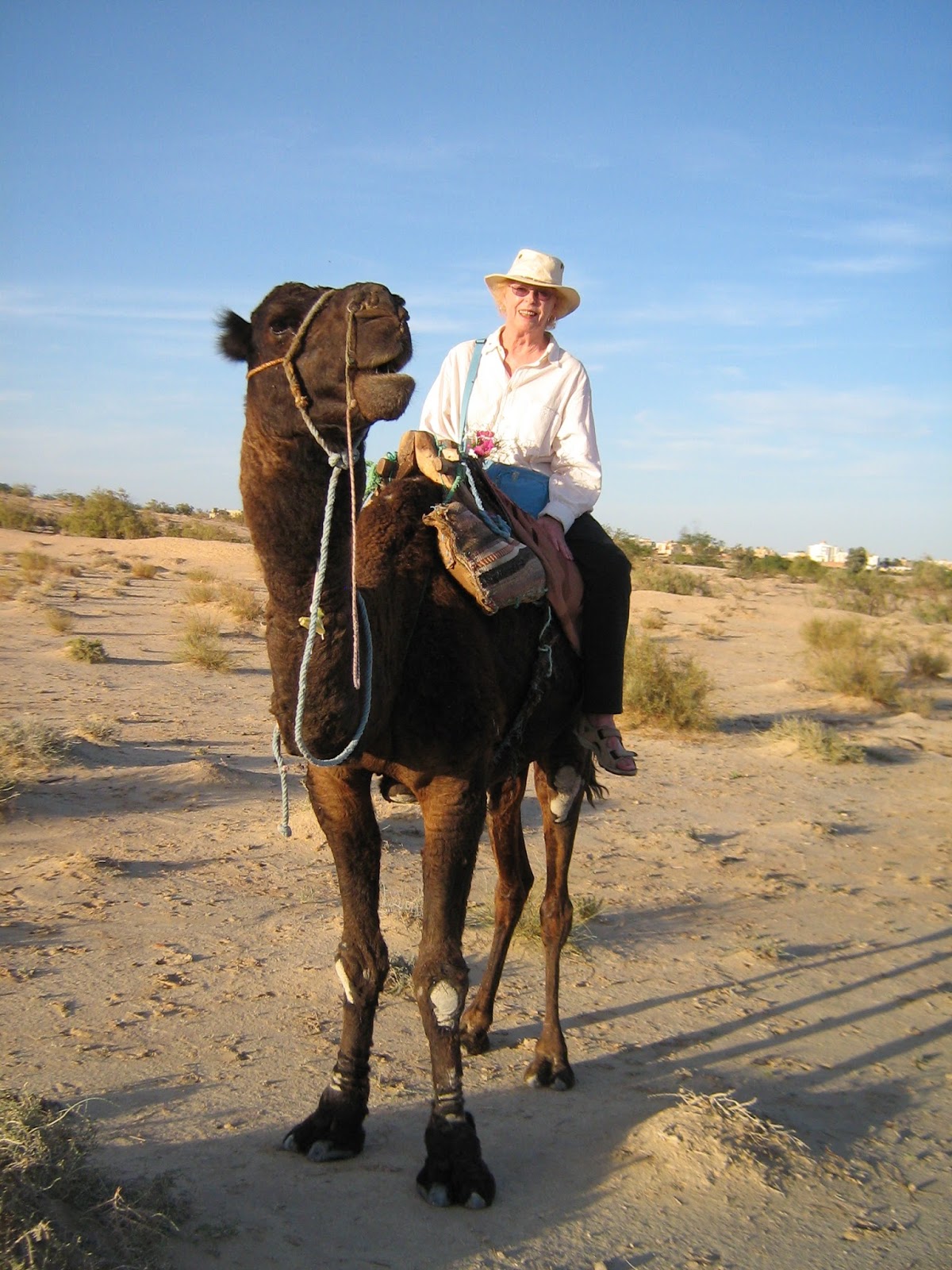
By now I’d already happily acquainted myself with a few camels in this country. Time for my specially arranged ride. Jelel drives me to the rendezvous that turns out to be at the edge of "downtown." Two guys we meet. One is there to ensure the arrangement, probably the owner, and disappears almost immediately. Misbah is the camel handler, age indeterminate, since he is very weathered and has few teeth. And speaks a French mixture at machine-gun speed, but we learn to communicate. He's had tourists from Quebec so "Montreal" is his reference point for Canada. 

I mount a white beauty called Ali Baba. I check for blue eyes: nope. And away we go along a curving back street that skirts the oasis watercourse, behind and below the tourist hotels. It's quiet and pleasant but the South Arabian saddle arrangement may become a problem. I see places where palms lining the watercourse are black and dead; our guide Sami tells me later there was a fire. The water itself looks polluted and refuse has been dumped in spots, so at odds with the pristine oasis we saw this morning. 


Then we pass a semi-grungy local bar getting primed for business — no question the source of last night's lively music. Wave to the guys! They cheer for me (“John Wayne!”) due to their cowboy interpretation of a Tilley hat. Misbah picks some jasmine and bougainvillea from passing vines and makes a little posy for me. Touristy but nice.

After twenty minutes or so of stately pace the vista opens and we approach signs of other activities. A golf course entrance, and an amusement park of sorts. One or two families are about. Misbah is very aware of photo opps and he knows the park. Ali Baba too is obliging and accustomed to posing; I swear that camel is a born actor. 

Misbah places us in front of a giant replica of a man's head. In vain I try to catch the Arabic name of the celebrity. Now I know it was Tozeur's favourite son, "one of the first poets of modern Tunisia,"Abu el Kacem Chebbi (1909-1934), born in the area where our hotel sits. 

After that to my surprise, we change camels. Reason unknown, a momentary blip in our franglais. Maybe something to do with leaving the cobblestoned street to hit dirt and sand underfoot. Now I am riding black Mavroud who is older and (forgive me) a little moth-eaten, with less conceit than Ali Baba. Maybe the switch is to give the poor old guy some exercise! We fuss at adjusting things so I am not totally behind the hump.

Misbah and I agree emphatically that building golf courses in the desert is regretful. Nevertheless we are traversing part of it on paths, apparently following a familiar route. He waves his arms describing new projected tourist plans. I’m quite happy there are no golfers in sight. Then, at last. We reach the desert. Desert with tufts of the grassy stuff camels like to eat. Away from civilization for a bit. But the saddle is truly uncomfortable. Misbah understands we need a conference. Stop, dismount. When I say "sore bum" he repeats BUM delightedly. His new English word. 

He carefully rearranges the blankets. Then he says "Montez!" pointing to Mavroud's neck. I pose astride the patient camel's neck, another tourist trick I guess but what the heck. Old Mavroud is gentle as a lamb. Set off again toward the waning sun and I wonder if we are going all the way to the old Star Wars set. Misbah gives me the nose lead and walks behind, switching the camel and commanding him. A little trot, I wondered? Could I hope for a canter? Whatever it was, it didn't work. My supplementary proddings are ignored. Mavroud is simply not up to it today. We continue into the sunset, already way over the allotted hour.

I ask Misbah what is the smoke coming from the left (what on the desert could possibly burn?!) ... with intense concentration I translate it’s from the brickworks. He is eager to show me so we dip into a fold between gentle hills to see acres of this walled open air factory. Once there, he insists on taking photos of piles of bricks as he explains the manufacturing process. The site is almost deserted at this hour; it’s easy to see over the walls on camel back. We poke back and forth along the enclosure. This place is likely the town’s biggest employer.


Misbah seems keen to go on forever but by this time my sitting bones are very sore from the unrelenting saddle. The man has done all the walking cheerfully and loquaciously, some of it barefoot. We take a route through a different part of the golf course (still deserted) with great views toward the town. We chatter a bit and he blows me a kiss after some remark I make. Seems to me a sophisticated gesture from a small-town small-time entrepreneur who may or may not even own a camel himself.
Back onto the watercourse and eventually into the corner of the town we departed from. No Jelel. Misbah decides not to couche Mavroud yet. We turn the corner, parade along a main street (more John Wayne fans) and there's Jelel. I could have walked to the hotel from here. As we part, we probably would have had a discreet hug but for prevailing convention; others were watching. 

Probably the best ever.

© 2015 Brenda Dougall Merriman