ABOUT THIS BLOG

Showing posts with label Canada. Show all posts

20 September 2015

Ferry Connections

Ferry whimsy. Who hasn't done this? Travelled on a ferry between point A and point B? It usually shortens the distance between two places, or enables reaching a specific place such as an island. For some people, a ferry is a daily ho-hum part of their commute. More fun are the holiday travels by ferry.
My first major ferry crossing was many years ago avec famille in a motor home over the Cabot Strait. I am convinced that at that time we boarded the ferry in Prince Edward Island to reach Port-aux-Basques, Newfoundland, although that route from PEI is not in operation now. Wherever we loaded on, it was a long overnight crossing. Did I say fun? Sleeping in a metal room with no portholes is quite an experience. The slightly shorter trip returned us from Argentia to North Sydney, Nova Scotia. Timing did not allow us to go to St John's ... how shortsighted was that?!

My memories of the Rock are rather hazy apart from the demands of making beds, washing dishes, and cooking meals.


Cornerbrook was a lovely little town for a visit with friends. Crossing the main part of the island included an overnight in a gravel pit for lack of camping grounds. The scenery was amazing, unlike any other part of Canada.

However, my overriding memory is the fate of our ferry, the good ship MV William Carson, which sank not long after. It struck a small iceberg near Battle Harbour, Labrador; by good fortune, all 158 passengers and crew aboard were rescued.

All subsequent ferry journeys were peanuts after that. The Bay of Fundy: Digby to Saint John. The Chi-Cheemaun: Tobermory to Manitoulin. Gradually the massive motor home was no longer required.
Vancouver (Tsawwassen) to Victoria; don't remember how long ago that was or the name of the ferry.


Cape Breton to Cape Breton; the Little Narrows cable ferry takes you from one side of a Lake Bras d'Or inlet to the other in five minutes. It's a shortcut if you are approaching the Highland Village from the north.

Not to ignore the Toronto Islands ferries ... or the almost-obsolete vessel that lumbers back and forth to the Island Airport.

Elsewhere in no particular order:

Istanbul to Uskudar; a short trip across the Bosphorus to Turkey's Asian side.

Tallinn to Helsinki; the end of a trip through Russia and the Baltics.

Amsterdam (Ijmuiden) to Newcastle, UK; this is a BIG ferry! But smooth crossing on the North Sea in July.

Oban to Coll, Scotland; ancestral excitement!

Spain (Algeciras) to Morocco (Ceuta); past Gibraltar to the land of royal cities.

Not exactly a ferry (!) but a significant water journey was on the Great Lakes from Port McNicoll near Midland on Lake Huron to the Lakehead, otherwise known as Thunder Bay. The ship was probably the SS Keewatin. They loaded my car on and away we went. Let me tell ya, it's impossible to look back on crossing Lake Superior without obsessively humming "Edmund Fitzgerald" (thanks, Gordon Lightfoot).

Not exactly as pictured in the 1970s!
Most fun of all was crossing the Ottawa River from Carillon, Quebec to Pointe-Fortune, Ontario. We were towing a race car on a trailer that had approximately four inches of ground clearance. The rig was going to take up all the space on the tiny ferry. Mr. Québecois Ferryman gave it close inspection before allowing us to board, then stated the obvious with some trepidation, "She's low like hell."

Thrilling, every one of them.

© 2015 Brenda Dougall Merriman

22 June 2015

WORLD CAMEL DAY


WORLD CAMEL DAY
22 JUNE

High Arctic Camel, mid-Pliocene period
(drawing by Julius Csotony, Canadian Museum of Nature)


13 June 2014

Camels Are Newsmakers. Sometimes.

My friends send me camel stuff. Sometimes camels get better press than the recent MERS reports.


My friend Elayne sent this.
(You know if you click on the image, it will enlarge, right?)


The Arctic Camel
Every news agency on the planet carried the story of the Arctic camels in March 2013. Canada's northern Fosheim Peninsula on Nunavit's Ellesmere Island was declared "a paleobiological hotspot."[1]
"In March, researchers at Ottawa’s Canadian Museum of Nature made international headlines when they found ancient, mummified camel bones in the Strathcona Fiord region—the most northerly region to ever yield camel bones."
"A coal exploration project proposing to tread the same ground as the ancient fossil forests on Nunavut’s Ellesmere Island has been temporarily put on the shelf. Canada Coal has delayed its exploration program on Ellesmere Island for at least a year, and withdrawn its application to Nunavut regulators, saying it needs more time to address a host of concerns raised by people in nearby Grise Fiord and scientists across Canada and the U.S."
Toronto Star rendering of High Arctic Camel
ScienceNews reported that these were giant dromedary-type camels accustomed to a colder climate (not as cold as the Arctic today).[2] The finding supports the origins of camels in Canada millions of years ago.


Of course that doesn't explain this from another friend:

The Cariboo Camel
But it goes to show that the U.S. Army wasn't the only outfit promoting the splendid beast of burden in nineteenth century North America. These Bactrians came to work as pack animals in the Cariboo Gold Rush (1860s) in British Columbia (BC), Canada, from San Francisco after similar service in mining camps there. Before that the animals came from a railway construction camp in Arizona. Various factors were against the BC venture, such as their disruptive affect on horses, stagecoaches, and the rugged terrain tearing up their feet. Their legends grew as the camels died off by chance, neglect, or killing.

And then there's this:
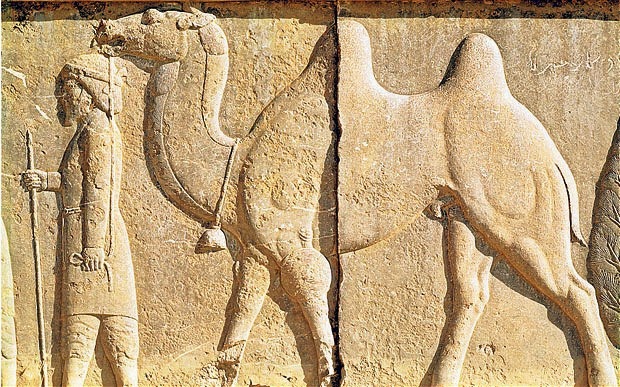
The Biblical Camel
Archaeological news in early 2014 said that domesticated camels were not in the Middle East until centuries later than the Age of the Patriarchs. "In all the digs, they found that camel bones were unearthed almost exclusively in archaeological layers dating from the last third of the 10th century BCE or later – centuries after the patriarchs lived and decades after the Kingdom of David, according to the Bible."[3] Their carbon dating refutes the use of camels, for instance by Abraham, Joseph, Jacob, and other historically dated figures. Therefore hot discussion (and not a little distorted sensationalism) was triggered about what else could be inaccurate in the Old Testament, a book written much later than its times. However, domesticated may have been the overlooked key word.

There we are. Camels are international headliners. Be ever alert.

[1] "Where Arctic camels once roamed, coal mining can wait," CBCNews, 24 December 2013 (http://www.cbc.ca/news/canada/north/where-arctic-camels-once-roamed-coal-mining-can-wait-1.2468667 : accessed 5 January 2014).
[2] "Fossils on Ellesmere Island suggest famous desert dweller got its start in the cold," ScienceNews, 6 April 2013 (https://www.sciencenews.org/article/camel-ancestors-lived-arctic : accessed 7 February 2014).
[3] "Archaeologists pinpoint the date when domesticated camels arrived in Isarel," Phys.org, 3 February 2014 (http://phys.org/news/2014-02-archaeologists-date-domesticated-camels-israel.html : accessed 7 February 2014).