ABOUT THIS BLOG

Showing posts with label Oman. Show all posts

15 February 2020

Oman's Great Treasure


With some sadness I noted the passing of Oman’s Sultan Qaboos bin Said on January 10th this year. For fifty years he was the figurehead of one of the Middle East’s most stable countries.

As the omnipotent ruler of several million people, the Oxford-educated Qaboos inspired widespread personal loyalty for his progressiveness. In 1970 when he took power from his reactionary father with British support, the scattered tribal country was divided and underdeveloped. In addition to an advisory Council of State, Qaboos established an elected Consultative Council. He used Oman’s comparatively modest oil resources to fund modern infrastructure and communications.

Education became paramount: it is free, but not compulsory, through secondary school; internal and external scholarships are available for university and colleges. Free national health care; universal suffrage; slavery was banished. Early on Qaboos had the foresight to plan for developing alternate resources, knowing oil is exhaustible.

Birthplace of Sultan Qaboos, Salalah

It wasn’t all roses during Qaboos’ rule, of course. The ripples of the Arab Spring (2011) were relatively minor in Oman with largely peaceful demonstrations for reform, although on occasion security forces did use tear gas and other measures to dispel crowds. Two people died, and more were arrested, charged with illegal gathering. Qaboos complied with reforming to a degree; he weeded out perceived corruption in his State Council and extended the Consultative Council’s powers. Despite being more liberal than its neighbouring Arab states, Oman nonetheless is under Human Rights Watch for the rights of women and immigrant labourers, as well as for harassment of political critics.

As a younger man
Oman has a majority Ibadi Muslim population, which partially accounts for it avoiding the Sunni-Shia sectarian conflicts in other parts of the Middle East and Africa. Smaller (but historically slightly older) than the two main sects of Islam, it is considered more tolerant and prone to justice without violence. Omani law protects all religious faiths.


Internal policies aside, Oman is a great pleasure to visit. The pleasure comes from not only the great variety and beauty of its expanses, but the genuine, warm friendliness of its people whether you meet them in urban or rural settings.

Palace gate, Muscat
The man himself, who united his country and inspired that personal loyalty, was intelligent, soft-spoken, and globally respected; Qaboos’ diplomacy in mediation was sought by all major powers in countless Middle East negotiations. And so he leaves a profound legacy inside and outside of Oman. 


Inshallah may his successor, Sultan Haitham bin Tariq, continue to earn such respect and extend human rights goals. I end with a quote:
Oman today ranks at the top tier of most human-development indexes but with little of the conspicuous consumption or flash of its richer Gulf Arab neighbors. Out of a fractious population of several million, riven by tribal and confessional differences, Qaboos shaped a sense of national identity in a region where sectarian divisions were multiplying. -- William J. Burns, 13 January 2020, “The Death of a Temperate Leader in an Intemperate Region,” The Atlantic (https://www.theatlantic.com/ideas/archive/2020/01/sultan-qaboos-oman/604807/ : viewed 10 February 2020).

26 June 2019

Nizwa, Oman 2013

Our route from Muscat is climbing the Hajar mountains not on foot, but on a smooth highway as we head south to Nizwa. The mountains are higher here than in the north; giant slabs of rock. Villages we pass have many houses of a common size, as if regulated. Nizwa itself is on an ancient trading route, an oasis of extensive date plantations.


Almost everything here in the town looks new modern development occurred only since 1971. Nizwa had long been the seat of an area of sharia rule by Ibadi imams; the first half of the twentieth century saw periods of armed hostilities between the powerful Imamate and the Sultanate of Muscat. To put it very briefly, in the 1950s the Sultan defeated the rebels with some difficulty and British assistance on a nearby mountaintop here, and the Imamate was abolished. Nizwa's conservative religious history included a period of notable Islamic scholarship. It was sometimes called "The Pearl of Islam," discouraging outsiders.


Nowadays tourists are very welcome. The weather is extremely warm even at this time of the morning and it's a relief to go into the food souk on the main level of the castle complex (entrance above). Here we sample coffee and date treats. And we stroll the aisles of market produce: vegetables and fruit, meat and sweets. The sellers are still setting up for the day; few customers have arrived yet. Fresh date confections, nuts, and spices tempt us to buy. Unfortunately this was not a day for the livestock market where goats predominate.


Adjoining the marketplace is a handicrafts area lined with pottery and souvenir stalls, and silversmiths who create exquisitely crafted khanjars.


The outstanding feature of the large castle is the huge round tower fort that defended the city. Inside, various sets of narrow stairways zigzag to lead up but without a guide you might never find the right ones to reach the top and catch distant views of the date palm plantations and surrounding mountain heights. Dates are the biggest export here. 


The castle museum is a great source for cultural heritage, showing clothing and daily life of this particular region. Although at this hour very few women are about, the museum gives information on the fascinating (what I call) "Nizwa Niqab," a distinctive face-covering that originated among the conservative Muslim women of the area. Known as battoulah, the same practice apparently also spread here and there around the Gulf region; only an older generation wears it more or less consistently.

Certainly I noticed it at a Bedouin camp in Wahiba Sands and occasionally in other Omani souks. Resembling a falcon's beak, the original purpose was simply to keep sand and dust from the nose and mouth. It is generally handmade of such fabrics as silk or leather. Sometimes it can look menacing, sometimes it is elaborately designed for special occasions, but always considered a sign of modesty. [The names of Muslim women's clothing items familiar to us ‒ e.g. burqa or hijab ‒ do not necessarily refer to the same clothing item in different countries.]
  
Here is the coffee "shop" where we could sit and relax after climbing and exploring.

Nizwa offers more than we were able to see or do in a few hours; mountain trails attract hikers who want, literally, to go off the beaten path into the former rebels' stronghold. Further up those mountains is UNESCO World Heritage (restored)site Bahla Fort, an enormous complex, the original section older than Nizwa's fort. The sheer size is overwhelming, with seven miles of walls and labyrinthine sections within. Beside it lies a village apparently scarcely changed from mediaeval days. And Jabreen Castle, perhaps the most impressive of all, which I deeply regret not seeing. It's a monument built by the seventeenth century imam who encouraged the arts and made it a centre of learning. Full of splendid, surprising architectural details and artistic decoration, it says much for the best of Islam.


Yet another facet of this interesting country.


© 2019 Brenda Dougall Merriman

17 March 2019

Muscat, Oman 2013-2018


The gleaming city of Muscat sits in folds of the western el-Hajar mountains, sloping to a natural harbour. Facing north and east into the Gulf of Oman, this is largely a twentieth-century developed city. Refreshingly, it avoids the ostentatious sky-high architecture of many oil-rich cities. Oman's iconic frankincense burner dominates one hill, symbolizing a long history of tribal/nomadic trading.

Muscat and indeed the entire country are proudly conscious of their Bedouin traditions. A charming diorama at the lovely small Bait al Zubair Museum displays the city origins, not so long ago. Certainly it was long known as a trading port.

Oman's national animal the oryx; a handpainted display at the museum
The enlightened Sultan Qaboos bin Said has led his country for almost fifty years. All power rests in him as king and benign dictator. He modernized Oman from poverty to prosperity with impressive infrastructure, universal education and health care, and freedom of religion. His likeness, at varying ages and stages, can be seen everywhere in Muscat.


Playing a mainly neutral position in Middle East politics, and also between the West and Iran, peaceful diplomacy is more the Sultan's style. The question of succession hangs over his people: he has no children, but he has a number of other family candidates to choose from. His principal palace here in Muscat is not open to the public. On the royal shield (and national flag), the khanjar (curved dagger) is another distinctive Omani symbol. Known for centuries in this area, it represents heritage and, depending on the engravings and precious-metal workmanship, social status.


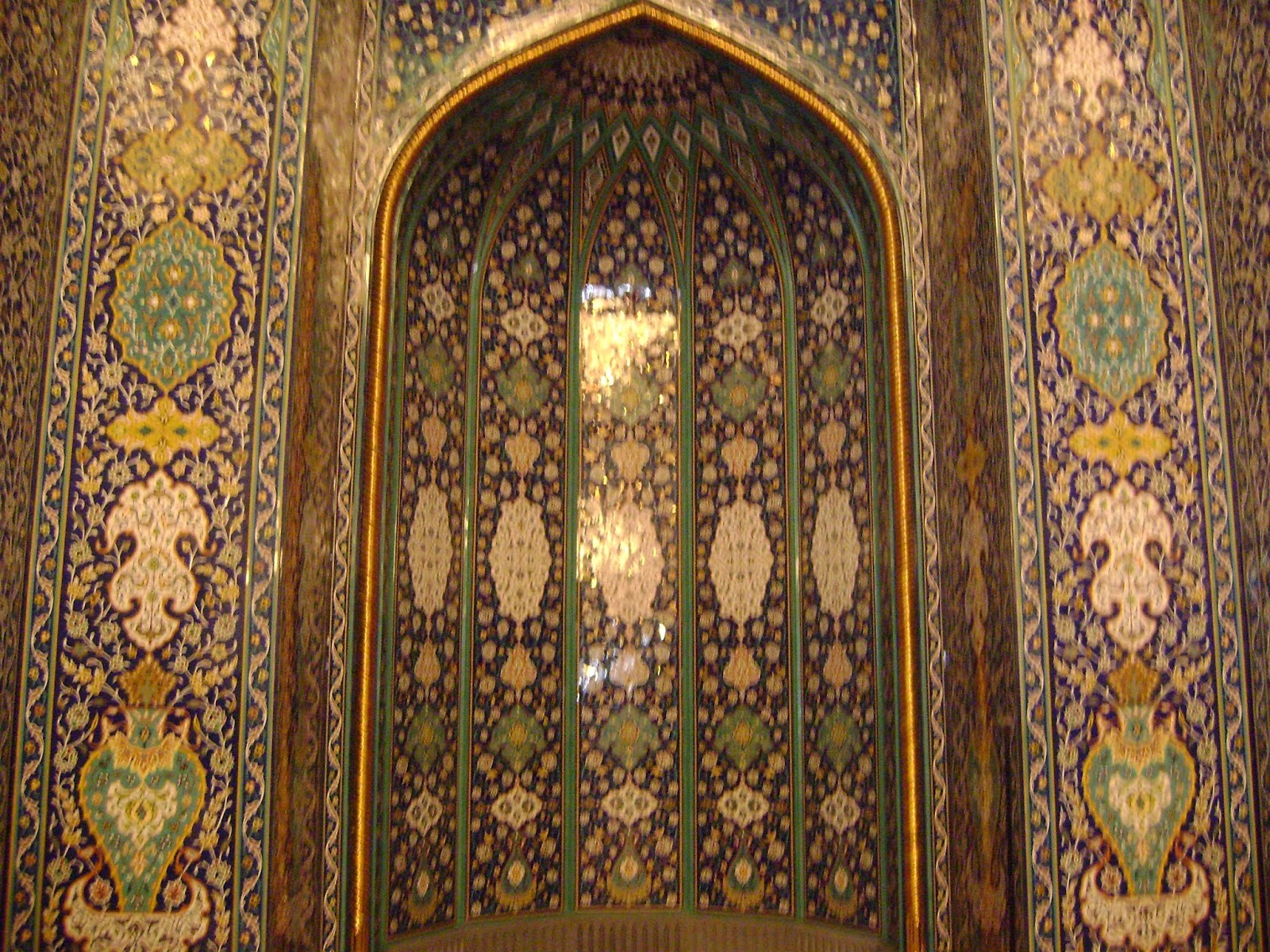
But the Sultan Qaboos Grand Mosque is open to visitors. Non-Muslims are welcome requiring modest, covered-up dress and doffing the shoes. One can only gape at the spectacular interior the massive chandelier, the enormous handwoven carpet, and stunning mosaics. Outside, all around the mosque, are acres of space and gardens, areas for placid reflection and admiring the graceful lines of the architecture.


A central gathering place in Muscat is one of my favourite markets, Mutrah Souk. Colours glow and textures commingle, tempting one to choose a souvenir that will recall the ambience. The stall fronts can be deceptive; behind them, merchants often have a large inventory they will eagerly search to find just want you want. If you look like a serious shopper, they will sit you down and serve you tea. To be sure, haggling over prices is customary, but there's little pressure to make a purchase, as Omanis are generally polite and respectful.


By evening light, traffic seems to hush on the Corniche and the call to prayer echoes across the harbour. Peace. The dhow is another well-loved symbol, the fisherman's traditional boat.
A dhow sits in front of the Sultan's private yacht.


Muscat, don't change! Oman, stay stable!


© 2019 Brenda Dougall Merriman

04 November 2018

Salalah, Oman 2018

The fates were against us on this trip. After five days of serene cruising south on the Red Sea and then through "Pirates' Alley" (halloo, Djibouti, in the distance) in the Gulf of Yemen, we arrived at Oman's agricultural city, Salalah. The air temperature had been slyly climbing to unseasonal heights; nothing is normal anymore in world climates. Combined with excessive humidity, spending much time on deck became uncomfortable to say the least. Perhaps that is why the "beach break" excursion was cancelled for want of enthusiasts. Sitting in scorching sun and sand for hours seemed folly when other excursions would have air-conditioned interludes in a bus or an indoors visit. The real possibility of sunstroke outweighed my regret at the loss of a potential camel ride on the beach.

https://commons.wikimedia.org/w/index.php?curid=276115

Salalah's coastal location, though of desert climate, benefits from mild summer monsoon rain that turns the brown to green and fosters banana, coconut, papaya, and pineapple plantations. Its low-rise architecture is a distinct relief from the unrestrained skyscrapers of UAE cities. The Dhofar region has been famous for millennia for its production of frankincense, that irresistible, aromatic, plant-based resin. The iconic incense burner can be seen everywhere.

So my companion and I took a bus to Al Haffa Souk for browsing, a familiar spot from previous trips and just the right place for gifts. Here was quite the sales pitch for frankincense:

In fact, the aroma became so overpowering in the souk alleys in the stifling heat that soon we opted for cold drinks and coffee in the shaded streetside cafe. Waiting for the return bus, another buddy with respiratory trouble was suffering even more than I was.


What happened next was quite unreal. We and the entire market street were startled by a horrendous metallic crash. Immediately a crowd of men surged into chasing an SUV with a smashed fender that came to a sudden, erratic stop opposite me. An angry-looking young man slammed out of the vehicle to confront the shouts. Fender bender, we thought. Such a busy street. Let's not gawk.

After the chaos began to make sense, we learned that the speeding young man had just run over and killed two of our ship passengers, who'd been unloading from a bus. Third person seriously injured. Smashed the bus door almost off its hinges. And then he had not tried to stop. The outraged crowd that materialized so fast had somehow forced him to a halt.

Police, ambulances, witness interviews; counselling provided for fellow passengers. Terse newspaper reports that the arrested perpetrator not from the Dhofar region they emphasized had been speeding, with no driver's licence! Much later, the survivor who'd lost his wife gave his own account:

Imagine the pall over the remainder of the cruise. This beautiful, peaceful country that I love has its flaws.

© 2018 Brenda Dougall Merriman


11 May 2016

Military and Police Camels

What an excuse for extraordinary photos! In the Middle East, South Asia, and parts of Africa, camels have long served in terrain where a horse could not perform. In fact camels still serve a useful role in strategic army and policing commands.

Probably the most exciting and popular part of India's annual Republic Day parade is the Border Security Forces contingent. You would scarcely believe a 36-piece brass band is included in the camel brigade. True! Even Google did this:[1]
Photo: NPR

Just as incredible is the mounted military pipe band of the Pakistan Desert Rangers. The old Empire has a long echo! In daily life the riders and their steeds are in far less colourful attire, musical instruments safely stowed elsewhere we presume.
Photo: Aamir Qureshi

But wait. Not to be outdone, how about the Royal Oman Police Mounted Pipe Band!?? Purely ceremonial, the band along with its camel cavalry exists to promote cultural traditions. Sultan Qaboos clearly has respect for his educational days at Sandhurst Military Academy and subsequent service in a Scottish regiment of the British Army.
Photo: sickchirpse.com

A photo of the Saudi National Guard eludes me. Qatar has a mounted camel unit, and probably so do several more countries of the same climate and traditions.
Qatar Heritage Police. Photo: www.news.CN

Of course what you are seeing are ceremonial dress uniforms and displays. Everyday routine requires their appearance to be much more suited to their desert surroundings. While some camel units have been replaced by tanks, others have transitioned to public law and order duties with high visibility as tourist attractions.
Jordan Royal Desert Forces. Photo: Warrick Page, NY Times
Photo: camelphotos.com
Photo: BDM
Placing Egypt's mounted police in tourist areas was a smart move. A quiet job, perhaps a bit boring?

Historically, army camels have been known since ancient times, at least from Hannibal's crossing of southern Europe. They were far superior to horses as pack animals in terms of cargo weight and distance coverage. As cavalry, they were equally fast and when couched would serve their riders as gun placements or shade from an unforgiving sun.

Recently a Bactrian camel skelton was uncovered in Austria, believed to be part of the Ottoman army besieging Vienna in 1683.[2]
Photo: BBC
The British became accustomed to using camels in their historic campaigns in Africa, India, and the Middle East. Australian troops formed the first companies.
Imperial Camel Corps Brigade, First World War. Photo: Capt. Douglas G. Pearman
Here is the Imperial Camel Corps's ambulance transport, an amazing photo from http://australiancamels.com/camels-in-war/:

The United States Army imported camels to be pack animals in southwest desert areas, a previous post here. Compare the results to Australia's importation of camels in the same nineteenth century period for similar purposes: Oz now has an explosion of feral camels whereas the American southwest has none. 
US Army Camel Experiment reenactment. Photo: Texas Camel Corps

Interestingly, one Australian police force is bringing camels back for desert patrols after a sixty year hiatus.[3] New South Wales has come full circle.

Camels are familiar to United Nations troops who now serve in missions in countries with demanding equatorial terrain, for instance Sudan and Eritrea.
Photo: http://www.defensemedianetwork.com/stories/camels-at-war/

It seems unlikely that the stolid beasts will be completely replaced by tanks.

[1] http://tech.firstpost.com/news-analysis/google-doodle-celebrates-indias-67th-republic-day-with-bsf-camel-contingent-296624.html.
[2] Jonathan Webb, "Intact Ottoman 'War Camel' found in Austrian cellar," BBC News, Science and Environment (http://www.bbc.com/news/science-environment-32145248).
[3] NSW Police Force, https://www.facebook.com/nswpoliceforce/?fref=nf.


© 2016 Brenda Dougall Merriman