ABOUT THIS BLOG

Showing posts with label Carthage. Show all posts

05 April 2020

Cemeteries - Tunisia


Some cribbing and commingling from a much earlier posts.

Tunisia is a secular country, estimated at 97% Muslim. In 2012 I noted it was the most liberal Arab country I had visited at the time. There I had opportunity to view a Muslim cemetery up close. Burials are generally made within a day of death, avoiding the embalming process that interferes with the body. While all mourners attend the funeral prayers led by an imam, only men accompany the body to actual burial in the cemetery. The deceased are buried on their right side facing Mecca. In general, elaborate grave markers and flowers are not encouraged; prayers are preferred as memorials.


The town of Hammamet is about 60km southeast of the capital, Tunis; a place of lovely beaches for holidayers. Apart from seaside attractions, it has a fascinating medina (old town) dating from the 15th century. After climbing one of the protective walls to enter (on a ramp), one meets a maze of narrow streets zigzagging throughout, bursting into colourful small piazzas of shops and vendors. Photographers’ delight!

A cemetery is located outside the walls along the Mediterranean seafront. Many tombs have traditional mosaic decoration. Here, the customary marker is the representation of a book: the left hand page identifies the individual with name and dates; the right hand side has a quotation from the Koran. Grounds maintenance does not seem to be a priority. We saw litter dumped in one section. A small Christian cemetery is nearby with many Catholics of Italian origin.


Some years ago, preparation for new construction in Hammamet unearthed an extensive Roman necropolis among remnants of the ancient settlement known as Pupput. We did not see that particular area, but signs of the old Roman occupation are everywhere across the country. Many museums exhibit excavated burial markers – stelae – and funerary objects, some as old as the 1st century AD. Most stelae commend the departed to the pagan household gods (dis manibus sacrum – DSM). They usually give the person's name, age, parents, status, and name of the person who erected the stone. Date of death does not seem to be the norm! That the inscriptions have survived so long is likely due to being covered by soil as new communities developed on top of them – inadvertent conservation.

Two photos above at Sousse Museum
Even older! Near the ruins of Carthage, that legendary city ultimately defeated and ruined by the Romans, parts of the excavated Tophet cemetery show stelae from the time of Carthage’s great power BCE. These were all child burials; the indicative geometric sign appears often. I diligently took many photographs, only to learn later my new SIM card was corrupted. The two photos below are thanks to Atlas Obscura and the individual photographers who shared.

by Patrick Giraud
by Dennis Jarvis
Tophet has long been a locus of serious controversy; scholarly and scientific researchers debate whether it was a place of infant sacrifice. My discovery of a blog called Bones Don’t Lie was serendipitous; here’s a great discussion:


The city of Kairouan ‒ inland but still considered coastal region – with its Great Mosque is Tunisia's spiritual centre. In fact, the Great Mosque there is the holiest Muslim site in Africa; the original portion is from the 9th century. Overall it is the fourth holiest site for (Sunni) Islam after Mecca, Medina, and Jerusalem.

In the courtyard

Outside the walls of the medina can be seen (with the mosque's minaret in the background) the small old Ouled Farhane burial ground named for the tribe that had once requested this location close to the mosque. I can’t ascertain when the burials began or the age of the stones. All inscriptions have long vanished over time and whitewash is the only memorable feature.


And then to modern times. A visit to the small town of Monastir included the mausoleum of Habib Bourguiba (1903-2000), the enlightened and revered father of modern Tunisia. He became the first president at the time of independence in 1956. Among other reforms such as banning the burkha and niquab, Bourguiba instituted universal health care and compulsory education up to full high school level. A processional avenue leads up to his grandiose monument with its golden dome, within the town's extensive el-Mazeri cemetery.

The interior has private rooms for family visitors and a public room serving as a small museum of Bourguiba’s life. Separate rooms have comparatively plain burial slabs for members of his and his second wife's extended families.


Thus, the deceased provide quite the contrast in time periods, cultures, even empires, in one rather small country.


© 2020 Brenda Dougall Merriman

23 March 2015

Phoenician Cities, Tunisia, 2012

Terrifying and incredibly sad, the recent slaughter of tourists in Tunis (March 2015) at the Bardo Museum. Weep for the victims and the senseless barbarity. Tunisia was the spark point, literally, of the Arab Spring in late December 2010 with Mohd Bouazizi's self-immolation protest against authoritarianism. Of all their neighbours in the Mahgreb and beyond, Tunisia has progressed best as a model for reform.
And now this.


A wonderfully picturesque country with an abundance of UNESCO-designated World Heritage Sites, Tunisia was once a location for Phoenician (Romans called them Punic) seacoast towns, established during their mastery of the Mediterranean trade world. We made visits to two of them.


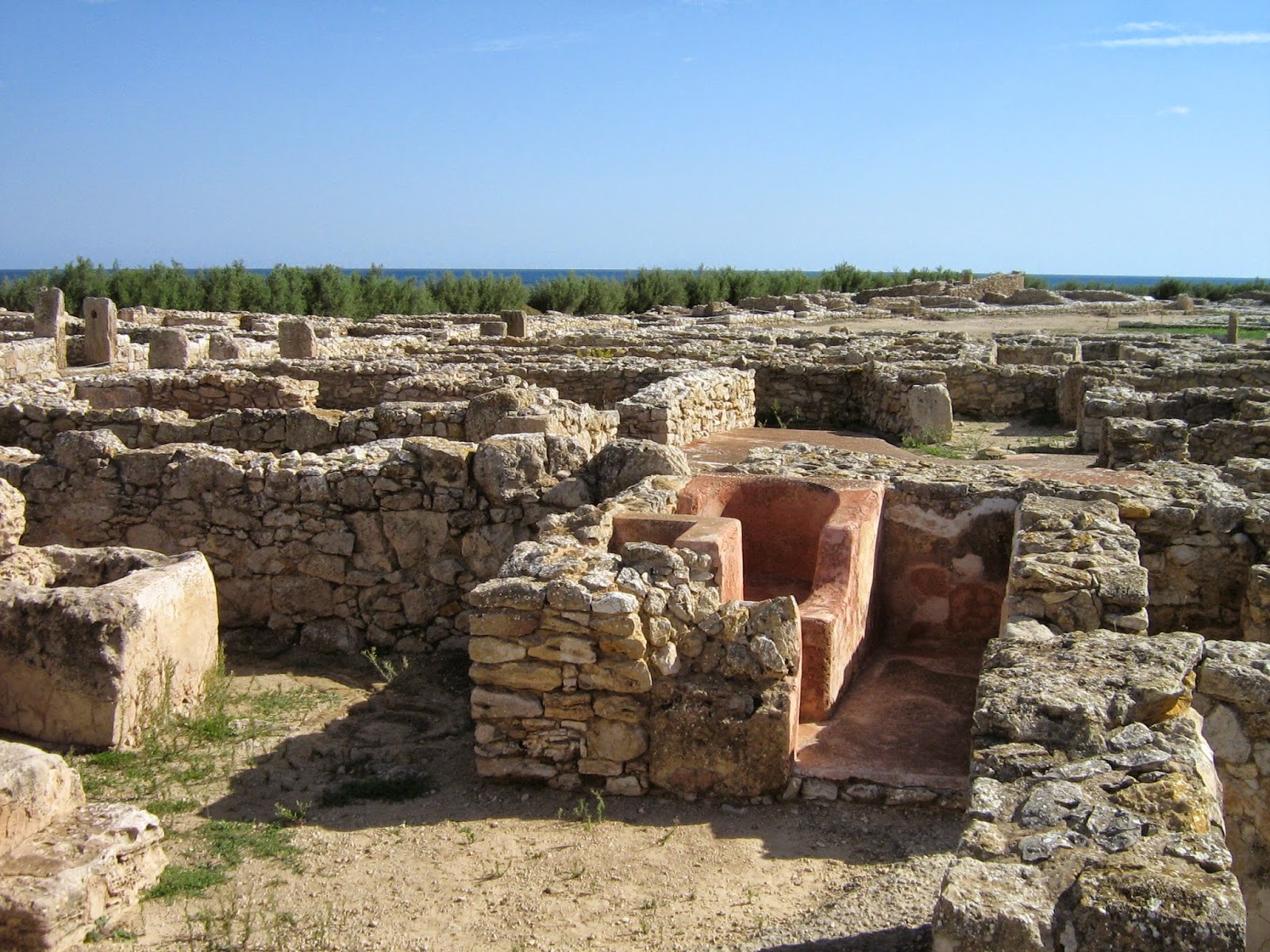
Kerkouane was a fourth century BC Phoenician town discovered in its entirety only about sixty years ago. An exciting, unique find because Carthage itself was purposely destroyed by the Romans and all other Punic cities were built over. The ruins at Kerkouane tell us more than we ever knew about the ancient Phoenicians. Theirs is a history still under study but they are thought to have originated in Canaan. They were known for being brilliant traders, merchants, and navigators, becoming the Mediterranean colonial power for seven hundred years BC. Cartagena in Spain is but one of the towns they founded; that is where Punic warrior Hannibal set out on his famous but failed attempt to conquer Rome.


Splendidly situated on Cap Bon peninsula overlooking the sea, Kerkouane had an estimated population of 2,500 (ca.500-200 BC). We can see sophisticated house plans, bathing and water facilities, and at least one temple to a triangular-depicted goddess. Conspicuously revealed after excavation were the mosaic floors and reddish-cement hip baths, each house having its own well. Note to self: The mosaic tradition obviously pre-dated the Romans. This town's major industry was creating the purple dye (sometimes called Tyrian purple) for which Phoenicians and Carthaginians were renowned. It comes from rotting murex shellfish and was highly valued. Kerkouane was abandoned, likely after the First Punic War.


The small associated museum was unfortunately closed. We did not fully explore the adjacent cemetery or tombs that raise debatable points being discussed by scholars ― whether the found remains of children indicated sacrifice of the first-born male child or merely the burial of stillborn children (the point came up again around Carthage). Departing on foot from the site entailed walking on the wild side for acrophobes: a narrow path along a cliff face high over the sea with a flimsy, haphazard railing.


Two weeks later in Tunis, we headed for the ruins of Carthage where I had EPIC CAMERA FAIL all day, unknowing at the time. On our way to the old harbour we passed the Tophet cemetery covered with Punic stelae (similar to examples we saw in the small, outstanding Sousse Museum). Tophet is a "reference to the biblical term which indicated the site where the Canaanites sacrificed children by burning them alive."[1] Ashes of babies, children, and animals were uncovered here ― encountering the same argument about Phoenician child sacrifice or burial practices.

Examples of pre-Christian stelae, Sousse Museum

Carthage was the Phoenician capital city, legend says founded by Queen Dido in 814 BC. Carthage was so powerful that the Romans, on finally winning the Punic Wars, decided to raze it utterly in 146 BC. They kept it under siege by sea and land for three long years and the weary citizens had lost all hope. What we know about that event comes from the second-century historian Appian. The Roman orders to eradicate every inhabitant and their homes was brutality in the extreme. Our guide Mehdi read us Appian's description of the Romans burning and killing. The fire burned for seventeen days and left a layer of ash over four feet deep. Watching, the victorious Roman general Scipio is said to have had a premonitory chill: 
"This is a glorious moment, Polybius; and yet I am seized with fear and foreboding that some day the same fate will befall my own country.''[2] 

Chill indeed ... Roman Carthage declined dramatically after conquests by Vandals and Arabs; much of the old Roman stonework was used to build the Tunis medina. Obviously no country, army, tribe, or ideology has a monopoly on war and slaughter.

Carthage from Byrsa Hill; credit: www.tunisien.tunisie.com

Now, a wealthy, desirable residential area surrounds the extended excavation areas. We are aware that the most visible ruins are Roman, from the city Julius Caesar built one hundred years after the carnage. The scattered ruins can be viewed from several points; Byrsa Hill was the one most relevant to Carthage, discovered by chance in 1921 under layers of soil and ash. Here we see some basic foundations and bits of Carthage houses that only survived because of Roman infill at the time. Most houses were multiple storeys when they existed. And as we saw at Kerkouane, they had excellent facilities for water and drainage. Byrsa was the terminus of Emperor Hadrian's later aqueduct, longest in the world, coming from a southern mountain near Zaghouan. A small museum displays artifacts from different periods ― Punic, Roman, Christian.

Preparing to depart the site, in the parking lot I am drawn to some burnt-out car wrecks, colourfully painted, pushed off to one side. Mehdi tells me they were burned during last year's revolution. Intuition flashed that this was no aimless display of graffiti. I did not know then that it had become one means of popular demonstration. Here was a visual, accessible, tactile medium whereby ordinary people had expressed their political outrage. "DÉGAGÉ!" ("Leave!") shouted one hulk prominently ― the chant the crowds chorused repetitively at Ben Ali. And leave he did. Peacefully. Such great regret at my lost photos! A few photographers did capture pieces of the phenomenon, although not my particular parking lot.[3]

Well, we went on to see the ruins of the Roman (Antonine) baths at the sunny seashore. But the present was with me, overriding imagined Roman indulgences and even the doomed Carthaginians.

 One Tunisian I spoke with felt that a single man – Bouazizi – should not be over-memorialized as the face of heroism when so many took part in the freedom protests. I can't say enough about the variety of this beautiful country. Hopefully today Tunisians have the strength to vanquish the terror-mongers.


[1] "Carthago (Carthage): Punic memories," A Rome Art Lover's Web Page (http://romeartlover.tripod.com/ : accessed 20 March 2015).
[2] "The Destruction of Carthage," Hannibal Barca and the Punic Wars (http://hannibalbarca.webspace.virginmedia.com/carthage-destruction.htm : accessed 19 March 2015).
[3] Ben Miled Zied, "Burnt out cars ...," 21 March 2011, Demotix (http://www.demotix.com/news/1580613/burnt-out-cars-turned-artistic-pieces-tunisian-revolution#media-1580588. "Intervention on cars burnt ...," Nafas (http://universes-in-universe.org/eng/nafas/articles/2011/emancipated_art/img).

© Brenda Dougall Merriman. All rights reserved.