With
enormous anticipation, I was about to see some of the Empty Quarter
(Rub el Khali), the world's largest continuous sand desert and
what many consider the most unforgiving.
Bruce
Kirkby's Sand Dance:By Camel Across Arabia's Southern Desert
had absorbed me.[1] Possibly
the most beautiful book I’ve ever seen; the photographs are
gorgeous. Not to pretend yours
truly will be or ever was up to anything like a safari for days,
weeks, of gruelling survival. In 1999 Kirkby and his companions the
Clarke brothers followed in the footsteps (the camel tracks, that is)
of Sir Wilfred Thesiger who twice crossed the desert in the late
1940s. No other westerner had recorded such travel since; the 1999
journey from Salalah in Oman through Saudi Arabia to Abu Dhabi in the
United Arab Emirates took them forty days.

Instead,
my tiny journey is from Salalah by jeep to "the lost city of
Ubar." Luckily for me, the attractive but slightly
sinister-looking driver Mahmed motioned me into the front. Three
people were squashed into the back seat. Mahmed and I were quite
satisfied with this arrangement of due propriety, casting
surreptitious glances at each other from time to time to confirm the proximity of the exotic other person. English is taught
in Omani schools but this man was silent which was fine with me. Back
seat engages in chattering away, much jollity, but I can't always
hear them over the jeep noise and visual distractions, difficult to
participate.
We have
a flat coastal ride across the north edge of town to climb the hills
where the scenery resembles northern California. The infrastructure
and highways are great. Of course: oil riches. Sultan Qaboos of Oman
is revered for his wise decisions in modernizing this new Bedouin
nation. They have universal education, health care, and so on. It's
encouraging that Salalah, a small city, does not have the ugly
skyscrapers of other cities in the Arabian
peninsula.

Up on
the plateau, we stop at a gasoline service centre where the four
drivers inspect the tires and gas up. And smoke. Mahmed is seldom
separated from his pipe. I note with approval that none of my dozen
fellow tourists are in embarrassingly immodest dress. We load up with
water and juice. A local in a leather jacket tells me that the
Bedouin are so accustomed to the heat that this early morning,
already in the high 80s(F), feels chilly to him. Then again, he had
slept in the desert last night when the temperature plunges
dramatically. Mahmed disappears as our group prepares to leave; back
seat squashee says I scared him off by talking so much (not). Like I
said, the back seat is a fun bunch.
Driving
north, the landscape again becomes totally flat approaching the Empty
Quarter. We drive and drive and drive, straight road in a vast
emptiness. Only a few loose camels are a sign of life. Then we turn
off and go west. Pass a village (I blink, hard to imagine in this
emptiness) that Mahmed indicates as Ubar. We don't stop. We take a
dirt road for miles and miles. Some irrigation farming going on here
but no obvious human life. All this is in the Dhofar province of
Oman.
Then we
turn onto a sand "road," north again. This is the
Empty Quarter. Drive more miles and miles, on flat, rocky sand. Has
it been hours? We pass the temporarily deserted Empty Quarter Camps
(Comps says the sign that back seat squashee obligingly
captures).
Stop
for a few minutes, the sun is baking and we gulp water. The drivers
are deflating the tires. I know what that means. It's time for them
to compete with each other at racing over the ruts in the sand, up
and down the increasing hills. Dune bashing. It's a mystery to me why
this body-pounding, cross-country racing should be an obligatory
tourist experience, except the drivers themselves take great glee in
it.
Unusual
vegetation appears sporadically, a low sprawling plant with
apple-like fruit. Later I learn what it is: al ashkar, or
Calotropis procera, aka Adam's apple or Dead Sea apple -- thank
you, Dubai Museum and Wikipedia. The root and leaves are used to treat a wide
variety of medical disorders.
Suddenly
we encounter the dunes. Huge. Endless. Dunes. This is our ultimate
destination. So different from the flat rocky sand we've been driving
through. The overbearing sun bleaches everything. Some of our group
climb the nearest one. Climbing in soft sand is incredibly difficult
and I'm not crazy. What I need is a camel to mount this dune, any
dune, as I bemoan to any driver who will listen to me. They think I
am funny.
Back to the "Comp" for a box
lunch. Pita sandwiches, tea, soft drinks, and a big chocolate cake
that looks totally alien in this setting. The tent gives shade from
the blistering heat. The tea is recommended for those wilting from
the relentless sun. Campers who come to this spot are usually away
during the day, exploring the secrets of the desert.
The drivers come to sit by me. Friendly
bunch, some eager to try a bit of English. They are not as
"conservative and reserved" as one of our lecturers said,
maybe because they're in the tourist industry. They are all Bedouin,
as are all true Omanis, a new century slowly transforming them. We
decide to compare and pool our sandwiches; they demonstrate their
appreciation of the yoghurt and soft drinks. A bit surprisingly, the
toilets are western-style here in the wilderness.
Then we race to back to Shisur, that
village we had passed. Once in a while a car passes us going the
other way, a bit of mad honking. Mahmed, perhaps encouraged by the
openness of his colleagues at lunch, delights in calling out to all
of us "Crazy man!" each time. He's a good driver; the
vehicles are comfortable and well-kept. He played Arab pop music all
day on the radio to my immense satisfaction; thumbs up works
well in any language.
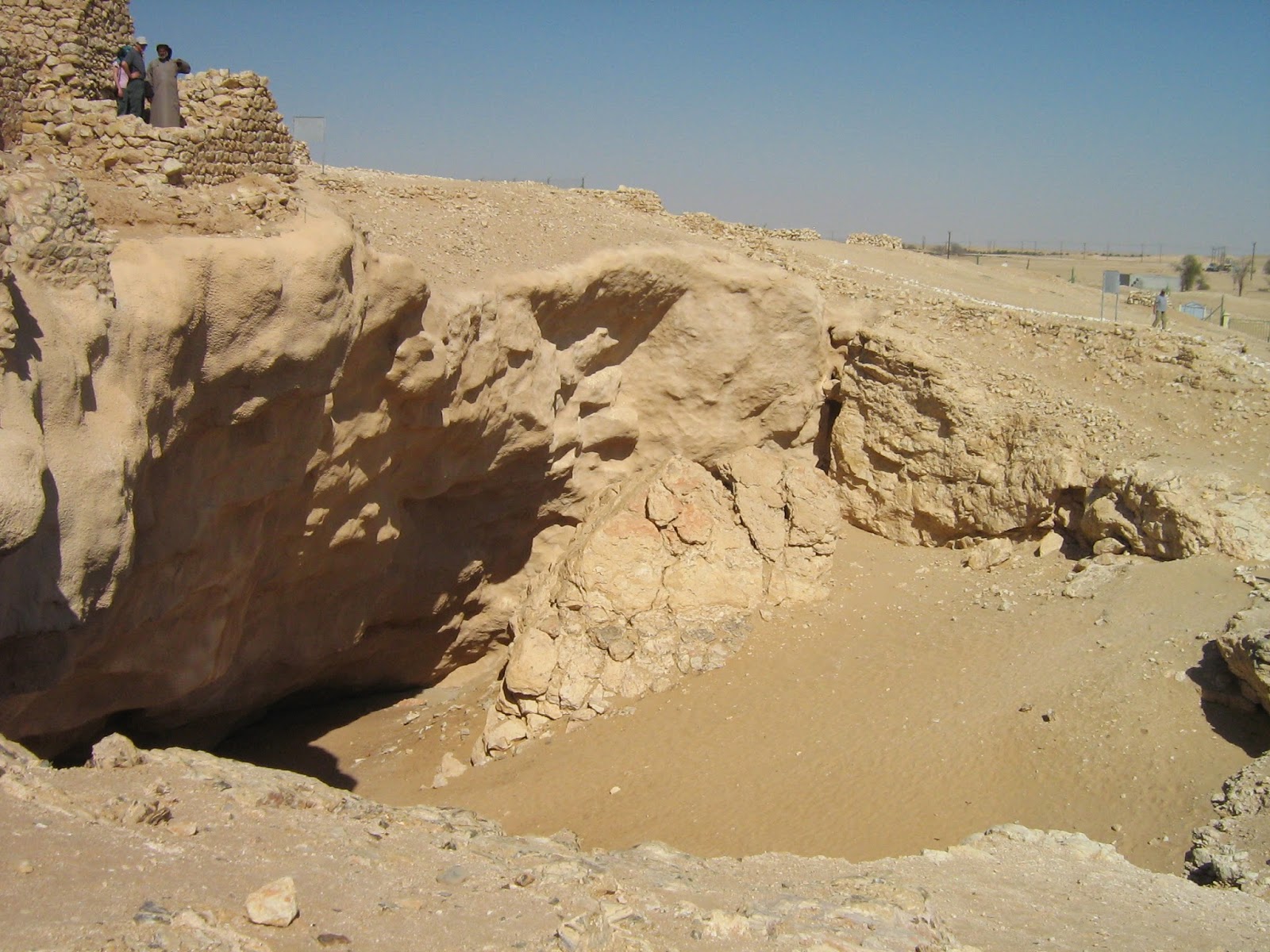
Beside the village
we have our walking-around time to see remnants of the
lost-and-found city of Ubar. Most of it fell into a sinkhole over two
thousands years ago. A well had provided the basis for a thriving
site in an inhospitable environment. Drifting sand dunes and later
stone structures obscured the site. Satellite images, just over
twenty years ago, along with ancient maps, finally helped
archaeologists pinpoint the location beneath the sand. Sought by
explorers for centuries, the city's reputed wealth was due to its
trading position on the incense caravan route. When archaeologists
began digging here by the village of Shisr, they revealed a wall and
towers dating back two thousand years.

What we can see are crumbling stone
remains on the edge of the chasm, and partial excavations. Signage is
up at various viewpoints, not always clearly explanatory. As a member
of the first working team, Ranulph
Fiennes described the find in his Atlantis
of the Sands[2]
but
a slew of experts still argue whether this place is historical Ubar,
or another ancient city. The name Ubar may have represented a tribe,
or a region, not a specific city. In 1997, chief archaeologist on the
original expedition, Juris Zarins, said:[3]
While
surveying oases in the Dhofar region our team discovered red- and
black-polished ceramics of the classical period (after 300 B.C.).
Based on these finds, we became convinced that a road at the edge of
the Rub al-Khali was linked to ancient urban centers mentioned in
classical sources and Arab histories. We chose to study Shisur, a
ruined city some 90 miles northwest of Salalah on the edge of the
desert. A permanent spring there had attracted people since the
Neolithic (ca. 5000-2500 B.C.), and a fortress first built during the
Bronze Age (2500-1300 B.C.) was in use until A.D. 1500.
Zarins'
conclusion?
Herodotus,
Pliny the Elder, Strabo, and other ancient authors, though not
specifically mentioning Ubar, gave brief accounts of cities in
southern Arabia that marketed resins from frankincense and myrrh
trees. While it is certain that people of the Dhofar area grew rich
trading these commodities, it would appear that the city of Ubar was
an Arabian Nights
fantasy.
Unfortunately
the little museum is closed! The
government has built new facilities at the village for the Bedouin,
fewer and fewer of whom live the old migratory desert life.
After the long way back to Salalah,
visiting the frankincense tree park is a denouement to a thoroughly
amazing day. In the park, many stairs up and down. Although the sun
is at half-mast by now, we
are pretty well knackered.
Mahmed has been waiting for me to
notice that he drank one of my lemonade bottles. When I scrabble
around the front seat looking for it, he grins and gives me a bottle
of water.
At the security checkpoint to the port
I take a photo of the port sign through the windshield as the
policeman checks with Mahmed. Back seat immediately hisses at me: no
photos! no photos allowed! Too late. I wasn't aiming at the cop;
never crossed my mind. Clearly we are back in the modern day after
an almost dream-like lull in a fabled land.
One of
Kirkby's companions, Jamie Clarke, was the instigator of their epic
journey. He too wrote a similar book.[4] The
logistics in planning and execution of such an arduous camel trip
seemed insurmountable sometimes. They came close to perishing,
totally dependent on the innate and sometimes inscrutable skills of
the Bedu.
Forty days in the Rub el Khali is an endurance
test incomprehensible to any but those of the most romantic and
resolute obsession.
There's
no comparison but one memorable day―in
relative comfort―helped
fulfill girl dilettante's compulsive leanings. And reinforced
admiration for those who dare.
[1]
Bruce Kirkby, Sand
Dance: By Camel Across Arabia’s Southern Desert
(Toronto,
ON: McClelland & Stewart Ltd., 2000).
[2]
Ranulph Fiennes, Atlantis
of the Sands: The search for the lost city of Ubar
(UK: Penguin, 1993).
[3]
Juris Zarins, "Atlantis of the Sands," Archaeological
Institute of America journal Archaeology
(http://archive.archaeology.org/9705/abstracts/ubar.html : accessed
28 May 2014).
[4]
Jamie Clarke, Everest to Arabia: The Making of an Adventurous Life
(Calgary, AB: Azimuth, Inc., 2000).
©
2014 Brenda Dougall Merriman. All rights reserved.


