ABOUT THIS BLOG

Showing posts with label Egypt. Show all posts

08 April 2019

MOVIES Part Three


Highly opinionated comments on movies that have some aspect of camels or desert. Continued from MOVIES Part One and MOVIES Part Two. You know you can click on those links, right?


The Sheltering Sky
Debra Winger and John Malkovich seek isolated places in the Sahara to find? avoid? remedy? their hollow relationship. I never liked Malkovich but he's bearable here, till he gets typhoid and takes far too long to die. She ‒ restless, dazed, possibly nuts ‒ wanders off, meets a camel caravan and one mishap after another. Appropriately acclaimed for its gorgeous cinematography, it's Bertolucci-directed, but Paul Bowles' aimless existentialism and characters leave me cold. Partially filmed in several Morocco locations.


Babel
OK, 'fessing up. Only watched the one-third (or so) that takes place in Morocco (and actually filmed there in studios I visited in 2017). A sad, harrowing tale of little boys playing with a gun and how far the consequences reach — in a random universe, we all have a degree of connection to everyone else. Brad Pitt does a more than creditable job; it was agony watching/waiting for Cate Blanchett to die.


Sahara
Pure treasure hunting good fun, and camels! Mathew McConaughey performs as Clive Cussler's action hero Dirk Pitt in an improbable story of a search for a missing Civil War-era iron battleship, supposedly sunk upriver in what would be Mali(!). Great camaraderie interaction with supporting actor Steve Zahn. Penelope Cruz plays the trusting wench, albeit a humanitarian doctor; no one dies except the bad guys. Yes, some filming in Morocco, more in Spain, 2005.


Sand and Sorrow
George Clooney's activist side narrates (and produced) this documentary of the humanitarian crisis in Darfur - a province in Sudan - largely being ignored by the rest of the world. Government-directed genocide of "non-Arab" civilians, millions of people still displaced and unsafe even years after the doc was made (2007). Killing and burning. Very difficult to watch.


P.S. I loved you once, George, but I can't forgive you for the NescafĂ© ads. 


The Story of the Weeping Camel
Oh — what a slice of life in rural Mongolia! Absolutely enchanting. This 2003 docudrama is available online. Of course it's the Gobi desert where, in the midst of their daily life, a nomad family tries to save a baby camel rejected by its mother. The effort requires special attention with traditional customs and music. Deeply moving and joyful.


Letters from Baghdad
A documentary of 2016, Gertrude Bell's letters speak to her adventures and British service in Arabia prior to and during the First World War. As much or more than the more celebrated T.E. Lawrence, Bell helped shape Middle East alliances and policies. Less attention is paid to her archaeological accomplishments and her founding of the renowned Baghdad Museum. Produced and voiced by Tilda Swinton as Bell, the film is rich with archival footage and Bell's own photographs, with contemporary commentary from the many historical figures she met or worked with. Extremely well done.


The Little Prince
Aside from unable to grasp the wispy little voices of child characters (uneven sound?) half the time, I could not make much sense of it. Maybe because it's so French? Same trouble with the book, moi, long ago. This new adaptation (2015) includes a darling little girl who, in searching for the Little Prince, sees the worst of grown-up behaviour, assisted by the incredibly ugly but kind Aviator. The Sahara makes a brief appearance along with an enigmatic fox and a snake. The Little Prince himself did not impress me. See with your heart seems to be the message, but it's enough to know that the twinkling of stars means happy laughter.


Cairo Time
A romantic side of Egypt, of Cairo (2009). Juliet arrives in the city to meet her husband who remains absent in Gaza until the end of the film. Husband's good friend Tareq escorts Juliet in sightseeing, a mutual attraction building. Ultimately, consummation is thwarted. Flimsy story, but the scenes of Cairo are wonderful, so many places I've been. ... I know he's acted in Star Trek and Syriana and numerous films or stage productions, but why can't we see MORE of hunk Alexander Siddig who played Tareq?!


Keep those movies coming ...


© 2019 Brenda Dougall Merriman


25 February 2019

Ships of the Desert (for real)


There ARE some. Real ships. Found in natural desert areas or in humanity-devastated deserts.


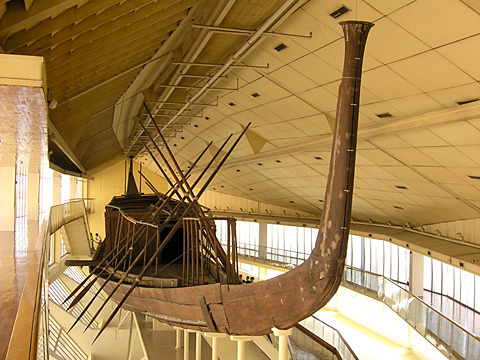
In 1954 in the ancient Giza plateau of Egypt, archaeologists discovered the solar boat of Pharaoh Khufu. Almost 5,000 years old, the ship had been buried in a pit covered by enormous stone slabs. In a dismantled state, it took years of painstaking reconstruction. Although this solar boat was not the only one known or found, it is the oldest and best preserved. Its location at the foot of the Great Pyramid indicates its dedication to Khufu.


Why "solar"? Well, it's been determined it is not a funeral vessel:
"Despite its exemplary design, it was not intended for sailing or any other use on actual water. Dedicated to Khufu (King Cheops), the second pharaoh of the Fourth Dynasty of the Old Kingdom of Egypt, the Khufu ship was most certainly a ritual vessel."[1]


You can see why it took years to reassemble, finally being put on display in the 1980s in a special building. Restoration experts had to carefully study ancient shipbuilding The boat symbolizes the travels of the sun god but all the mysteries have not been understood or interpreted yet.


A different place, a different story.


The Aral Sea in central Asia was the fourth largest fresh-water lake on the planet. Scenes like this, of abandoned fishing boats, have been common in the past forty-fifty years. In the late 1950s Soviet engineers began diverting the two great rivers that fed the sea, in order to construct an enormous irrigation system for the agricultural steppes of Kazakhstan and Uzbekistan.


As a result, the Sea dried up at a fearsome rate until only small lakes remained of total volume less than 10% of its original size. Once providing one-sixth of the Soviet Union's entire fish industry, jobs were lost, prosperous towns died, people migrated. Not to mention the ecological effects.
"As a result of the drying over the past decades, millions of fish died, coastlines receded miles from towns, and those few people who remained were plagued by dust storms that contained the toxic residue of industrial agriculture and weapons testing in the area."[2]

The good news is that restoration attempts since 2005 by a World Bank-financed project are making some recovery in the northern section. Replenishing fish stocks has been successful there.


What anthropogenic havoc we wreak on our beautiful planet!


1. http://www.bbc.com/travel/story/20180510-the-egyptian-boat-buried-for-5000-years

2. https://news.nationalgeographic.com/news/2014/10/141001-aral-sea-shrinking-drought-water-environment/


© 2019 Brenda Dougall Merriman

08 February 2017

Safaga, Egypt 2014

Noon-ish: Into Egypt's eastern desert I go again. Big 4x4 jeeps. I know, I'm a masochist. Three people allocated for each side bench, unlike some previous squished trips. With no side doors, getting UP over the high tailgate is an athletic and ungraceful adventure in itself. My companion "S" and I settle ourselves to observe the company with satisfaction. Until the sixth passenger is hoisted into the vehicle with the assistance of the driver and our leader. The man is not only tall and broad, he is unfortunately, grossly overweight. He slowly unfolds into place, filling most of one side. His core density is such that his appendages shoot out helplessly in all directions so the rest of us are forced to adapt (scrunch). S does not look happy with the knees of his own long legs around his ears.

The excursion promises a thrilling desert sunset on the return. A perfect ending for a camel ride from the village we are about to visit. Once we have climbed the heights, the route quickly turns off the highway onto a sand road. After an uncomfortable cramped hour or so, I have dèja vu. Yes, there is the lonely tree I remember from last year. Good, we pile out to see if our joints are still working and hear about desert flora. That means we have to make the jeep re-entry. S tries to claim leg space right off the bat but Number Six sprawls opposite, arms and legs akimbo. The third man in our group looks very ex-military and never says a word coming or going.

The familiar Um Dalfa welcoming committee awaits. We can hardly wait to unload. And of course, the customary serving of refreshing mint tea ... with reference to Bedouin courting customs. If a potential bride adds sugar to the tea she serves the young man, it means she accepts his offer of marriage.
... while our leader gives us the introduction to a tour of the village. I am, of course, peering everywhere for the camels. As soon as I can get his attention, he tells us in no uncertain terms there will be NO camel rides. OH! This particular tour operator had a recent incident with a tourist injury, falling off a camel, and so they will not risk it again. My luck! For sure, an insurance company must be involved. Crushed, I obediently resign myself to following the village tour.

The women show us bread-making.

This is the village mosque that I never realized existed in last year's tour.


I have to settle for admiration without being seated on an animal. No sign of Hassan or his mother whom I'd met the year before. Then for reasons unknown, the tempo of the visit accelerates as our tour leader hustles us along to depart.


Minimal time for the crafts display. No time to chat with the vendors and browse the goods or handle the shawls and carpets. Why are we being so rushed? Some women linger, wishing to buy, but tour leader busily motions everyone onward. Few sales take place; not a happy ending for the villagers or us.

The villagers' goodbye song gets short shrift while a couple of stragglers are still trying to pay for purchases. I suspect the tour's timing was tardy from the beginning. What a difference from last year. Once more we heave ourselves into the damn jeep. After five of us take what we think are strategic spots, Number Six is heaved in last, expanding in our space like a full-blown airbag. So much for tactical planning. No-one resents his opportunity for world travel, just could the Jeep Planning have been handled a little better? There is no break for relief on the way back for two plus hours. Long legs are trapped whichever way we wiggle.

Here behind us is the missing sunset of the "sunset excursion." In fact the sunset is never mentioned; no photography stop. Those of us who can actually move our upper bodies try for camera shots through the back window. All in all, this poorly organized tour operator is not recommended. Win some, lose some.

Later, my companion refers to Number Six as a portly man. S is obviously a well-mannered, polite person. Except for the ferociously painful face he made in the recall.

© 2017 Brenda Dougall Merriman


11 May 2016

Military and Police Camels

What an excuse for extraordinary photos! In the Middle East, South Asia, and parts of Africa, camels have long served in terrain where a horse could not perform. In fact camels still serve a useful role in strategic army and policing commands.

Probably the most exciting and popular part of India's annual Republic Day parade is the Border Security Forces contingent. You would scarcely believe a 36-piece brass band is included in the camel brigade. True! Even Google did this:[1]
Photo: NPR

Just as incredible is the mounted military pipe band of the Pakistan Desert Rangers. The old Empire has a long echo! In daily life the riders and their steeds are in far less colourful attire, musical instruments safely stowed elsewhere we presume.
Photo: Aamir Qureshi

But wait. Not to be outdone, how about the Royal Oman Police Mounted Pipe Band!?? Purely ceremonial, the band along with its camel cavalry exists to promote cultural traditions. Sultan Qaboos clearly has respect for his educational days at Sandhurst Military Academy and subsequent service in a Scottish regiment of the British Army.
Photo: sickchirpse.com

A photo of the Saudi National Guard eludes me. Qatar has a mounted camel unit, and probably so do several more countries of the same climate and traditions.
Qatar Heritage Police. Photo: www.news.CN

Of course what you are seeing are ceremonial dress uniforms and displays. Everyday routine requires their appearance to be much more suited to their desert surroundings. While some camel units have been replaced by tanks, others have transitioned to public law and order duties with high visibility as tourist attractions.
Jordan Royal Desert Forces. Photo: Warrick Page, NY Times
Photo: camelphotos.com
Photo: BDM
Placing Egypt's mounted police in tourist areas was a smart move. A quiet job, perhaps a bit boring?

Historically, army camels have been known since ancient times, at least from Hannibal's crossing of southern Europe. They were far superior to horses as pack animals in terms of cargo weight and distance coverage. As cavalry, they were equally fast and when couched would serve their riders as gun placements or shade from an unforgiving sun.

Recently a Bactrian camel skelton was uncovered in Austria, believed to be part of the Ottoman army besieging Vienna in 1683.[2]
Photo: BBC
The British became accustomed to using camels in their historic campaigns in Africa, India, and the Middle East. Australian troops formed the first companies.
Imperial Camel Corps Brigade, First World War. Photo: Capt. Douglas G. Pearman
Here is the Imperial Camel Corps's ambulance transport, an amazing photo from http://australiancamels.com/camels-in-war/:

The United States Army imported camels to be pack animals in southwest desert areas, a previous post here. Compare the results to Australia's importation of camels in the same nineteenth century period for similar purposes: Oz now has an explosion of feral camels whereas the American southwest has none. 
US Army Camel Experiment reenactment. Photo: Texas Camel Corps

Interestingly, one Australian police force is bringing camels back for desert patrols after a sixty year hiatus.[3] New South Wales has come full circle.

Camels are familiar to United Nations troops who now serve in missions in countries with demanding equatorial terrain, for instance Sudan and Eritrea.
Photo: http://www.defensemedianetwork.com/stories/camels-at-war/

It seems unlikely that the stolid beasts will be completely replaced by tanks.

[1] http://tech.firstpost.com/news-analysis/google-doodle-celebrates-indias-67th-republic-day-with-bsf-camel-contingent-296624.html.
[2] Jonathan Webb, "Intact Ottoman 'War Camel' found in Austrian cellar," BBC News, Science and Environment (http://www.bbc.com/news/science-environment-32145248).
[3] NSW Police Force, https://www.facebook.com/nswpoliceforce/?fref=nf.


© 2016 Brenda Dougall Merriman

24 October 2015

Alexandria, Egypt 2008

Fabled city (in my mind), highly anticipated. Alexandria on the Mediterranean, former seat of empire-builders and scholars. Our departure from Cairo is ill-timed at rush hour; it was a relief, though, to leave the worst day of brown fog pollution and rush hour traffic. Our guide Sameh gives us an occasional perfunctory comment on the passing scene. Which happens to be the rich delta lands of the Nile. We figure out ourselves that the odd towers scattered in the countryside are pigeon-cotes, long cultivated in Egypt. The three-hour bus trip turns into five (why did we not take the train?!).

Well after dark we arrive at our hotel steps away from the seafront and across from the main park. The Cecil is a faded Euro-style hotel with some nice touches of grandeur leaning towards the seedy side as if against its will. So well situated, and the ambiance pleases us. Many past celebrities stayed at the Cecil in its heyday, something like the Shepheard in Cairo judging by their signatures displayed on a wall, lots of Brit and Swedish royalty.

The two elevators are small and quaint, reminding me of a favourite hotel on the left bank in Paris. Travel buddy and I get crammed into one elevator with fellow travellers Marty and Ken and our baggage. Way too much to handle, apparently, because elevator decides to descend to the basement and stick there, door firmly closed. Marty panics, pushing every button and sweating. It's a bit soon for claustrophobia as our whereabouts are obvious to dozens of people waiting, but it seems like a good idea to talk calmly to him; he's using up all our oxygen. Some hotel official bangs away outside in the rescue effort. We doubly appreciated a late drink on our tiny balcony overlooking the Corniche, a boulevard along the sea typical of most Mediterranean cities.

Out in the morning for our condensed day of tourist sites. Traffic is just as insane here as in Cairo. First spot is the fort, Qaitbay Citadel on the harbour, where we get ten minutes “free time” for photographs, no time to visit the museum inside! This is where the famous lighthouse Pharos of Alexandria once stood. One of antiquity's Seven Wonders, the advanced engineering feat was constructed in the third century BC by the Ptolemies who succeeded Greek rule. It fell to the devastating earthquake of the fourteenth century. Underwater ruins and statuary are still being recovered. The fort was built in the fifteenth century, probably with some of the salvaged lighthouse stone.

I manage to get into the citadel courtyard with some others for an extra fee. Someone takes a picture of me but who's that? Marty has latched onto us and won't go away. Maybe because we were cool in the face of (a mini-) crisis. I scramble up the huge stone stairs looking for the seraglio rooms but I’m out of time. A gaggle of school children going the other way delights in chorusing hello to me.

Photo: britishmuseum.org
Our bus whizzes past a statue of Alexander the Great although no-one tells us that (and then who is the substantial man depicted in bronze wearing a fez?). Whither Alexander ... what traces have you left us?

Alexander died in Babylon (324 BC); his preserved body was taken to Memphis, Egypt for burial; years later he was re-interred in Alexandria. The location of his tomb is still unknown and debated. 

Photo: Supreme Council of Antiquities
Our second visit is to Pompey’s column, tallest Roman structure in Egypt. A memorial to the Emperor Diocletian built in the late third century AD, it was believed that the remains of the great General Pompey were placed at the top. Local female guide cautions us not to descend on the ancient stone steps which are dangerous and crumbling for want of restoration / protection. Hordes of tourists ignore her and clamber down, chipping the friable stone, raising dust, and stumbling all over themselves.

Number three is a Roman amphitheatre, well excavated and reconstructed. It was discovered beneath a later Muslim cemetery. This city clearly has more Roman ruins in evidence than Greek or Ptolemaic. Thus ~ alas ~ little evidence of the extraordinary Alexander.

A display and a video show how huge toppled artifacts were hauled out of the sea. This is more like it! My inner archaeologist comes to life. That earthquake was a real monster, destroying so many periods of civilization.
Our guide at this venue (and her guide friends) does not have a lot to say here thanks to so much explanatory evidence at hand. Typically dressed for their age, they keep their hair and arms covered but faces (mostly!) exposed.

bibalex.org
On to the world-famous Bibliotheca Alexandrina. World-famous once for collecting every known writing of its times and as a centre of erudition — all lost — not from earthquake, but by fire. Famous again now, as the second largest library in the world (in number of books) after the Library of Congress in DC. We must wait for a special library guide. Tourists are slowly funnelled through the security-conscious interior entrance. We mill around in some confusion as no guide shows up and we get sent to an exhibit area to mill around some more.

 Three or four separate buildings make up the complex; they are all totally different architecturally from each other and I’m not impressed with the designs except for this one. The reading room is impressive, accommodating 2,000 students! Also impressive is the video demonstration of their eminent digitization program. The fascinating gift shop then pulls us like a magnet.

Those were the highlights of our quickie visit. Otherwise we had a little free time to walk the city, braving the killer traffic. How fire trucks or ambulances ever reach their destination, I can’t imagine.

A bit of window shopping (in case you wondered what's underneath a burqa) and shisha experimentation. There is much more to the city, of course; regrets at not seeing the extensive catacombs.

Photo: M.A. Waring, 2008
All unattributed photos by BDM, 2008

© 2015 Brenda Dougall Merriman