ABOUT THIS BLOG

Showing posts with label Mexico. Show all posts

09 December 2019

CDMX: Diego Rivera


The artistic works of Diego Rivera (1886-1957) are on view in many Mexico City buildings and attract hordes of tourists locals and international alike. The Palacio Nacional (with Rivera's "The History of Mexico") and Palacio de Bellas Artes are but two instances of many; the home he shared with Frida Kahlo is another. Rivera is an artistic icon, one of the world's greatest muralists; his frescoes are usually of epic size, a medium in which he truly found his expression. Tumultuous times affected him the Mexican Revolution, the Russian Revolution, social injustice; his Marxist and anti-religious convictions made him personally controversial yet they drove his creative energy. The impoverished working classes and indigenous images are often his subjects.


What we wanted to find were slightly offbeat sites or possibly less-crowded venues. Tipped off by a friend, we headed across Alameda Park to find the Diego Rivera Mural Museum. We did find it after circling several blocks, distracted not unhappily by sidewalk vendors.


But find it we did. The small museum is devoted to one fresco, "Dream of a Sunday Afternoon in Alameda Park" (1947), certainly one of Rivera's best-known works. Originally created for a hotel, it was saved from demolition at one point and moved into its own custom space. It's fifty-one feet long, but being populated by some 400 figures is perhaps a better way to measure it!

The historical panoply amazes and captivates. From Conquest to twentieth century, Rivera has inserted people and scenes that offer a story or social commentary. Disdain of the upper classes was perhaps his mildest theme. Printed diagrams will show you who these people are, or who they represent, all partaking of a fine day in the park, in his dream. In a prominent section, the artist depicts himself as a youngster with his wife Frida behind him. Holding his hand is the now-famous Catrina figure created by José Posada, also portrayed (not shown here) on the skeleton's left.


There's no shortage of information out there about Rivera, but I did like this charming essay about Dream of a Sunday Afternoon:

Directions to reach our next destination were rather vague but eventually a quiet section of Chapultepec Park provided the ultimate reward.


Meet TLÁLOC, Meso-American god of rain. This is not just a fountain. When the city decided to completely repair and update its water system, Rivera was commissioned in 1950 to create a public monument celebrating water as life's essential element. The resulting Fuente de Tláloc, to my mind, is a masterpiece, exhibiting his deep feeling for indigenous lore. Sculpture makes quite a difference from painted frescoes although it's not the first time he used mosaic tiles.


The small adjacent building (El Cárcamo del Dolores) that houses the pumping station now displays photographs and articles about Rivera's work there. He painted a mural on the four sides of the water tank, paying tribute to the precious resource; you have clear views of each colourful side of the concrete tank (no longer in use).


Ironically, the mural deteriorated so badly over fifty years of water flow that the complex was finally closed to the public. But funds were raised in 2010 to restore it. A unique bonus is the ingenious sound installation by Ariel Guzik the technological terminology of the engineering is beyond me but "basically a real time sound interpretation of three elements: the sun, the wind and the water."[1] It's a type of organ playing natural sounds we can't ordinarily hear, quite ethereal.


A mere handful of visitors were around while we were there. Outside in the park itself are four large garden-like circles of low walls, each surrounding a tower below which are huge water storage tanks. By walking around them we discovered that each circle was actually a sculpture of the Quetzalcoatl serpent.

 I find this photo extraordinary. Taken almost as an afterthought. This is the back of Tláloc's head, facing the Cárcamo. So unlike the typical, implacable Tláloc face of the recumbent figure. Water used to flow through his mouth here from the fountain pool. How can a creation of cool mosaic tiles make such eyes that beguile me? Is it merely the angle, the slight cast of shadow, that capture my gaze? I feel a certain tenderness, verging on sadness, in that expression.


Rivera was a "countercultural symbol of 20th century, and created a legacy in art that continues to inspire the imagination and mind." ... "Additionally, and perhaps most importantly, Diego Rivera took art out of the gallery and into the public domain so that more people could enjoy and appreciate its beauty. "[2]

© 2019 Brenda Dougall Merriman

[1] "One of Mexico's Hidden Treasures," Apartment 25, (https://apt25.com.mx/blogs/news/one-of-mexico-s-hidden-treasures).
[2] diegorivera.org.


19 July 2019

CDMX Sor Juana


Illegitimate child Juana Inés de Abaje became Sor Juana de la Cruz, a celebrated seventeenth-century writer. Falling in love with Sor Juana de la Cruz is easy when you view the Netflix series called Juana Inés. In her lifetime, her intellectual gifts were recognized in both the Old World and the New. Not without a price to pay.


Unattributed portrait at https://www.biography.com/writer/sor-juana-ines-de-la-cruz

Many details and intimacies of her life ‒ four hundred years ago ‒ are opaque or unknown. Clearly her humble birth (circa 1650) did not hold her back; sent to relatives in Mexico City, she flourished in self-learning. Her devotion to scholarship attracted the attention of the Spanish vice-regal court where she became a lady-in-waiting. At one point she ‒ this anomalous female prodigy ‒ was tested on a range of advanced knowledge by doubting Church authorities, leaving them astonished at her erudition.

Consumed with learning and writing, and with no interest in the customary path of marriage and domesticity, Juana's destiny was the convent. She chose to be cloistered within the Hieronymite order at Santa Paula convent, Mexico City (aka San Geronimo convent), where she also taught. The convent was not terribly strict; inhabitants were allowed visitors and gifts. Sor Juana and her apartment were "protected" for years by the vice-regents Marquis and Marquise de la Luna who published her works in Spain. It's reported that she had one of the largest private libraries on the continent.


San Geronimo convent
The convent was next door to our AirB&B lodgings. Fittingly, today, it is an active hive of university programs.

Over the years she created a prodigious amount of writing: poetry, philosophy, hymns, letters, theatrical drama. Among other attributes, her sharp wit and staged plays gained a popular following. Secular love as well as sacred is evident in her poetry. If the Netflix script were to be believed, gossip hinted at a special relationship with the marquise. Sor Juana's distrust of men being all-dominant in every walk of life was not hidden; she was a pioneer feminist who deliberately challenged conventional ideas of women's nature and "place" in the world, advocating their right to access education and knowledge.

Such an unequivocal attitude did not sit well with the Church, of course. As her stature and admirers grew, so did disapproval in the religious hierarchy. Among other events, an argument with her confessor and the departure of her vice-regal supporters in 1688 left her vulnerable to criticism of her spiritual commitment. She was not without humility and self-reflection. By 1694 she had retired as a public figure.

A few quotes are scarcely sufficient to give the flavour of her varied output:

"I have this inclination to study and if it is evil I am not the one who formed me thus – I was born with it and with it I will die."
"I believed, when I entered this convent, I was escaping from myself but alas, poor me, I brought myself with me!"
"In my opinion, better far it be to destroy vanity within my life than to destroy my life in vanity."
"I walk beneath your pens, and am not what I truly am, but what you'd prefer to imagine me."
"You foolish men who lay the guilt on women, not seeing you're the cause of the very thing you blame –"

The Cabrera portrait is the usual image associated with Sor Juana. A curiosity is the breastplate, or shield, on her habit. Typical of Hieronymite nuns of the time, the shield displayed a pictorial devotion to the Virgin Mary.

A celebrated (and sometimes castigated) person, no one can deny the stunning integrity and magnitude of her opus — words and thoughts that reverberate today. "A woman of genius" is the common judgment, as per Britannica, which has an excellent biographical sketch (https://www.britannica.com/biography/Sor-Juana-Ines-de-la-Cruz).


© 2019 Brenda Dougall Merriman

16 September 2018

Cabo San Lucas, Mexico, 2018

The iconic rocks welcome us to Cabo San Lucas. Once a small, low-key town known for deep sea fishing, the place has mushroomed into laidback tourist party town from what I could see. It makes me wonder how its sister town, San Juan del Cabo, fared in the meantime; an even quieter, more high-end residential town that did not encourage tourism. Now ... the rocks are the only familiar sight to me from thirty years ago.

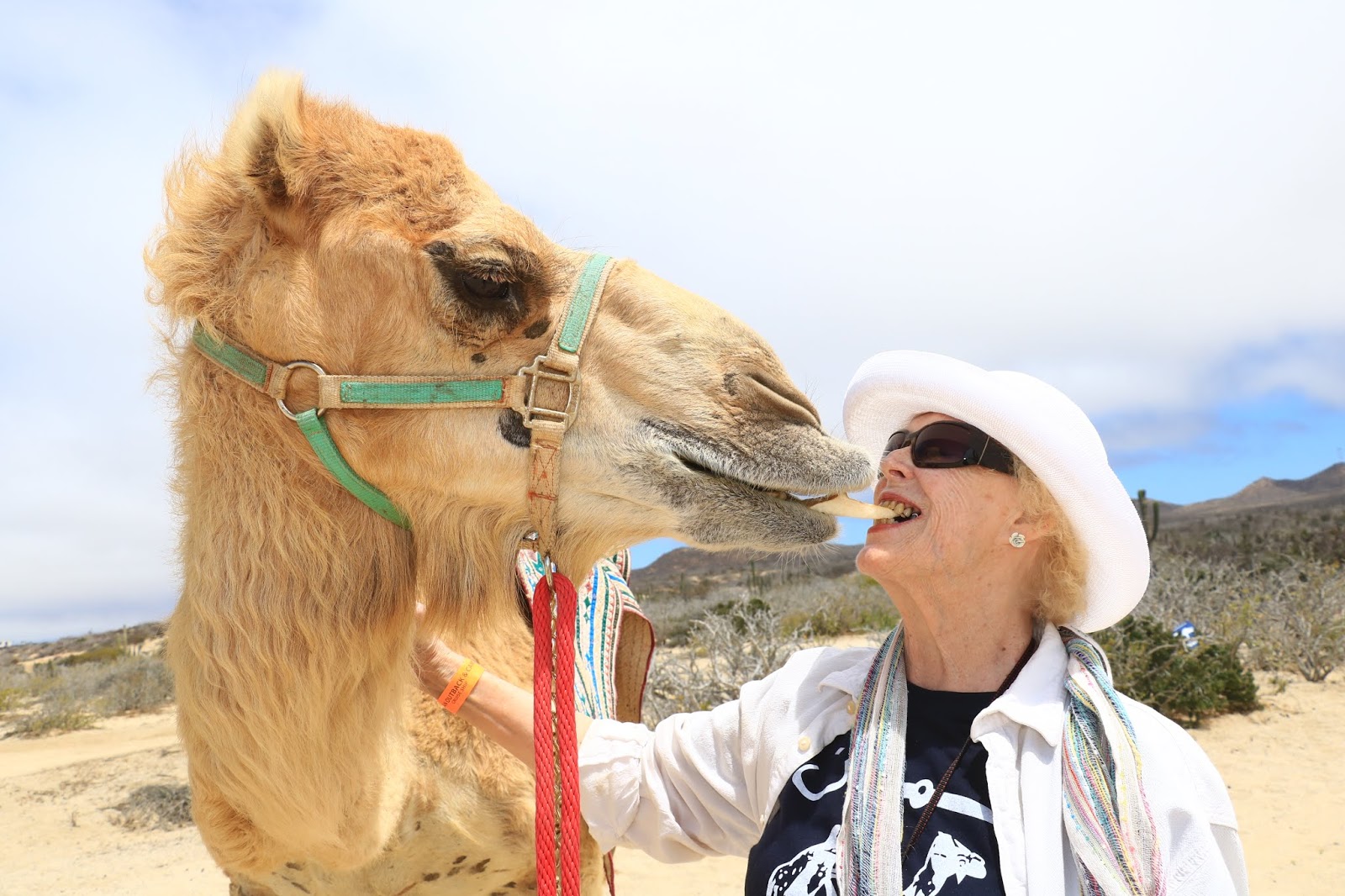
The arid desert locale and spotless white sand beaches in Mexico's Baja peninsula seemed a natural setting for a camel ride.


If the camel enterprise seems unusual for this country, it's become something of a trend in various Mexican resort areas. A tourist company operates this particular outing from Cabo, taking guests by truck north to Rancho San Cristóbal. There about a dozen well-behaved, pampered camels take turns offering small group rides. I say pampered because the animals are beautiful and obviously well-cared for. Our chatty guide ("call me Marco," with a joke about Marco Polo) is irrepressible.

 
My Texas cameleer friend Doug Baum was involved with a partner, Sidi Omar, in originally bringing these camels to Cabo and training them with their new handlers. That was some six or seven years ago with a fair amount of turnover among handlers since. Doug also goes on training and saddle support missions to Cancún, for instance.


First we get to do the third-party photography. Taking your own photographs while riding is a no-no, simply because they want both your hands clamped on the safety grip. Good thing they'd never seen me in the Middle East. They encourage the camel-kissing trick and the sharing a bite to eat trick. Camel has a piece of jicama in his mouth and waits for me to chew on the other end. Ugh. Pineapple would have been nicer!


No surprise that a waiver is required; this is North America, after all, where most camel ranches would require the same. (I wanted to say shades of Bellingham, Washington, where we indeed had the waiver but none of the follow-up safety issues). Therefore must don the accompanying helmet with something intended to resemble an Arab headdress attached to it. Goofy-looking, but can't escape it or the emphasis on safety. And disappointing: we mount the standing camels. No fun in that, especially with the two-seater saddles. Hoping my Oman camel T-shirt impresses them, I successfully convince them that I am riding on my own.


Once in the saddle, a very pleasant ride commenced. Through the cactus-strewn landscape to a small tidal pool, then back along an endless, pristine, uninhabited beach. Glorious, really (but hating the headgear sorry/not sorry). Then a walk through the desert flora with a guide. Finally we were taken to view the collection of rapidly developed print or digital photographs.


A very tasty Mexican lunch followed. A woman was kept busy cooking the corn tortillas for us to gorge on cheese tacos, beef molé, beans, spareribs, rice, and Dos Equis beer. I'm sure I took photos of the invitingly arrayed tequila shots but after a few samples I must have misplaced my touristy sense.


Olé ... a very safe venture.


© 2018 Brenda Dougall Merriman

20 February 2017

Quintana Roo 1980s

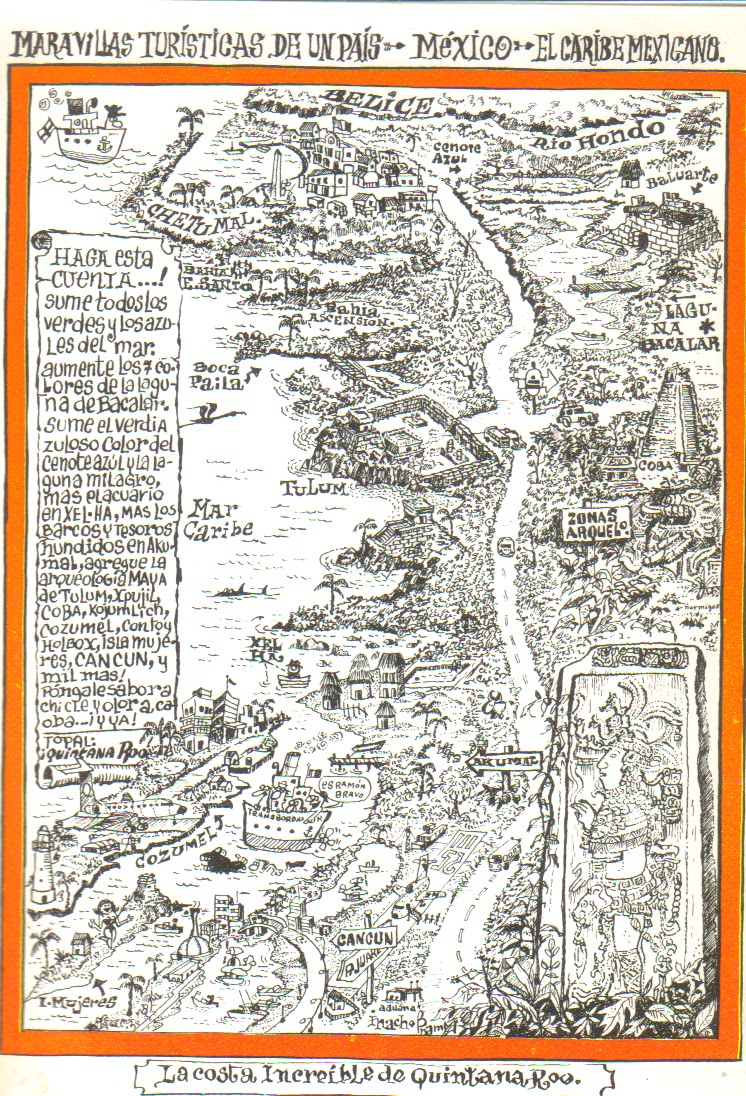
Nostalgic throwback. Going south to break up the winter in the 1980s was to return over and over again to the Mexican province of Quintana Roo on the Caribbean Sea. It was then that the Mexican government was beginning a concerted effort to create a desirable new destination for snowbirds. Today ... it seems to be re-christened the Mayan Riviera. I can tell the new version has the difference of a generation of investment more resorts, more population, more urbane, and more tourists what it's all about, naturally.

Our first visit was to the fledgling resort complex of Cancun, under construction on an extensive sandbar next to the small town. A handful of hotels were open for business ... hotels that made much of their beaches and dispensed slightly chaotic gaiety in their newness. I have no photos of our then low-rise hotel but above shows the topography, probably late 1970s, in comparison with today's dozens of enormous resort hotels.
We could walk or take a quick taxi to the town where a few casual restaurants offered meals and sometimes spontaneous music. Not many hotel guests seemed to venture that way; local diners far outnumbered any gringos who might amble by. 

With a rented car we could explore the coast, visiting the deserted, idyllic bay at Akumal, the (then) neglected majesty of Tulum, the fishing village of Puerto del Carmen. A boat trip to snorkel on Isla Mujeres; ouch, a lesson in great caution when entry to the sea involves crossing a bit of razor-sharp coral. Not to forget Chichen Itza, the magnificent Mayan city re-emerging from centuries of sleep. We even navigated to the old colonial city of Mérida (beyond Quintana Roo), hours of sometimes impossible roads. Where are all those photographs?!

It was all warm and fascinating and exotic but we learned to love snorkelling and had not found the right place.

Then we did. The island of COZUMEL. Across the strait from Cancun. It was already known as a world favourite for diving in its miles of coral reefs. Direct flights were available from Canada. Seeing the brilliant turquoise waters from the airplane window on arrival every time was a trigger for joy and anticipation.
The right place was where you walked out your hotel room immediately into the sand to the water's edge. El Presidente Hotel was it, one of the few then situated right on a beach. Er, remembering to carefully clamber down the coral ledge to the water, that is. The entire island is coral with a sand cover. Being scuba divers' heaven, it's also paradise for snorkellers.


Here there was no sense of inhabiting an artificial construct. No effort at infrastructure "improvement." The little town of San Miguel was still basically a fishing village happy to accommodate divers and the occasional afternoon of cruise ship passengers. Our first stop would be for tacos and queso fundido at the cafe on the plaza, spurning the earnest attempts to reproduce norteamericano hamburgers or pizza. This almost always seemed to ensure our stomachs would process any unfriendly bacteria the sooner the better. Acclimatizing included lazily watching the marine activity, a regular habit between visits to our own waterworld.


San Miguel was relaxing and fun in a low key way after a sunburned day. Gringos were accepted in a friendly, unpretentious ambiance.


Motor scooters were a popular way to get around, probably still are. Tried it for a while, but circumnavigating the island was best by car. Till the road ran out. Gorgeous isolated beaches everywhere. Occasional evidence of scuba activity: a small pile of belongings on a beach. Finding ruins in the jungle. Wildlife.
Well, the pigs weren't exactly wild, but the turkeys were


One thing led to another over time and ... scuba lessons, ultimately.


Yours truly chickened out at that stage, sticking to snorkelling. I learned scuba at an earlier age from a Great Lakes salvage diver but sustaining oneself in a submerged environment was a bit too much for me. On the surface is fine, just fine, thank you.

Warm memories can never be duplicated at a later date; time and circumstance dictate otherwise. They are best hauled out, dusted off, revived for a smile, and gently stored away for another time.


© 2017 Brenda Dougall Merriman

06 April 2016

Tecolutla - Part Four

Zocalo rehabilitated
It was November the last time I was there. Slowly over several years the town is recovering from the flood. But Hector was bedridden and the hotel had that sad look of seen better days. Daughter Sylvia was here more often. The hotel is not up to snuff because Rosario has her hands full looking after Hector and her (by now) two small boys. A Boyfriend appears to be living in; what was his name? Ostensibly he is here to help run things, be a practical resource, a strong pair of arms.
And new ventures for high season

Juan Carlos took us to meet Turtle Man: Fernando "Papa Tortuga" Manzano. For years the man has been rescuing and nurturing the seasonal eggs of an endangered species Tortuga Loras, or Kemp's Ridley Sea Turtles. Juan sees a future in eco-tourism for Tecolutla. He is contacting biologists and government officials. [In fact, the Tecolutla Turtle Preservation Project became a reality a few years later, with programs and an education centre now underway.] One of the regular El Rincon patrons suggested Mr. Gringo might enjoy going to a cock fight in Poza Rica, which he might have ... nasty repellent idea. Thankfully that never materialized.

Typical Teco restaurant flyer
One day The Boyfriend is on a ladder at the side of the hotel with Rosario desperately wringing her hands. Our hydroelectricity has been cut off. Unpaid bill, it seems. Boyfriend tinkered with things on the hydro pole; at any moment we expected his hair to burst into flames, charred body plummeting. But he managed to make it work. Otherwise he made himself scarce and Mr. Gringo became the default handyman.


We went to a parade in Zamora after enjoying the weekend bustle of its market. Sure as fleas on a Mexican cat, I've forgotten which feast day or festival was being celebrated. We found "my" restaurant too. One time Tecolutla erected a stage on the beach for a night of music and dancing, with fireworks as a highlight. It was a bit unnerving to watch showers of sparks falling into the dry thatch of the palapas. But when Tecolutla has a party no worries spoil the boisterous fun. 

Novel advertising experiment
November was not a good month to be there. The weather was cold at night thanks to el Nortes. I was attacked by sand fleas, not knowing they flourish at daybreak and dusk on the beach. Our friend thought there may be bedbugs!
Cristobal, magic mechanic
Plans were afoot to convey some used cars from Canada to Tecolutla whereby Mr. Gringo and Juan would Make a Profit. Here we must acknowledge that neither's language skills had improved vis-á-vis the other. Small old pickup trucks were highly valued and with the attentions of an excellent mechanic would keep running forever. Lord knows, Cristóbal kept our old car in working order. Mr. Gringo set out southward on his own one day in such a vehicle, towing another, to end up stranded in Reynosa. The incoherent story received on my end involved an intermediary in the Reynosa jail and an impound car lot. Don't ask. I immediately dropped the cross-examination.
New highway sign at the turnoff near Zamora
  Then life intervened as they say, and contact was intermittent. Sadly, word came that Hector died. Instead of being described as a fishing village now, I see that Tecolutla has indeed morphed into an eco-tourism destination. The place has grown exponentially; I scarcely recognize the size of it now. Garabatos is still on the hotel directories ... brava Sylvia!


© 2016 Brenda Dougall Merriman