ABOUT THIS BLOG

Showing posts with label Petra. Show all posts

15 November 2016

Baida, Jordan 2007


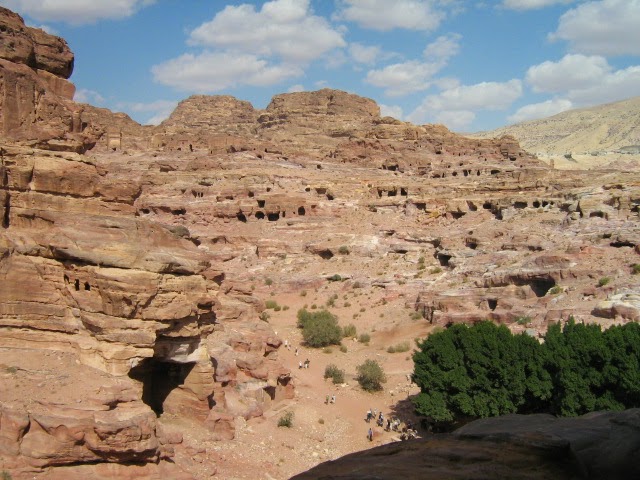
A side trip, ten miles from Petra, through more stunning country to a mini-Nabatean site. Baida is often called "Little Petra" because of its similar geology and evidence of human occupation. From here, one descends to Wadi Araba, part of the Rift Valley. Like Petra itself, it's a canyon ― you would not want to be caught here when rain causes flash floods ― lined with tombs and grottoes in the cliffs. The ancient Nabatean cisterns are still in use, collecting winter rain for local needs. Intriguing staircases once led to dwellings.
Photo without benefit of sunlight somewhat enhanced
 This is land of the Bedouin, the Bdool tribe. It has been suggested, due to their being unrelated to other nearby tribes, that they are descendants of the original Nabatean inhabitants. In the village of Um Sayhoun they were given homes and government resources along with perpetual use of the surroundings in exchange for abandoning their seasonal cave dwellings in Petra. But their traditional tents and goats continue to dot the landscape. Children were excited to greet some unexpected visitors.


A woman was weaving while someone quickly thought to display local jewellery to tempt us.


Probably the most awesome site here is the partially excavated Neolithic village. Dated to 7,000-6500 BC, it has been called the oldest known site where human beings were agriculturally active. "Some of the archaeological finds date to the 9th and 10th millennia BC."[1]


The village was rebuilt over hundreds, thousands, of years. In the oldest section, house foundations were partially dug into the ground and would have had some shelter overhead. An ancient winepress speaks to their cultivation ― Nabatean wine has been found in tombs in Egypt. The climate was more salubrious and the land more fertile 9000 years ago!


Contemplating this manifestation of (Jordan's segment of) the Great Rift Valley was breathtaking ― absorbing the visuals, feeling the textures, hearing the kids' chatter, breathing the air. Moments out of time.


With the assistance of "Petra and Nearby Baida," Ruth's Jordan Jubilee (http://www.jordanjubilee.com/visitjor/petra4.htm : accessed 14 November 2016).

[1] Site plaque: seventh photo.


Photos: BDM, 2007

© 2016 Brenda Dougall Merriman


27 September 2014

Petra, Jordan 2011

Third time lucky? Who said that?

Half a year after the Arab Spring began, a one-day expedition was a choice of Wadi Rum or Petra. Since the cruise Nazi excursion leader said no camel ride option at Wadi Rum, I chose Petra. Our leader has only one priority: getting us on the bus, off the bus, and finally getting us back on the bus at the appointed time. How many times did we hear this: no bus, no boat, no cruise, goodbye vacation.

Our entry port is Aqaba, still the small town of four years ago, destination of savvy scuba divers. I see further signs, though, of a developing, stand-alone tourist resort. Away we go on a two-hour drive up, up into the mountains, 5,000 feet, how high the desert is here! ... and the spectacular scenery I remember. My heart gives a strange lurch as we bypass Wadi Rum off in the distance; I would rather be there. Turning onto the King’s Highway (the ancient route), there are more villages than I recall.


Not much later, we begin the winding descent into Wadi Musa. Four hours here: allowing almost an hour each way for the entrance walk, not much time to traverse the entire “city.” I tell our guide Talal I’m gone once we enter Petra. No problem, but do not miss the bus departure! The entrance walk itself has no shade for the first half; the second part is rough footing through the wadi leading to the Siq. The return hike needs more time because then it’s uphill and the sun in the final part is blistering. Avoiding dehydration is a must.


Some Bedu continue to return to the caves on a seasonal basis. Once we enter the ancient site, I head myself along the cityscape trail. I’m not sure about the timing for reaching the little museum at the end of the trail. My plan is to have a glorious ride back to the Siq (camels are not allowed on the long entrance walk for obscure reasons). In hindsight I’m sorry I didn’t take a camel both ways within the “city” but was enjoying the lack of tourists compared to other times. The vendor stalls are fewer now, indicative of the sudden tourism decline. Marguerite’s (Married to a Bedouin) son Raami has moved to a different spot.

I’ve been walking briskly for about an hour, pausing here and there to buy trinkets or take photos. Only one or two camels pass me. As usual, many donkey rides are on offer, for climbing the surrounding mountains. It would take a young Olympian to attempt the entire ascent on foot, consuming the better part of the day to reach acrophobic heights like the shrine of Aaron (brother of Moses). 

A youngish guy with a donkey spots me. No, I want a camel, I say. Big mistake to speak up: he will get me one. No, I’ve already seen my destination ahead: the camel station by the museum. The ensuing conversation gets more annoying as I understand he doesn’t want me to reach the camel station. I don’t stop. He quotes US$35 to ride back to the Siq. In my bag I have a sole JD$20 bill, but some American cash. I laugh and say JD$15 .. not telling him three years ago I paid a fair price for a first class ride. He is indignant and we have a largely incomprehensible dialogue about the American dollar exchange rate. The camel station still offers more promise. Onward.

He won’t go away. We do more haggling with me up to US$20 and he is stuck at $US30. For like a forty minute ride? I’m getting a creeping Giza feeling — and I should have stayed with it. “His” camel is nowhere in sight but he has a cell phone and somehow his minion, an older guy, beams onto the spot with two decent-looking camels. More arguing, no attempt at charm. I’m almost at the camel station and he throws in the deal-clincher for US$25. His claim that the camels at the station are reserved for a shipload of tourists is highly suspicious but I cave. Maybe I’m having sunstroke. Donkey boy rides off before I can ascertain any names for men or beasts. 


Via sign language the totally taciturn (let’s just say surly) minion agrees to photograph me. Maybe he’s the actual camel owner for all I know. His photography is adequate as far as it goes but no long shot when the friggin’ camel is standing

Away we go with him on the lead camel so this is not going to be a thrilling, independent Zsou-Zsou ride. Where has gone the welcome of Petra’s Bedu people? Worries, of course. The slow economy and political uncertainty have made them desperate and more like the Giza rogues. But this year the Giza rogues, perversely, had more charm.


This little tyke was selling bits of stone, mama hovering in the background. The poorest do not have stalls; they spread their crafts on a blanket or send their children about — more children in evidence than previous times, with souvenirs and strings of beaded necklaces. 


About halfway between the midway rest stop and the Siq, my guy stops and at a silent command my camel folds up. What?!! No, no, I say. I’m not getting off – my ride isn’t over! (naturally, there’s no way I can make this camel stand up again.) Minion then informs me rather clearly for all his want of English that this is how far I get for $25. Looks like payback for not forking over US$35. I am so pissed off. He leaves with the camel. Me not happy with my failed bargaining. Now who’s surly? 

Youngster approaches to offer necklaces, quite the patter. One is cheap but two are cheaper (the chosen one is always the most expensive). He motions to sit down ... perhaps anticipating extensive but mutually satisfactory haggling. Or else he senses my now-vulnerable self-esteem. Why not. A couple more kids gather: a live customer! Maybe this is a kids’ co-op. We settle down with some Cokes. 

They have a few stock English phrases but not much interest in learning more. We struggle to find words for what one necklace is made of. Camel bone seems most agreeable to all. I pay for three necklaces trying to tell the boy I made his day. One of the little girls picks it up, “Make my day!” but I don’t think she has a clue about Clint Eastwood. Haggling is exhausting. She shyly gives me a small stone, striated sandstone, the kind the kids try to sell. It’s a piece of Petra to take home. 

Cruise people have mustered by the Siq entrance for a rest. The heat is taking its toll. Clearly, in the allotted time, they did not get far enough to see all the tombs, especially the higher ones requiring some climbing skills and a mastery of vertigo. Treading the sandy parts of the walk back is even harder than navigating the Roman paving stones. Dodging the careening horse carriages is another hazard.

Photograph by Jean Housen, 2010, Wikimedia Commons
http://upload.wikimedia.org/wikipedia/commons/1/17/20100925_petra045.JPG
When I stop to rest where the wadi opens into the sun, an unaggressive young man suggests a horse ride to complete the last mile of this trek. Included in my entrance ticket: who knew?! So I get on the horse, grateful for the relief; photo opp is the last thing on my mind. He’s happy to chat away about “Canada” and the Rocky Mountains and horses (among her multiple activities, Queen Rania sponsors care of these Arabian horses in their senior years). This is more like the relaxed, engaging Jordan I remember. The tip he gently recommended was worth it. My timing is good. Enough to browse the Rural Women’s Co-op Shop and not miss the damn bus.

© 2014 Brenda Dougall Merriman. All rights reserved.

27 June 2014

Petra, Jordan 2008

2008 was a banner year for perfect camel riding. A half day on our own in this ancient Nabatean World Heritage site, my travel buddy begins her walk back along the main trail. The plan is for her to perch somewhere along the way and photograph me as I ride gloriously by. I give her some time to get settled in advance.

Then I haggle for a camel. A few camel rides under my belt and trekking Petra trails for the third time gives me confidence. Some German tourists are pondering the same thing. A woman about to mount says she paid (Jordanian dollars) $JD25 for a camel, way too much, and heard me starting at $JD10. She starts yelling nastily at me I shouldn’t do it for less than $JD25. The camel owners are enjoying their unexpected advocate. Because of her I have to settle for $JD20 which is more than par, wounding my hard-earned bargaining skills.
Zsou Zsou greets me
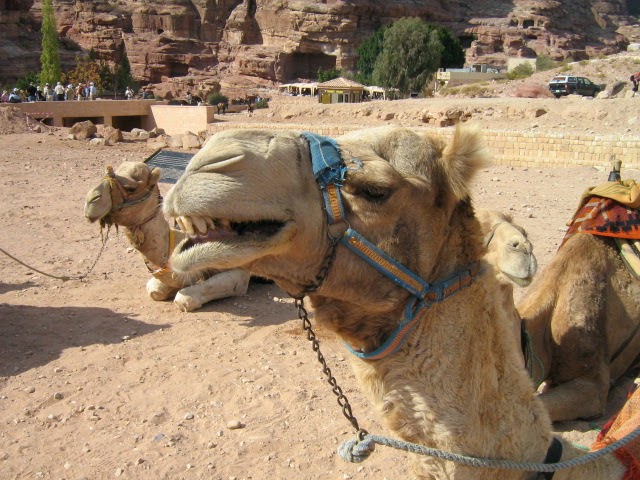
Nevertheless, I choose a large camel named Zou-Zou for her height. Like me, she shows a bit of age. Unlike me, she does not look excited about going for a walk. However, she does not snuffle or bawl which could portend well for her character. Her handler Mahmoud starts out walking behind us, or so I think. What I am really thinking is that Mahmoud recognizes an experienced rider. For example, I know the back end goes up first. A few people on donkeys are way below me. They have a boy more or less herding them.

I’m trying to take photos as I go. Capture the Bedouin women selling trinkets. It’s tricky juggling a camera since one hand is often on the pommel grip—a certain relentless, swaying, circular motion is involved (not appealing to everyone, but it’s a big part of the whole mystique). Not much later I notice Mahmoud is no longer with us. 


Boy tending donkeys doesn’t respond to sign language about whether he might be in charge of me. Evidently not. I become fully aware of this when Zou-Zou ploughs right into a gaggle of tourists before we round the first bend. Maybe she is blind? The rope in my hand is connected to her primitive halter that seems to have no possible steering effect. Therefore I must put my camera away and be alert for pedestrians. Her pace increases. 

Zou-Zou my runaway camel and I spend twenty-five minutes on our own, scattering many people and knocking over vendor displays. Maybe her urgency indicates hunger and she’s heading for the barn? In my limited experience this is not a usual camel. Nonetheless, one is above one’s surroundings and the show must go on in dignified fashion. Concentrating on the job at hand, I can’t frequently admire the amazing, towering cliffs and colours, but then I did get photographs last year. 
Zou-Zou breaks into a canter at one point — what absolutely great fun! Lawrence couldn’t have had it any better! Wouldn’t you know, this happens just about the time we pass my travel buddy and a few of our tour group. They are sipping tea at a rest stop, mostly too stunned (I like to think jaw-droppingly impressed) to photograph me. No time for designated photographer to lift her camera. I hardly see them, as I am exuberantly shouting “Watch out! Achtung! Camel coming through!”
Only one swift fellow with a camera catches me disappearing ... gaily trying to wave my hat at them. 

As we reach the Siq, it comes to an end. Mahmoud, of course, is nowhere in sight. Zou-Zou slows to a halt in recognition as an appointed boy comes to intercept. He seems surprised to hear that we knocked over postcard stands and wants to know if the vendors are angry. How would I know? My arthritic neck seldom permits posterior viewing of collateral damage, especially on the fly. For part of the $JD20 it must be his luckless job to mollify any business repercussions. 

Zou-Zou will go to wait at the camel station for another tourist. She shows no regret at my dismounting. They say camels do have distinctive personalities but I need more evidence.

© 2014 Brenda Dougall Merriman. All rights reserved.

17 May 2014

Married to a Bedouin

Since the book of that name was mentioned in a previous post, here's a little more of a most unusual story.[1] Marguerite van Geldermalsen was a young New Zealand nurse backpacking in Jordan in 1978. On her visit to Petra, she and her girlfriend Elizabeth wanted to stay among Bedouin families that still lived in the ancient caves. The spontaneous arrangement was not as easy as they anticipated until they met Mohammed Abdallah Othman, a resident then working at selling souvenirs. Tourism there was in its fledgling days with few amenities.

Mohammed was clearly taken with the tall, lively girl and the feeling was reciprocated. A couple of days in Petra became half a lifetime in love, to Marguerite's surprise. Their courtship was spurred by attending a community wedding that extended for days. Bachelor Mohammed had already chosen his own home, a fixer-upper we would say, in a cave high on a ledge overlooking the amazing Nabatean vista, not too close to his neighbours. No running water. No electricity. But he was self-sufficient and energetic.
something like this
"In years to come, when visitors, on finding out I lived in a cave with my Bedouin husband, called me brave, or courageous, or daring, I felt like a bit of a fraud. I had just done the easiest thing. No politics or philosophy; just a wonderful man, who started his day by praying that God would be pleased with him, and that his parents would be pleased with him, and then went off to his work with a flick of his mendeel and a joyful step, while I did what I felt like without a care in the world." (p. 33)

They married officially in Amman to ensure her necessary resident's permit, after many a bureaucratic difficulty. Normally at that time, traditional Bedouin marriage did not involve paperwork at all. But a celebration at Marguerite's new home was in order.
"It soon became clear that although I couldn't speak Arabic, didn't know how to milk a goat, make bread or start a fire, and certainly wasn't planning on moving in to look after my in-laws, they were still intending to make a party that would be talked about for years to come." (p.51)

Marguerite learned to do all of those things and eventually converted to Islam. Together they improved their home; travelled in Europe and Asia, and of course to New Zealand; became the parents of three children; and shared a happy life. Mohammed became an entrepreneurial husband. Marguerite provided nursing care for his tribe and the village to which the government finally removed them. Mohammed died in 2002 of complications from diabetes. 

Marguerite was encouraged to write her extraordinary story. She provides an unrivalled insight into the Bedouin way of life, much of which continues today.

From a recent interview:
"I started writing the book in 1997, when I realized just how much the life had changed and how special my stories were, to capture that recent history of the site and to show the world that people are pretty much the same everywhere."[2]

[1] Marguerite van Geldermalsen, Married to a Bedouin (UK: Virago Press, 2006).
[2] Matt Rees, "Married to Mohammad: Marguerite van Geldermalsen's Writing Life interview," 2 April 2011: http://www.themanoftwistsandturns.com/2011/04/02/married-to-mohammadmarguerite-van-geldermalsen%E2%80%99s-writing-life-interview/ (accessed : 17 May 2014).

© 2014 Brenda Dougall Merriman. All rights reserved.

08 May 2014

Petra, Jordan 2007


This was definitely a bucket list item: PETRA! ... "a rose-red city half as old as time ... ."


I not only saw this iconic site, but a great deal more of this awe-inspiring country (for later posts).

[Click on photos to open to full size.]


For me Petra conjured ancient cultures, archaeological sites, exotic landscape, and of course camels. On this my first visit to Jordan I was completely enthralled with the experience of being so close to the storied birth of civilization. So enthralled, I neglected making many notes or photographs. The lapse was overtaken as I visited the region more often. My travel journals become slightly more reflective as time and travels went on. 
We would see little of Amman 

I arrived at the Amman hotel after dark where tour leader Jihad (a Moslem Syrian) introduced himself. What can his name portend, I was thinking. Our news at home associates the word with death-to-the-infidels "jihadists." Later, I was gently disabused of any such personal connotations (Jihad is not an uncommon male first name). More of Jihad's story will be in a later post.


My first night in the Middle East, Amman was celebrating Eid, the end of Ramadan. I was going to sleep with Arab music pouring into the street below my window; initially strange to our ears, but it has a hypnotic quality. Then, awakening to the call for prayer signifies so many things to me: a structure to the day; synchronicity with the essential human continuum; affirmation of life in general.


Unlike most tours, we had two full days at this fascinating World Heritage site. Day one, onto the entrance trail with Jihad and local guide Ramzi (a Christian Jordanian). The entrance trail of almost a mile is in two parts.


The first part is unshaded; it's the reason for starting very early in the morning. An option is to ride a horse from here to part two or take a bumpy carriage ride the whole way as boys on Arabian horses whip by like cowboys on a dusty parallel track. Caves and tombs in the rocks prepared us for increasing wonders. Part two goes into crevices between the mountains, a much longer hike and an education in itself. The old caravans entered this way ... carvings, writings, and ancient aqueducts to study. 


These sandstone mountains seem like something out of this world. Colour striations are amazing, impossible to describe or capture on amateur film. We stopped at various spots along the way for lessons in history and geology (Ramzi was a recent PhD in geology). It's a gradually downhill walk, on stony or sandy ground, interspersed with huge blocks of ancient Roman paving. One must watch the feet when walking, and stop constantly to gaze about.


At the end of the entrance trail, more than an hour later, we paused for our first glimpse of the most famous monument. The iconic photo of Petra is the spectacular opening from a narrow canyon called the Siq (photo at top). The traveller comes from towering shade into a burst of sunlight on the magnificent "Treasury" (one of those foreignly applied misnomers from its modern "discovery" in 1812). Thanks to misunderstanding of the name, it's said that earlier visitors would shoot at it, thinking they could release a spill of "treasure."

There's so much more. The entire valley of sandstone cliffs was carved by the Nabateans for habitation and worship, flourishing from the third century BCE. A mixed history followed until the Romans became dominant and the forces of nature, including an earthquake, saw Petra's decline. At its height, it was a major trading hub for camel caravans.


And the camel population has scarcely changed since then!


Impressive dwellings and tombs line the mountainsides along the inner way. One can follow a number of side trails and climbs to great heights. We stayed (staggered?) the length of the main trail as the sun heated up, another couple of hours, up and down hills and rocks, staring awestruck as Ramzi's encyclopaedic information unfolded. 


It does not seem unusual, somehow, that Bedouin nomad families still occupied these structures and caves until a few short years ago. The Jordanian government has provided nearby housing for them but it's not the same. Many families continue their seasonal migrations back and forth to the south.


After passing the signs of Roman occupation, including an enormous amphitheatre and ruins of a colonnaded street, we were ready for the lunch break at the trail's natural end. An improbably situated (and almost invisible) restaurant was a welcome sight. Next door was a small gem, a museum and craft shop under the sponsorship of Queen Noor's many activities for the preservation of Petra and its artifacts. 


A few mad dogs and Englishmen (midday sun) in our group then undertook the 800-step climb to the Monastery (not such a misnomer, as Byzantine monks made use of the first-century building at one time) and the rest of us were on our own for the return trek. A camel ride back to the Treasury looked ideal to me. My companions demurred, content to watch me. Much taking of photos, thanks to Gloria. 


So I rode grandly off, waving imperially to the straggling group behind. We swayed past small clusters of souvenir and refreshment vendors. They are not as aggressive as in some other countries. Sand art designs are among the more unique souvenirs. It was a smooth ride retracing the long trail. A drink of “iced” tea at the little Treasury rest stop was just the thing before tackling the entrance trail back through the Siq. Uh-oh: ever so slightly but relentlessly uphill this time. Tough going by the time we hit the blazing sun in the last part, mid-afternoon killer!


Day two was much the same although we were free to explore on our own. I did want to visit the young man selling the autobiography Married to a Bedouin ... because the author, Marguerite Van Geldermalsen, was his mother, a native of New Zealand! She lived and raised him in one of these cave homes until the death of her husband, as I learned after I bought the book. He was selling some exquisite, locally crafted silver.


A few of us climbed to the high royal tombs: high enough for me with no railings or support in most places! Even here a few vendors were setting up tables to sell simple jewellery while keeping an eye on their goats. Others of our group went to climb to Aaron's Tomb, the highest peak, where Moses' brother is said to be buried; that will take several hours. I purchased a small camel-wool carpet, lugging it all the long way back.

In two words: magnificent and overwhelming.

© 2014 Brenda Dougall Merriman
Photographs by BDM, 2007