ABOUT THIS BLOG

Showing posts with label Wadi Rum. Show all posts

24 September 2019

Wadi Rum, Jordan 2018


They say you can't go back again. Because it's never quite the same. Sometimes you can, and it works. Wadi Rum desert in the south of Jordan has been a beacon to me since first visiting in 2007 and then having the perfect camel ride in 2008.


The expanded visitor centre was to be expected because of the intervening years, but it's almost featureless, and deserted. It's still early morning despite the hour's drive from Aqaba; by the time the sun becomes ferocious at noon, we will be on our return to town. Our timing permits only a hasty once-over in a shop barely opening up; no chance to see if the interpretive display has also been enhanced. Our group is hurried to several old pickup trucks for the ride to a desert rendezvous, perching two on a side in the back with some sunshade. The transport always varies for these desert incursions.


The experienced locals had estimated in advance how many camels would be required. This time three companions decide to join me. Would-be women warriors


They are friendly (indicating well-treated) animals. Who doesn't love a hug as we mill around to mount? The Scot is a magnet.


Taking the lead camel was almost as good as being alone. My problematic hip joint allows some latitude for hooking my knee ‒ so much more comfortable ‒ but not perfect form. No racing today! As we amble along, the handler lets the camels nibble at some low-growing crunchy savoury grass smelling like thyme. Why is the desert strangely colourless this morning?


Riding high ... Ah. There is no feeling to equal this, merged into a timeless, magnificent planet. We drift along the sand, skirting the majestic cliffs. Carvings and petroglyphs on the rock walls are a common sight. Wadi Rum is a Protected Area and a UNESCO-designated natural and cultural landscape.


Always over too soon, our journey catches up with the non-riders who are shopping for crafts in a large tent. Familiarity. There's the boulder remembering Lawrence. Over one hundred years since the Arab Revolution against the Ottoman Empire, "Aw-renz" is imprinted on the collective memory here; this is only one of the modest commemoratives to him throughout the desert of the Arab Revolt.


After visiting the base of enormous dunes that beg most people to climb, away we rattle in the trucks for a refreshment stop at one of the desert camps. The temperature has risen slyly and fast. The large size of Captain's Desert Camp seems surprisingly anomalous to me. Tourism on a managed scale creates income for many Bedouin families. Here is welcome shade, musicians happily entertain as we sip mint tea, eat dates and small cookies.


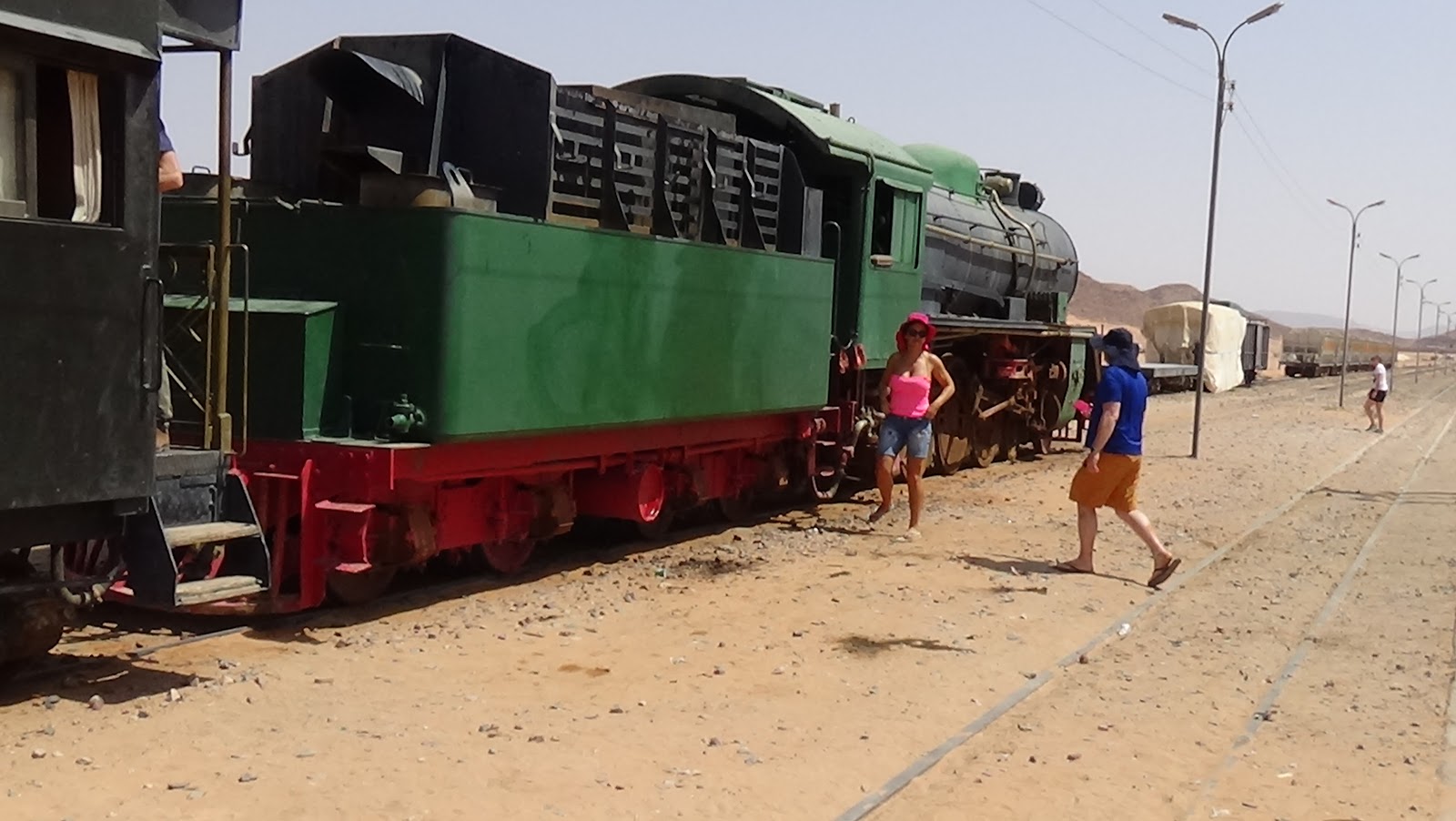
The sun is then high above us as we finally turn toward the highway. But we're not leaving the desert before we have a look at the Hejaz Railway train. The railway was built by the Ottomans in the first decade of the twentieth century railway for transport to Aqaba and access to the Red Sea; this restored steam engine now shows its stuff only on special occasions. Ghosts of the filming of "Lawrence of Arabia" hover here.


Who can say if that was to be my last camel ride? Thank you, Wadi Rum, and thank you, Hashemite Kingdom of Jordan, for your hospitality. Please stay as fabulous as you are.


© 2019 Brenda Dougall Merriman

27 November 2016

Wadi Rum, Jordan 2016

Photo of my camel ride in spectacular Wadi Rum, possibly the most beautiful desert in the world:


That's right. No photo. Didn't happen. No visit. No camel!
My wildly anticipated third visit to Wadi Rum was a bust.

In fact, our entire promised schedule was destroyed by Mother Nature in a fit of November pique. Brings you face to face with climate change, this rainfall that "normally" would have occurred two months earlier. For us, the storm began in Sharm el-Sheik (Sinai, Egypt). Witnessing the dramatic thunder, lightning, downpour, wind, and hail was rather overwhelming in such an arid area. Sharm received its "average" annual rainfall in that one day, its streets turning into rivers of mud.

  
The same deluge had hit south Jordan by the time we reached Aqaba, at the south end of the King's Highway (and the north end of the Red Sea) leading to the high desert. In good faith we set off on the one-hour trip to our destination but at the Wadi Rum Protected Area boundary we were turned back. Although only a few mild rain showers were occurring by then, flash floods from the surrounding mountains had wrecked the tents and preparations of our Bedouin hosts impossible to receive us. Not only that, the road was eroding and officials clearly wanted to avoid facing stranded, woebegone tourists.

  
At a standstill while our driver contemplated a tricky about-face manoeuvre, we had to suck up the huge disappointment. Our local guide hastily (and inadequately) improvised his planned discourse. Distant views across the desert did not compensate. Nor did a makeshift tour around Aqaba. Even the inhabitants were excitedly gathered at the vista of a newly-born turbulent river, rushing to the sea beside the highway.

What a terrible shame in more ways than one. Tourism in Egypt everywhere suffered a mortal blow after last year's explosion of a Russian airliner departing from Sharm. So many Egyptians depend on the industry to support their families. They are warm, friendly, good-natured people, trying to stay optimistic. Atmanna laka al'afdal (I wish you the best) from me and my fellow travellers.

Wadi Rum nostalgia:

(https://camelchaser.blogspot.ca/2014/07/wadi-rum-jordan-2008.html)

Photos: BDM
© 2016 Brenda Dougall Merriman

20 July 2014

Wadi Rum, Jordan 2008

In the year 2008, visiting Petra was not my last camel experience.

If you could have but one camel ride in your lifetime ~ should you be so inclined ~ I strongly recommend you book yourself to Jordan and the Wadi Rum desert. On a scale of 1 to 10, although considering I haven't been everywhere yet, Wadi Rum is a 10.
 
My second visit to the Hashemite Kingdom of Jordan preceded widespread events of the "Arab Spring." Writing of it at the time, I had (and have) faith that Jordan will retain its stability in the unpredictable Middle East. Better scribes than I have written glowingly of Jordan’s magnetism. A relatively new nation, the country includes some of the world’s oldest inhabited sites. It’s not only on the ancient Fertile Crescent, it’s also on the Rift Valley.

If you are into archaeological, if you are into biblical, if you are into cultural, if you are into photography, or just plain scenic awe, the country amazes from the Dead Sea to the Red Sea. Truly majestic.

Wadi Rum desert is in the south; descending into it from a plateau is spectacular, certainly one of the world’s most extraordinary places. We cross part of the railway line famously bombed by T.E. Lawrence in 1917, to access the modest Welcome Centre in the protected area. One of the local women’s co-op handicrafts shop is here. The tiny support village is full of camels.
What do most tour companies offer, encouraged by entrepreneurial young village men? Careening across the sand in a 4-wheel-drive jeep or truck lacking shock absorbers. Go figure! Environmental irony. Camels were not on our tour's agenda but I had persisted.
 
Like most Jordan women, our guide Nadine spurns the hijab. Myself is wrapped up more than she is, against the sun and the possibility of blowing sand. We go well beyond any sign of civilization and on my behalf she bargains fiercely with some camel handlers in Arabic. Nadine does everything fiercely, including telling raucous jokes.

Finally. The others tear off in their kidney-splitting jeep to bash some dunes and inspect ancient inscriptions. I get a couple of hours as Queen of the Desert. 
The arrangement involves a female and her baby who must not be separated. This tells me the colt is less than five years old. The boy who leads me is very serious in his responsibility for the animals. Good thing he’s along because he knows where we are going. All is sandy desert in every direction to the horizon, with gigantic mystical rock outcroppings here and there. If by some flight of imagination I were allowed to trek alone — unthinkable of course — no question I would soon be lost, wandering between one isolated cliff to the next, until someone finds my dessicated corpse splayed across the hump of a steadfast camel.

The boy-who-won’t-tell-me-his-name (not understanding the question) disapproves whenever I lean to touch the baby. Experimenting with saddle positions also earns me scowls and rapid verbal orders. I am so relaxed I don’t even try to decipher. Nevertheless I want to practice the leg-hook favoured by camel police and born-to-it Bedouin. Baby’s hair on the hump — which is as far as I can reach without falling off and disgracing myself — looks bristly but feels soft. Of course! That’s why we humans have cold-weather coats made of camel’s hair.

My guide stops remonstrating with me. I am one with the stately undulation of my steed and her sidekick. “Oh the desert is lovely in its restfulness. The great brooding stillness over and through everything ...”.[1]

We are in the heart of silence. Separation from everything in routine life! No cares. Just be. Another writer put it well: "Breathing is easier out there. There is something particularly powerful about the desert scenery, it extends your horizon endlessly, and cleans your soul like a strong wind, deprives it of everything that’s not important."[2]
Bedouin tribal memory still reveres Lawrence here in places where he camped. “To those bred under an elaborate social order few such moments of exhilaration can come as that which stands at the threshold of wild travel. The gates of the enclosed garden are thrown open... and behold! the immeasurable world.”[3] Yes. “Wild” in that special sense of the unfamiliar becoming a momentary, thrilling gateway.
It had to end. Dismount at a Bedouin camp. Until the next camel experience, insh’allah.

[1] Terry Kelhawk, “Skirts on Camels: Early Women Travel Writers,” The Huffington Post (http://www.huffingtonpost.com/ : accessed 24 October 2010); citing Lilias Trotter, Journal 1885.
[2] Ivana Perić, "I fell under the spell of Wadi Rum," 18 June 2014, Your Middle East (www.yourmiddleeast.com/travel : accessed 27 June 2014).
[3] Gertrude Bell, The Desert and the Sown (London: William Heinneman Ltd., 1907).


© 2014 Brenda Dougall Merriman. All rights reserved.
labels: camels, Jordan, Bedouin, Wadi Rum